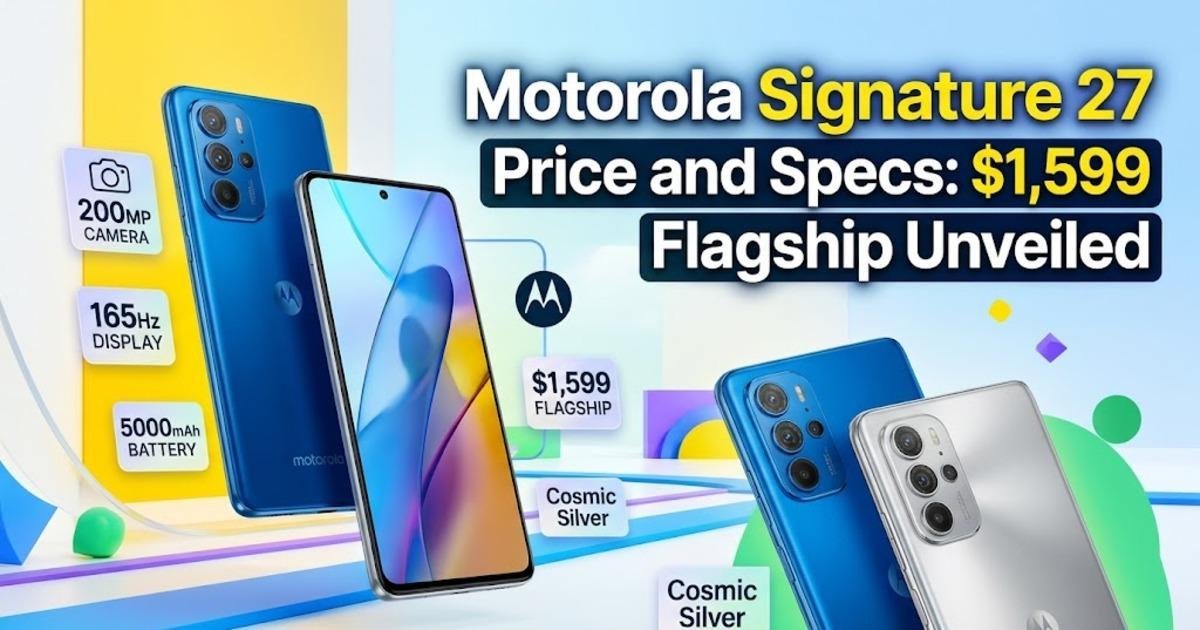
Motorola Signature 27 Price and Specs: $1,599 Flagship Unveiled
Motorola's Signature 27 arrives at $1,599 with a 7,000mAh battery, 200MP periscope camera, tandem OLED display and planned GrapheneOS support. Here's what its premium specifications mean for buyers.
On this page
Motorola has put a $1,599 price tag on its new Signature 27, placing the company's flagship smartphone directly against the most expensive phones from Samsung and Apple. Announced on November 5, 2026, the device combines a 7,000mAh battery, a 200MP periscope camera, a tandem OLED display and a planned expansion into GrapheneOS support. The interesting question is whether Motorola's unusual combination of hardware and software can justify a premium that many buyers would normally associate with established flagship brands.
The Motorola Signature 27 price puts it in a new category for the brand
Motorola's Signature 27 starts at $1,599 in the United States, according to the company's launch announcement. That price places it firmly in the ultra-premium segment, rather than the upper-midrange market where Motorola has traditionally attracted buyers with competitive specifications and relatively accessible pricing. The company is now asking consumers to pay for a combination of premium construction, advanced camera hardware, long-term software support and specialized features.
The European launch price is also substantial. Notebookcheck reported a retail price of €1,899 for the phone in the European Union. The difference between the US and European figures reflects regional pricing, taxes and market arrangements, so they should not be treated as direct currency equivalents. Motorola has not confirmed a Pakistani retail price, and any local estimate should remain provisional until an authorized distributor announces availability.
The launch also introduces a broader question about Motorola's strategy. Instead of competing primarily on affordability, the company is attempting to establish its Signature family as a premium alternative to the Galaxy S Ultra and Apple's highest-end iPhones. That requires more than an impressive specification sheet: buyers at this price expect reliable cameras, consistent software performance, strong after-sales support and a device that holds its value.
The 7,000mAh battery is one of the Signature 27's biggest advantages
Motorola has equipped the Signature 27 with a typical battery capacity of 7,000mAh, a substantial figure for a flagship smartphone. The battery is designed to support the device's large display, high-performance processor and advanced camera system without forcing users to recharge as frequently. Capacity alone, however, does not establish real-world battery life. Screen brightness, cellular reception, background applications and processor efficiency all influence how long a phone lasts between charges.
The company also advertises 90W wired charging and 50W wireless charging. Motorola says its wired charging system can provide up to 12 hours of battery life from a 12-minute charging session under specified conditions. That figure refers to estimated usage time gained, not a full battery recharge. The wireless system is advertised as capable of charging the phone from zero to 100% in up to 80 minutes, with the appropriate proprietary charger.
These charging figures are manufacturer claims rather than independent measurements. The Signature 27's larger battery could make it attractive to travelers, mobile gamers and people who use their phones heavily throughout the day. Independent testing will still be needed to determine whether its endurance exceeds that of competing flagship devices by a meaningful margin.
The tandem OLED display aims to solve outdoor visibility
The Signature 27 features an Extreme AMOLED Duo tandem display, a panel technology that stacks two light-emitting layers to improve brightness and efficiency. Motorola advertises peak brightness of up to 12,000 nits in specific scenarios. That number is a peak measurement under controlled conditions, not the brightness users should expect across the entire screen during everyday use.
The display supports 1.5K resolution and Dolby Vision, a video format that preserves a wider range of brightness and color information in compatible content. The practical benefit is that movies, photographs and supported video can appear more detailed and visually dynamic. The tandem structure is also intended to improve energy efficiency and panel longevity, although Motorola's advertised improvements will need independent testing before they can be treated as established real-world results.
For buyers who frequently use navigation outdoors or watch videos in bright environments, screen visibility could be a meaningful advantage. Still, maximum brightness is only one part of display quality. Color accuracy, reflection handling, adaptive brightness and power consumption are equally important when evaluating a premium phone.
The 200MP periscope camera is built for distant subjects
Motorola has made photography a central part of the Signature 27's identity. Its rear camera system includes a 50MP Sony LYTIA 910 main sensor, a 200MP periscope telephoto camera and a 50MP ultrawide camera. The phone also includes a dedicated Event Vision Sensor, which detects changes in light intensity to capture motion information independently of the conventional camera sensors.
A periscope camera uses folded optics to fit a longer focal length inside a smartphone's relatively thin body. This makes it possible to photograph distant subjects without relying entirely on digital cropping. Motorola advertises up to 100x Super Zoom Pro, using artificial intelligence to help reconstruct details at extreme magnifications. Such a figure should not be confused with 100x optical zoom: the highest zoom levels depend heavily on computational processing.
The dedicated motion sensor is another unusual feature. Motorola's Action Shot functionality is designed to capture fast-moving subjects with less motion blur, potentially helping with photographs of sports, pets or moving vehicles. A conventional smartphone camera often struggles in these situations because it must balance shutter speed against available light. A specialized motion sensor may help the phone make better decisions, but its actual effectiveness depends on the camera software and the conditions in which it is used.
Motorola says the Signature 27 has received a DXOMARK Gold Label for image quality performance. This is a company-reported recognition of its camera evaluation, not a substitute for a full independent comparison with other flagship smartphones. The camera hardware looks promising, but image processing, consistency and low-light performance will ultimately determine whether it deserves the premium price.
GrapheneOS support could make the Signature 27 more interesting than another Android flagship
One of the Signature 27's most unusual features is its planned compatibility with GrapheneOS, a privacy-focused operating system built on the Android Open Source Project. GrapheneOS strengthens Android's security through additional protections and gives users more control over how their devices handle applications, permissions and personal data. It has historically been associated with Google Pixel hardware, making Motorola's participation a notable change.
GrapheneOS previously identified the Signature 27 as its initial supported Motorola device. Motorola's launch announcement also highlighted the partnership. However, buyers should distinguish device support from immediate availability of a complete alternative operating system. The announcement does not establish that every retail unit will ship with GrapheneOS preinstalled or that the software will be available in every region on the same date.
The hardware is designed with additional security capabilities, including ARM Memory Tagging Extension (MTE), a processor feature that helps detect certain memory-safety errors. These errors can occur when software accesses memory incorrectly, creating potential vulnerabilities. MTE can assist in identifying such problems, but it does not eliminate every type of security risk.
Motorola also promises seven operating system upgrades and up to seven years of security updates, starting from the global launch date. That commitment matters for buyers who want to keep a premium phone for several years. Longer support reduces the need to replace a device simply because its software is no longer maintained, although the exact update schedule may vary by market and carrier.
The Snapdragon processor and cooling system target sustained performance
The Signature 27 uses Qualcomm's Snapdragon 8 Elite Extreme Gen 6 mobile platform. Motorola positions the processor as the foundation for demanding gaming, advanced photography, artificial intelligence features and high-speed connectivity. The chip's performance is only part of the equation, however. A phone must also manage the heat generated during prolonged workloads.
Motorola's ArcticMesh cooling system combines diamond-infused thermal gel, liquid metal, copper mesh and a redesigned three-dimensional vapor chamber. The company says the vapor chamber is 40% larger than the previous generation. A vapor chamber spreads heat across a wider surface, helping the phone dissipate it instead of allowing one area to become excessively hot.
The larger cooling component may help the phone sustain performance during gaming or extended video recording. It does not automatically mean the Signature 27 will run 40% cooler or deliver 40% better performance. Those outcomes depend on the processor, thermal limits, ambient temperature and software tuning. Independent stress tests will be needed to determine whether Motorola's design delivers a meaningful advantage.
Bang & Olufsen audio and premium construction round out the package
Motorola has partnered with Bang & Olufsen for the Signature 27's audio system. The company says the phone uses a custom speaker architecture and sound modes designed to improve clarity, bass response and the overall listening experience. The partnership adds a recognizable premium audio brand to the device, although the quality of smartphone speakers still depends on their physical size, acoustic design and tuning.
The phone uses an aluminum frame, ceramic and glass construction, and Corning Gorilla Glass Ceramic 3. Motorola also lists IP68 and IP69 ratings for water and dust resistance, alongside military-standard durability testing. These certifications indicate protection under specified laboratory conditions rather than a guarantee against every type of accidental damage.
The Signature 27 is offered in PANTONE Coal Smoke and PANTONE Capulet Olive finishes. Its materials and textured surfaces are intended to distinguish it from conventional glass-backed flagship phones. Buyers should nevertheless consider how the finish feels in hand and how the phone's camera module affects everyday handling before deciding whether the design justifies its premium positioning.
Motorola Signature 27 availability remains a regional question
Motorola says the Signature 27 will reach markets worldwide in the coming months. The Verge reported that US presales are scheduled to begin on November 19, with retail sales starting November 26. These dates apply to the US market and should not be assumed to represent the launch schedule in every country.
For prospective buyers in Pakistan, the key missing details are official local pricing, distributor availability, warranty coverage and Pakistan Telecommunication Authority registration requirements. A premium imported smartphone can become considerably more expensive once taxes, registration and retailer margins are included. Until Motorola or an authorized local partner confirms these details, an estimated rupee price should not be treated as an official figure.
The Signature 27 is an ambitious attempt to reposition Motorola in the ultra-premium smartphone market. Its large battery, advanced camera system, bright display and long software support make it a serious contender on paper. Its $1,599 starting price, however, means the device will need to deliver more than specifications. Independent reviews of battery endurance, camera quality, thermal performance and GrapheneOS support will be the evidence that determines whether Motorola's flagship is worth the money.
Share this post