
XREAL 1 Pro+ AR Glasses: $599 Price and 1,200-Nit Display
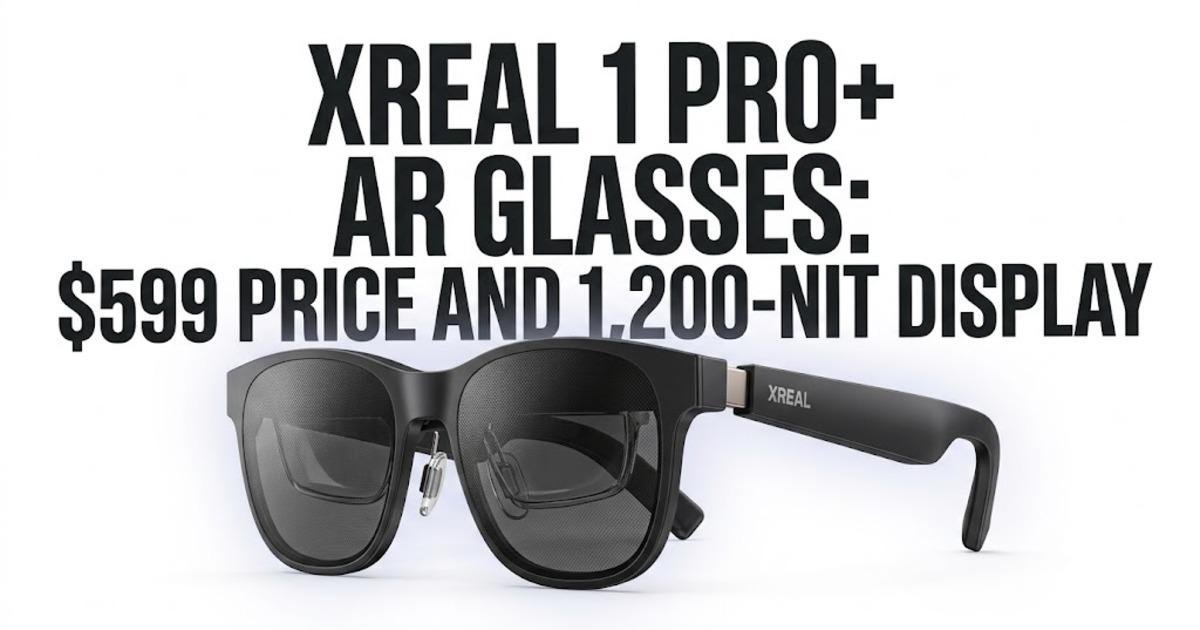
XREAL's 1 Pro+ AR glasses retain the $599 price while increasing peak brightness to 1,200 nits, adding AI HDR and improving 2D-to-3D conversion. Here's what changed and who should upgrade.
On this page
XREAL's new 1 Pro+ glasses increase peak display brightness from 700 nits to 1,200 nits without raising the previous model's $599 US launch price. Released on October 15, 2026, the wearable display adds artificial intelligence-powered high dynamic range (AI HDR), smoother conversion of ordinary 2D content into 3D and a redesigned nose pad. The changes target a familiar weakness of glasses that project a virtual screen: image quality and comfort can vary considerably between a dim room and a bright environment, or between a short viewing session and several hours of use.
The XREAL 1 Pro+ improves the screen rather than redesigning the product
The 1 Pro+ builds on the XREAL One Pro platform instead of introducing a completely new device. It retains the company's X1 spatial-computing chip, a 57-degree field of view and support for a refresh rate of up to 120 hertz. A field of view describes how much of the visible scene the display occupies, while refresh rate indicates how often the image can update each second. Those specifications remain important for gaming and virtual monitors, but the main hardware change is the higher peak brightness.
XREAL says the new model reaches 1,200 nits, compared with 700 nits on the One Pro. That is roughly 71 percent more peak brightness on paper, although it does not mean every scene will appear 71 percent brighter to the wearer. The difference is most relevant when bright content needs to remain visible against ambient light or when a scene contains both highlights and shadows. Independent hands-on testing will help establish how consistently the improvement translates into everyday viewing, rather than relying solely on the manufacturer's specification.
Why 1,200 nits matters when using glasses as a screen
These glasses are designed to make a connected phone, computer or gaming device appear to have a large screen floating in front of the wearer. That can be useful on a flight, in a shared room or at a desk where a physical monitor is inconvenient. The glasses do not eliminate the surrounding world in the way a fully enclosed virtual-reality headset does, so ambient light can influence how clearly the displayed image stands out. More peak brightness gives the screen additional headroom in those conditions, though it cannot guarantee a perfect picture in direct sunlight.
The 1 Pro+ also adds AI HDR, a processing feature intended to improve the perceived contrast and detail of supported images. High dynamic range describes the relationship between the darkest and brightest parts of a picture; in practice, good HDR processing aims to preserve visible detail in bright highlights without making darker areas unreadable. XREAL presents AI HDR as a display-quality improvement, but its actual benefit will depend on the content, processing and viewing conditions. Buyers should distinguish the presence of the feature from proof that every video or game will look better.
Three viewing modes give users more control over the picture
The glasses add Standard, Movie and Reading modes, letting users choose different presentation settings for different tasks. Standard is intended as a general-purpose option, while Movie targets video viewing and Reading is aimed at text-heavy material. This matters because a setting that makes colorful entertainment look appealing is not necessarily ideal for a document or a long session of reading. The new modes give users a way to adjust the experience without having to treat one picture profile as suitable for everything.
Reading through glasses still involves trade-offs that brightness alone cannot fix. Text clarity depends on optical alignment, the position of the virtual screen, the connected device's output and how comfortably the glasses fit the user's face. The 1 Pro+ retains the same 57-degree field of view, so the update does not promise a wider virtual workspace than the One Pro. People considering the glasses primarily for office work should test whether the visible screen area and text sharpness suit their applications before replacing a conventional monitor.
2D-to-3D conversion now targets 60 frames per second
The 1 Pro+ improves XREAL's Real 3D feature, which converts conventional two-dimensional photos, videos and games into content with an added sense of depth. The company says the processing rate has increased from 30 frames per second to 60 frames per second. Frames per second measures how many individual images are processed or displayed each second; moving from 30 to 60 can make motion appear smoother when the system successfully maintains that rate. It does not mean the original source has been filmed in 3D, nor does it guarantee that every scene will be converted convincingly.
Conversion is a different task from playing content that was originally created for stereoscopic 3D. Software must estimate depth from a flat image and decide how objects should appear from slightly different viewpoints, which can produce imperfect edges or unnatural separation in complicated scenes. The higher processing rate addresses smoothness, not every possible artifact in the conversion. Users who mainly watch ordinary streaming video may find the feature interesting, but those who prioritize an unaltered picture can continue using the glasses as a conventional display.
The redesigned nose pad addresses a problem specifications cannot measure
XREAL has also redesigned the nose pad system to improve stability and comfort during longer sessions. That change may sound less significant than a brighter display, but fit can determine whether wearable screens are practical beyond a short demonstration. The position of the glasses affects how the image aligns with the eyes, while pressure on the nose can become distracting over time. A better-fitting design could therefore improve the experience even for users who rarely use AI HDR or 3D conversion.
Comfort remains personal, however, and a redesigned nose pad cannot guarantee a good fit for every face. Buyers should consider the bridge of their nose, prescription requirements and whether they intend to wear the glasses for gaming, films or extended computer work. The product's advertised specifications do not substitute for trying the frame on, and an improved fit on one wearer may not translate directly to another. For people who already own the One Pro, this is a reason to try the updated model rather than assume the upgrade is automatically worthwhile.
Spatial tracking has an additional cost
The glasses support three degrees of freedom (3DoF), which allows the virtual screen to respond to rotational head movement. For example, a user can turn their head and keep a virtual display positioned in a chosen direction rather than having it follow every movement like a fixed screen attached to the glasses. More advanced six-degrees-of-freedom (6DoF) spatial anchoring lets a virtual screen remain positioned in the surrounding space as the wearer also moves their head and body. XREAL states that 6DoF spatial anchoring requires its separate XREAL Eye accessory, so buyers should not assume the full tracking experience is included in the $599 glasses price.
This distinction matters when comparing wearable displays with mixed-reality headsets. The 1 Pro+ is primarily a glasses-style personal display for connected devices, rather than a self-contained computer that replaces a phone or laptop. Its functions depend on the source device and supported accessories, and the optional tracking hardware adds to the overall cost. Anyone planning to use multiple anchored virtual screens should confirm the complete hardware requirements before choosing this model as a workstation replacement.
The $599 price makes the upgrade more interesting for new buyers
XREAL announced the 1 Pro+ at $599 in the United States, the same price at which the previous One Pro was offered at launch. The new model is available through the company's website, with broader retail availability announced as a later step. Keeping the headline price unchanged while increasing brightness and adding features makes the new version easier to consider for first-time buyers than a refresh accompanied by a substantial price increase. Regional pricing, taxes and shipping can still change the final cost outside the United States.
For existing One Pro owners, the decision is less straightforward. The core display concept, X1 chip, field of view and 120Hz refresh capability remain, so the value of switching depends on whether the brighter image, additional viewing modes, faster 3D conversion and revised fit address a real problem. The company has announced improvements, but those specifications alone do not establish that every owner will notice enough difference to justify another purchase. Independent comparisons using the same content and lighting conditions will be more useful than judging the upgrade by peak brightness alone.
Who should buy the XREAL 1 Pro+?
The 1 Pro+ is best suited to people who want a portable personal screen for gaming, films or computer work and who value a glasses-style design over a conventional monitor or enclosed headset. The higher brightness is particularly relevant to users who often watch content outside a dark room, while the Reading mode and revised nose pad may appeal to those who expect longer sessions. The 3D conversion feature is an additional attraction rather than a reason to assume every video will look better. As with any wearable display, fit and compatibility should be part of the buying decision.
At $599, the model makes the strongest case for someone buying into XREAL's flagship display experience for the first time. Existing owners should compare the new hardware in person if possible, paying attention to brightness under their normal lighting, text readability and comfort over time. Anyone who needs 6DoF anchoring should add the price of the required XREAL Eye accessory to the budget. The most useful next evidence will come from extended reviews that test the glasses with real games, work sessions and varied lighting rather than simply repeating the manufacturer's peak specifications.
Share this post
Written by