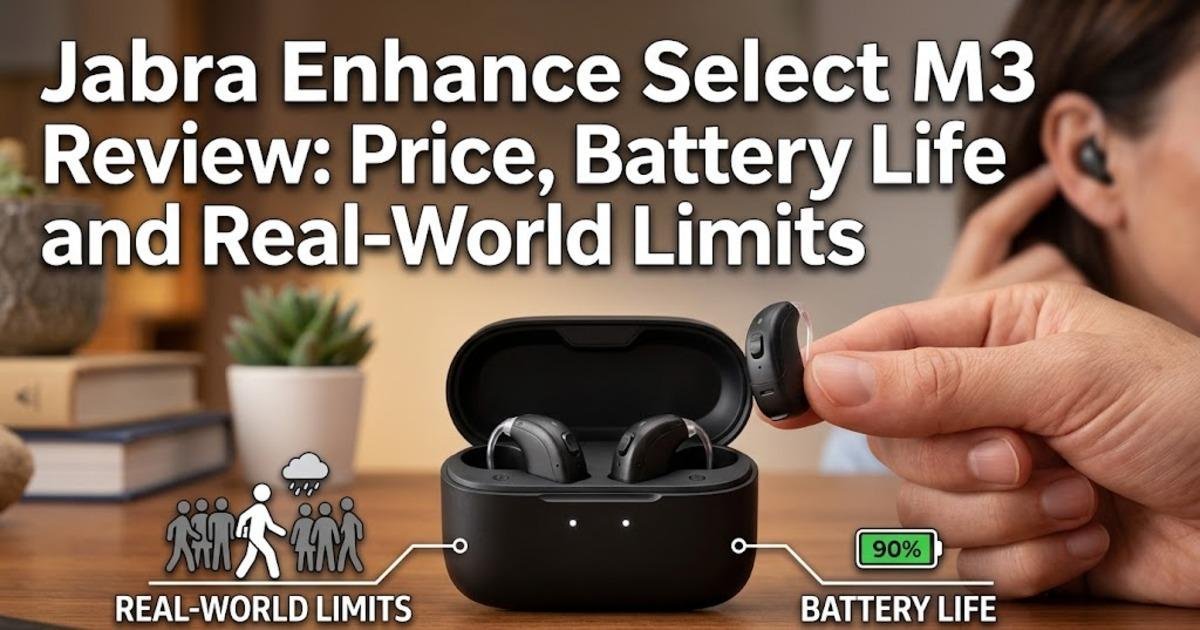
Jabra Enhance Select M3 Review: Price, Battery Life and Real-World Limits
Jabra's Enhance Select M3 combines automatic speech processing, all-day battery life and remote audiology support. Here's what independent testing reveals about its price, sound quality and limitations.
On this page
Jabra's Enhance Select M3 hearing aids cost $1,995 per pair at their standard price, putting them in a very different category from ordinary wireless earbuds. Their selling point is not music playback but clearer conversations, particularly when background noise makes it difficult to follow someone speaking. The rechargeable devices combine smartphone-based hearing adjustments with automatic sound processing and remote audiology support. Independent testing published on October 16, 2026, found useful improvements in speech clarity, but also identified shortcomings that prospective buyers should weigh before paying a premium.
What makes the Jabra Enhance Select M3 different from ordinary earbuds?
The M3 belongs to the over-the-counter (OTC) hearing-aid category, which allows eligible adults with perceived mild-to-moderate hearing loss in the United States to purchase qualifying devices without a prescription. Unlike conventional earbuds, hearing aids are designed to amplify and process sounds to help people hear conversations and other everyday audio more clearly. Jabra combines this function with Bluetooth connectivity, rechargeable batteries and an app that lets users personalize their listening experience. The result is a device intended to support daily communication rather than simply play entertainment.
The M3 sits at the top of Jabra's Enhance Select M-series, alongside the less expensive M1 and M2. All three share the same general behind-the-ear design, but the M3 adds the company's most advanced automatic listening features and a smaller receiver-in-ear form factor. Jabra also offers six color options, including a red finish exclusive to the M3. Those differences matter most to people who want discreet hardware and automatic adjustments, rather than buyers who simply need basic amplification.
The M3's main advantage is how it handles conversations in noise
Jabra calls its sound-processing system SoundScape. One of its key M3 features, Auto Focus, attempts to identify and prioritize speech so a listener can follow a conversation while other sounds compete for attention. Its Advanced Adaptive Listening feature goes a step further by changing noise reduction and volume according to the surrounding environment. In practical terms, these systems are intended to reduce the need to stop a conversation and manually adjust hearing-aid settings whenever the listener moves from a quiet room into a busy restaurant.
That promise needs to be separated from the company's marketing language. In a hands-on review published by WIRED on October 16, reviewer Christopher Null found the updated autofocus moderately effective in noisy environments and reported clear dialogue during a test in which a conversation partner moved around him. However, the automatic environmental modes were less useful than expected, and manually adjusting levels in the general listening mode often produced better results. The review suggests that the technology can help, but it does not eliminate the difficulty of understanding speech in every noisy setting.
The battery lasts a full day, but the charging case is bulky
Jabra specifies up to 24 hours of operation from a charge, while WIRED's testing reached approximately 26 hours. That is enough to cover a typical day without an afternoon charging break, although actual results depend on listening habits and settings. The portable charging case holds three additional full charges, providing a way to replenish the hearing aids away from a power outlet. Together, the devices and case are designed for people who need hearing assistance throughout the day rather than just during occasional calls.
The compromise is portability. WIRED found the charging case unusually large and noted that its design had not improved with the new generation. This is a practical issue for anyone who carries a small bag or expects a discreet charging setup similar to that of wireless earbuds. The hearing aids themselves are compact, but their charging accessories take up more space than the product's small size might suggest. Buyers should consider the entire kit, not just the devices worn behind the ears.
Bluetooth streaming is useful, but it is not the M3's strongest feature
The M3 supports Bluetooth audio streaming and hands-free phone calls with compatible Apple and Android devices. It also supports Bluetooth Low Energy Audio and Auracast, a technology that allows compatible audio transmitters to broadcast sound to supported hearing devices. These capabilities can make phone conversations and access to shared audio more convenient, particularly for people who would otherwise need separate earbuds. Compatibility still depends on the phone, operating system and audio source, so buyers should check their specific devices before relying on every wireless feature.
WIRED's testing found that streaming quality remained a weakness, despite a modest improvement over previous Jabra generations. The reviewer described music and movie audio as washed out at lower volume levels, with surrounding noise further reducing the experience. That distinction is worth understanding: a hearing aid can be effective at making speech easier to understand without delivering the sound quality expected from dedicated music headphones. If high-quality music playback is the main priority, the M3 is an expensive way to obtain it.
The price is easier to justify when remote support matters
Jabra's standard advertised price for the M3 is $1,995 per pair, although its official store displayed a limited-time $300 discount, bringing the price to $1,695 when checked for this article. Promotions can change, so the discounted figure should not be treated as a permanent price. The purchase includes app-based self-fitting, access to audiology professionals for adjustments, a three-year warranty and a 100-day trial under Jabra's stated terms. Those services help explain why the product costs more than a basic hearing amplifier, even though they do not guarantee that every buyer will achieve the same results.
The less expensive M-series alternatives also complicate the decision. WIRED identified the M2 at $1,695 and the M1 at $1,195, with the M3's higher price buying access to its more advanced automatic features and smaller design. Someone who mainly struggles with conversations in quiet rooms may not benefit enough from the M3's extra processing to justify the difference. A person who regularly attends social gatherings and values automatic speech-focused adjustments may find the additional features more useful, provided the fit and sound profile suit their needs.
Who should consider the M3, and who should look elsewhere?
The M3 is most relevant to adults who want rechargeable hearing aids, smartphone controls and ongoing remote support without beginning with a traditional prescription-device purchase. Its long battery life, discreet design and useful speech-processing features make it a credible option for everyday conversations. However, the independent evidence available here comes from hands-on review rather than a controlled clinical comparison establishing that the M3 consistently outperforms cheaper alternatives. Jabra's claims about superior performance should therefore be weighed alongside real-world testing, individual fit and the buyer's own hearing needs.
Anyone experiencing persistent difficulty hearing should consider a professional hearing assessment, especially if the change is sudden, affects one ear, or comes with pain or dizziness. OTC hearing aids are intended for a particular range of hearing difficulties and are not a substitute for evaluating every possible cause of hearing loss. Before purchasing, check the return conditions, local availability, phone compatibility and whether remote support is available in your country. For buyers outside the United States, including those in Pakistan, US pricing and service terms do not establish local availability or eligibility.
The decision comes down to speech clarity, not the feature list
The Enhance Select M3 makes the strongest case for itself when its automatic listening features help someone follow conversations that would otherwise be tiring or frustrating. Its 24-hour rated battery life and included remote support add practical value, while the bulky case and disappointing music streaming reveal where the product falls short. The $1,995 standard price is a substantial commitment, and a temporary discount does not change the need to compare the M1 and M2 carefully. The most useful next step is to establish which listening situations are difficult, confirm that an OTC device is appropriate, and use the available trial period to judge whether the M3 delivers a meaningful improvement in everyday life.
Share this post
Written by