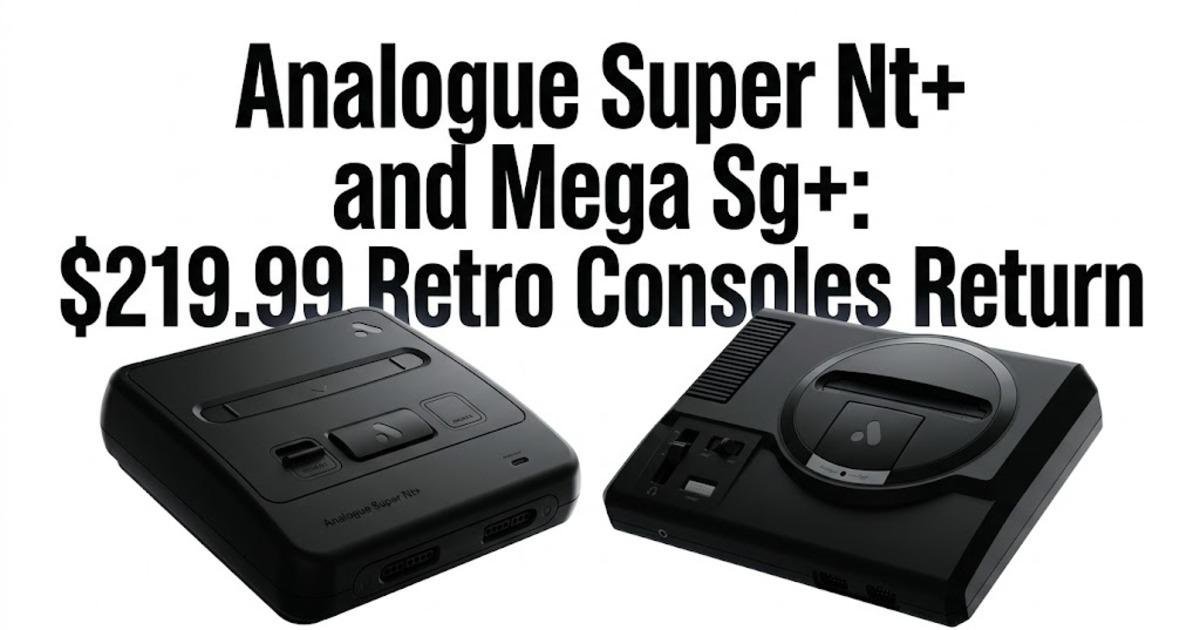
Analogue Super Nt+ and Mega Sg+: $219.99 Retro Consoles Return
Analogue’s Super Nt+ and Mega Sg+ bring original Super Nintendo and Sega Genesis cartridges to modern TVs with built-in wireless controllers, USB-C power and 1080p output. Preorders open October 19 at $219.99 per console.
On this page
Two of Analogue’s specialist retro-gaming consoles are returning with a practical fix for a modern annoyance: connecting wireless controllers to original game cartridges. The Super Nt+ and Mega Sg+ are priced at $219.99 each, with preorders scheduled to open on October 19, 2026, and shipping planned for December. Rather than replacing physical games with downloads, the systems are designed to play original Super Nintendo and Sega Genesis cartridges on modern televisions, adding updated connectivity while retaining their hardware-focused approach.
What the Super Nt+ and Mega Sg+ are bringing back
The Super Nt+ is designed for original Super Nintendo and Super Famicom cartridges, while the Mega Sg+ supports Sega Genesis and Mega Drive games, along with selected older Sega systems through compatible cartridges and adapters. Their predecessors were built for players who wanted to keep using original game collections without relying on aging consoles or conventional software emulation. The refreshed models retain that purpose but update several everyday details, including wireless controller support, USB-C power and cartridge swapping through the system menu. For someone who still owns a collection of 16-bit games, those changes address setup and convenience rather than attempting to reinvent how the games play.
Both systems are designed around a field-programmable gate array (FPGA), a chip that can be configured to reproduce the behavior of the original console hardware. That differs from conventional emulation, where software running on a general-purpose processor imitates another system's behavior. Analogue says its approach is intended to deliver accurate compatibility and responsive gameplay, although the company's performance language should be treated as a manufacturer claim rather than a substitute for independent testing of the new models. The important practical point is that these consoles are built for physical cartridges, not as general-purpose boxes for downloading and running game files.
Built-in wireless controllers are the biggest everyday upgrade
The original systems could be used with wired controllers, but modern wireless gamepads often required extra hardware to connect. The Plus models add Bluetooth and 2.4-gigahertz wireless support directly, with a dedicated pairing button and support for up to two wireless controllers. That means players can use compatible modern gamepads without needing to buy a separate wireless adapter just to get started. Wired controller support remains available, so owners who prefer original-style controls are not forced to switch.
The distinction between Bluetooth and 2.4GHz is worth understanding before buying a controller. Bluetooth is widely supported across consumer devices, while dedicated 2.4GHz connections often rely on a compatible controller and receiver or pairing system. Analogue advertises both connection types, but buyers should still check whether their particular controller is supported rather than assume every wireless gamepad will work. The company specifically highlights compatible 8BitDo controllers and arcade sticks, making controller compatibility a sensible item to verify before placing an order.
USB-C power and cartridge hot-swapping modernize the setup
Both consoles replace the older power connection with USB-C and include a USB-C cable and a 30-watt power supply. They also add a USB-A port for supported accessories, including Analogue's digital-to-analog converter for connecting compatible equipment to older televisions. USB-C makes the power setup more familiar, but it should not be confused with a promise that every USB-C charger or accessory will work identically. The supplied power adapter avoids that uncertainty for initial setup.
The other useful change is cartridge hot-swapping through the system menu. Instead of shutting the entire console down whenever a player wants to change games, the user can quit to the menu and then replace the cartridge. This is a controlled software-supported process, not permission to pull a cartridge out while a game is still running. It is a modest improvement, but one that makes a collection of physical games more convenient to use during a long session.
1080p output is deliberate, not a modern 4K upgrade
The Super Nt+ and Mega Sg+ are designed to output up to 1080p over HDMI, with image settings intended for older two-dimensional games. That resolution is enough to present classic pixel art clearly on many modern televisions, especially when the console provides scaling and aspect-ratio options tailored to older graphics. It does not mean the original games have been remade in high definition; the console is adapting their output for a newer display. Players seeking a retro system with 4K output should not confuse these machines with Analogue's separate Analogue 3D product.
The 1080p limit also reflects the intended audience. These systems focus on recreating the original 8-bit and 16-bit gaming experience rather than adding modern rendering effects or turning old titles into remastered editions. Analogue lists multiple aspect ratios and image-processing options, giving players control over how the original picture fits a television. The company advertises high accuracy and low latency, but prospective buyers should wait for hands-on testing of the Plus hardware before treating those claims as independently established results.
The Mega Sg+ has a broader Sega cartridge story
The Mega Sg+ is not limited to the standard Genesis and Mega Drive library. Analogue lists compatibility with additional Sega-era cartridge systems, including Master System and Game Gear, through the relevant adapters. The Master System cartridge adapter is included, while other adapters and compatible hardware may need to be purchased separately. Owners of Sega CD or Mega CD hardware can also connect an original compatible unit, but the console does not replace that add-on with a built-in disc drive.
That flexibility could make the Mega Sg+ more attractive to collectors whose libraries span several Sega systems, but it is not a universal all-in-one retro console. Compatibility depends on the original cartridge, the appropriate adapter where required and, for Sega CD support, the original expansion hardware. Analogue also states that the system does not include built-in games and does not support copyrighted game files as a substitute for physical cartridges. Buyers should check the official compatibility information against the specific games and accessories they own.
What $219.99 buys, and what it leaves out
Each console costs $219.99 before any applicable taxes, shipping charges or local import costs. The included package covers the console, HDMI and USB-C cables, a power supply and cartridge-cleaning accessories; the Mega Sg+ package also includes its Master System cartridge adapter and a Sega CD spacer. A wireless controller is not included, so the total cost for someone starting without a compatible gamepad will be higher than the advertised console price. The systems also do not include a library of games, which makes them most compelling for people who already own original cartridges or are deliberately building a physical collection.
The preorder window is scheduled for October 19 at 8 a.m. Pacific Daylight Time, with shipping planned for December 2026. Those dates describe the announced schedule, not a guarantee that every region will receive stock at the same time. Buyers outside the United States should check the relevant regional edition, shipping availability and final checkout cost before ordering. The advertised price is in US dollars, and the actual landed cost can be materially different once international delivery and import charges are considered.
Who should consider the Plus consoles
The strongest case for either model is a player who values original cartridges, wants a modern HDMI connection and prefers hardware designed specifically around the games it supports. The built-in wireless connections and USB-C power remove some of the small hassles associated with older setups, while the cartridge-menu feature makes switching games less cumbersome. For someone who mainly wants to sample retro games cheaply, a software emulator or a more general-purpose retro device may be more practical. These Analogue systems are aimed at preserving a physical-console experience, and that focus is part of what buyers are paying for.
Before ordering, make a list of the cartridges you want to play, check the required region and adapter support, and decide whether you already own a compatible controller. Then compare the full cost with the condition of your original console and the convenience of other ways to play the same library. Independent testing after the Plus models reach reviewers should help establish whether the updated hardware delivers meaningful improvements beyond the feature list. For collectors, that evidence will matter more than the nostalgia attached to the familiar console shapes.
Share this post
Written by