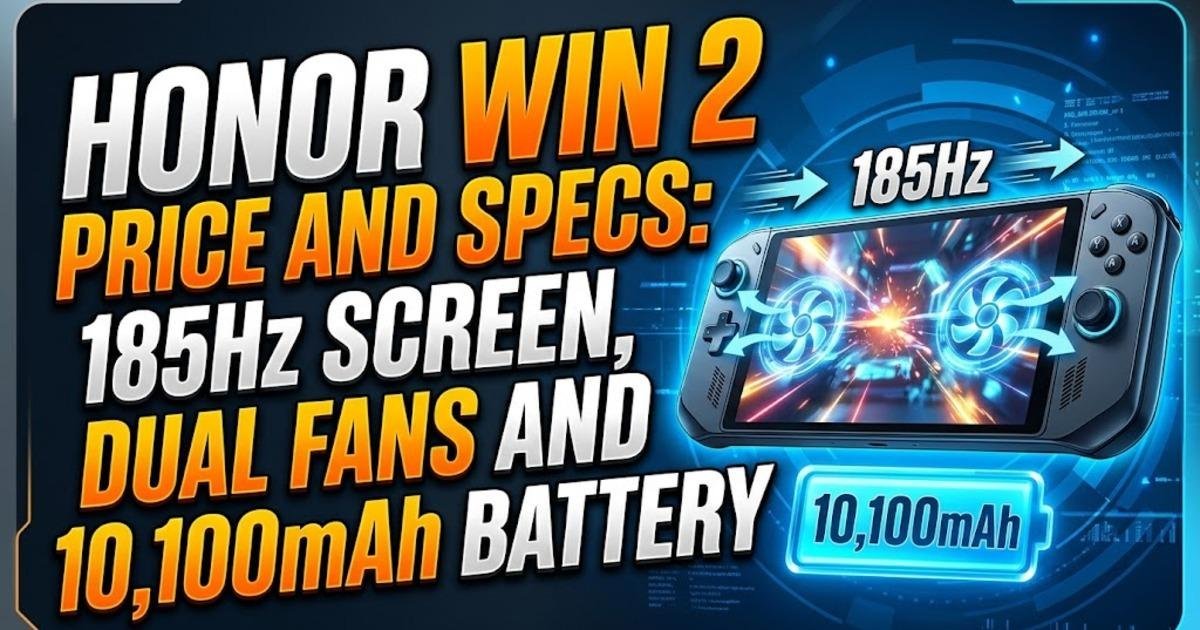
Honor WIN 2 Price and Specs: 185Hz Screen, Dual Fans and 10,100mAh Battery
Honor's WIN 2 launches in China with a 185Hz 2K display, dual cooling fans, a 10,100mAh battery and a starting subsidised price of 4,999 yuan. Here is what its specifications mean for mobile gamers and what remains unverified.
On this page
A 10,100mAh battery, a 185Hz high-refresh-rate display and two built-in cooling fans make the Honor WIN 2 an unusual smartphone even among gaming-focused devices. Honor launched the phone in China on October 21, 2026, with a starting list price of 5,499 yuan and a reported starting price of 4,999 yuan after applicable Chinese consumer subsidies. The hardware targets a familiar problem for mobile gamers: powerful processors can deliver fast frame rates, but sustained gaming also creates heat and drains batteries quickly. Honor's answer combines a large battery with active cooling and a screen designed for fast motion. The key question for buyers is whether these specifications translate into a better long-session gaming experience, rather than simply an impressive specification sheet.
The Honor WIN 2 starts at 4,999 yuan with Chinese subsidies
Honor announced the WIN 2 at its October 21 launch event in Hangzhou, China. The standard starting price is 5,499 yuan for the configuration with 12GB of memory and 256GB of storage, while the advertised price after eligible national consumer subsidies starts at 4,999 yuan. These figures refer to the Chinese market; the subsidised price is not a universal discount that buyers in other countries can automatically claim.
The higher configurations cost more as memory and storage increase. Honor's launch pricing lists the 16GB/256GB version at 5,799 yuan, the 12GB/512GB version at 6,299 yuan, the 16GB/512GB version at 6,999 yuan and the 16GB/1TB model at 7,999 yuan. Some higher-capacity configurations have separate regional subsidy prices, so the final amount depends on the offer and location. Anyone comparing prices should check the exact configuration and whether a quoted figure includes a subsidy.
| Configuration | Listed price in China | Advertised subsidised price |
|---|---|---|
| 12GB RAM / 256GB storage | 5,499 yuan | 4,999 yuan |
| 16GB RAM / 256GB storage | 5,799 yuan | 5,299 yuan |
| 12GB RAM / 512GB storage | 6,299 yuan | 5,499 yuan |
| 16GB RAM / 512GB storage | 6,999 yuan | 6,199 yuan in eligible regions |
| 16GB RAM / 1TB storage | 7,999 yuan | 7,199 yuan in eligible regions |
The price places the WIN 2 in the premium-phone bracket in China, so its appeal depends on whether buyers value gaming performance and battery capacity more than a thinner design or a broader camera system. Honor has also promoted the WIN 2 as part of a wider gaming product family, including a tablet and accessories. That ecosystem may interest people who want several devices for gaming, but the phone's own performance and day-to-day comfort matter more than the size of the product lineup.
The 185Hz display is built for fast-moving games
The WIN 2 uses a 2K-resolution display with a refresh rate of up to 185Hz. Refresh rate measures how many times per second a screen can update its image, so 185Hz allows more frequent updates than a conventional 60Hz screen and can make supported games feel smoother. The 2K resolution also aims to keep fine details sharp, although higher resolution can demand more processing power and energy. The benefit is most noticeable in games that can actually render frames at high rates; a 185Hz panel does not make every game run at 185 frames per second.
Honor describes the panel as a dual-chip Oasis gaming display and advertises high-frequency pulse-width modulation, or PWM, dimming at up to 5,920Hz. PWM is a method some displays use to control brightness by switching light output rapidly. A higher dimming frequency can reduce certain kinds of visible flicker for some users, but it does not guarantee that everyone will experience less eye strain. Comfort still varies with brightness, viewing conditions and individual sensitivity.
The screen's high refresh rate is therefore a feature with a practical condition attached: the game, graphics settings and phone's thermal state must all support the desired performance. A game capped at 60 or 120 frames per second will not show the full benefit of a 185Hz panel. Buyers who mostly watch videos, browse social feeds or play casual games may get less value from the extra refresh rate than competitive players who can use it.
Two cooling fans address the heat problem directly
Unlike a typical smartphone that relies on passive heat spreading, the WIN 2 includes a dual-fan active cooling system. Small fans move air through the phone's cooling structure, helping carry heat away from components during demanding workloads. This matters because a processor may reduce its speed when temperatures climb, a behaviour known as thermal throttling. Better cooling can help a phone maintain performance for longer, although it cannot eliminate heat or guarantee a fixed frame rate in every game.
Honor says its new cooling design delivers a combined airflow of 1.19 cubic feet per minute and claims a 150% improvement in cooling performance. These are manufacturer figures, not a substitute for independently controlled tests comparing temperatures, noise and sustained frame rates against competing phones. The company also describes a three-dimensional airflow structure intended to make better use of the air moved by both fans. Real-world results will depend on the game, room temperature, graphics settings and how long the device is used.
Active cooling brings trade-offs as well. The fans need space inside the chassis, add moving parts and can create audible noise or draw extra power when operating. Dust management and long-term reliability are also worth considering, particularly for a phone used during frequent gaming sessions. Honor has announced protection ratings of IP68, IP69 and IP69K, but buyers should still follow the device's care guidance rather than assume that water resistance makes every component invulnerable.
The 10,100mAh battery could matter more than the processor
Honor equips the WIN 2 with a 10,100mAh battery, a capacity substantially larger than the batteries found in many mainstream smartphones. For a mobile gamer, the attraction is straightforward: demanding games use the display, processor, graphics hardware and network connection at the same time, which can consume energy quickly. More battery capacity gives the phone more energy to draw on before it needs a charger. It does not, by itself, establish how many hours the phone will last under a particular game's settings.
The actual runtime will depend on brightness, refresh rate, wireless signal strength, game workload and whether the cooling fans are running. A 2K display at a high refresh rate can consume more power than a lower-resolution panel operating at a slower rate, while a game that pushes the processor continuously will draw more energy than a lightweight title. Until independent battery tests are available, buyers should treat any all-day or marathon-gaming expectation as unverified rather than a guaranteed result.
A battery this large can also make a handset heavier and thicker than a conventional phone. That trade-off may be acceptable to someone who plays for hours without access to a charger, but less attractive to someone who carries a phone in a pocket all day or prefers one-handed use. Battery capacity is one of the WIN 2's clearest selling points, yet its value depends on how much weight the buyer is willing to carry.
The Snapdragon chip is powerful, but benchmark claims need context
The WIN 2 uses Qualcomm's Snapdragon 8 Elite Extreme Gen 6 platform, which Honor identifies in Chinese as the sixth-generation Snapdragon 8 Supreme Edition. The chip is paired with LPDDR5X Ultra memory and UFS 4.1 storage. Memory helps the phone keep active game data and apps available, while storage affects how quickly files and game assets can be read. Together, these components are intended to support demanding games, rapid loading and multitasking.
Honor reports an AnTuTu benchmark score of 5,702,964 from its own laboratory testing. AnTuTu combines several kinds of performance tests into a single score, making it useful as a rough comparison when devices are tested under similar conditions. However, a result supplied by the manufacturer is not the same as a score independently reproduced by reviewers using retail devices. Benchmark versions, performance modes, software builds and temperature can all influence the result, so the number should not be treated as proof that the WIN 2 will outperform every rival in every game.
For gamers, sustained performance is often more useful than a brief peak score. A phone that reaches a high benchmark result but becomes hot and slows down during a long session may be less satisfying than one that delivers consistent frame pacing. The combination of a powerful chip and active cooling is promising on paper, but controlled long-session tests will show whether Honor's design achieves that goal.
The camera and build make it more than a single-purpose gaming phone
Honor has not limited the WIN 2 to gaming hardware. The company says the phone includes a 200-megapixel main camera with a 1/1.4-inch sensor, optical image stabilisation and electronic image stabilisation. Optical stabilisation compensates for some physical camera movement, while electronic stabilisation uses software to help steady footage. Honor also advertises up to four-times lossless zoom, but the quality of that result depends on the camera's processing and the conditions in which the picture is taken.
The phone runs MagicOS 11 and includes Honor's YOYO assistant features, according to the launch announcement. It also supports USB 3.2, has an ultrasonic fingerprint reader and includes an X-axis linear vibration motor, which can provide more precise tactile feedback than a basic vibration motor. These features make the device more versatile for everyday use, although the gaming-oriented design and large battery remain its defining characteristics. Independent camera comparisons will be needed to determine how its photographs perform against similarly priced camera-focused phones.
The design uses a horizontal rear camera and cooling module with an illuminated WIN energy ring, which Honor says supports more than 40 gaming-light effects. That gives the phone a recognisable gaming appearance, but it will not suit every buyer. The advertised IP68, IP69 and IP69K ratings indicate different levels of dust and water protection under specified test conditions; they should not be interpreted as permission to expose the phone routinely to water, pressure or debris.
Should you buy the Honor WIN 2?
The WIN 2 is aimed most clearly at people who play demanding mobile games for extended periods and want a high-refresh-rate screen, substantial battery capacity and active cooling in one device. Its 185Hz display, dual fans and 10,100mAh battery address three practical gaming concerns: motion clarity, heat and time away from a charger. The premium processor and fast memory also give it the hardware foundation for demanding workloads. Those are credible reasons to consider it, but they do not replace independent testing of comfort, sustained performance, noise and battery life.
For everyday users who mainly message, browse, stream video and take occasional photographs, the extra cooling hardware and large battery may be more than they need. A conventional flagship could offer a slimmer body or a camera system better suited to their priorities. Buyers should also check local warranty coverage, network compatibility, software support and the final price before importing a China-market model. As of the October 21 launch, Honor's announcement establishes Chinese pricing and specifications, but it does not by itself confirm an international release date or local pricing in markets such as Pakistan.
The next useful evidence will come from independent tests that run demanding games for long periods, measure temperatures and fan noise, and record battery drain at different display settings. Those results will show whether the WIN 2's cooling system and large battery deliver a meaningful advantage in actual play. Until then, its hardware makes a strong case for dedicated mobile gamers, while the final buying decision should depend on verified performance and regional availability rather than the headline specifications alone.
Share this post
Written by