
POCO F9 Series Launch: What the Pro and Ultra Bring
The POCO F9 Pro and F9 Ultra launch globally on September 1 with Snapdragon 8 Elite Gen 5 chips, 185Hz displays, fast charging and an 8,050mAh Ultra battery.
On this page
POCO's F9 series is set for its global launch on September 1, 2026, with the company preparing two flagship phones: the POCO F9 Pro and POCO F9 Ultra. The official launch material already confirms some unusually aggressive hardware, including Snapdragon 8 Elite Gen 5 processors, a 185Hz display, an 8,050mAh battery on the Ultra and a Bose-tuned speaker system with a dedicated subwoofer.
The POCO F9 Pro and Ultra arrive as a two-phone lineup
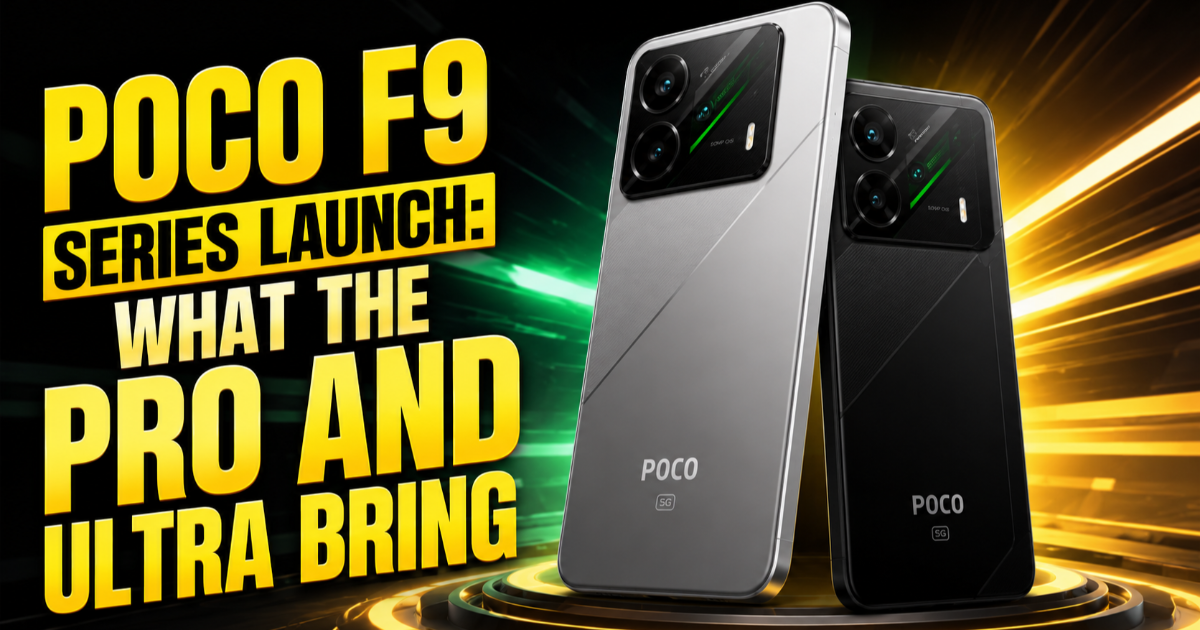
POCO has confirmed that the F9 series consists of two models rather than a standard F9 followed by higher-end versions. The global event is scheduled for September 1 at 8:00 PM GMT+8, giving buyers their first official look at regional pricing, configurations and availability. POCO has already shown an Aurora Green finish for the F9 Pro and a darker cherry finish for the F9 Ultra, making the two phones visually distinct before the full launch.
The timing also puts the F9 series directly into the busiest part of the smartphone calendar. Apple's next iPhone generation is expected later in September, while other Android manufacturers are preparing their own high-end devices. That makes POCO's decision to emphasize raw performance, gaming and battery capacity particularly relevant: it is trying to stand out on specifications that buyers can understand immediately rather than relying on software features alone.
Both phones are built around Snapdragon 8 Elite Gen 5
The most important shared component is Qualcomm's Snapdragon 8 Elite Gen 5 family, a flagship mobile processor designed for demanding Android phones. POCO's official launch material confirms the chip family across the F9 lineup, with the F9 Ultra using Snapdragon 8 Elite Gen 5 and the F9 Pro using a V-series variant. That distinction matters because the exact processor configuration can affect clock speeds, power consumption and sustained performance, so the two phones should not automatically be treated as identical despite sharing the same processor family.
For buyers, the practical reason to care is sustained performance rather than a benchmark number alone. A powerful processor can make high-refresh-rate gaming, camera processing and demanding multitasking faster, but the final experience depends on cooling, software optimization and how long the phone can maintain performance under heat. POCO itself lists an AnTuTu score of 4,165,108 for the F9 Ultra, but that figure comes from POCO's internal testing, so it should be treated as a company test result rather than an independent performance ranking.
The 185Hz display is aimed squarely at mobile gaming
POCO is also pushing the display beyond the 120Hz or 144Hz refresh rates commonly found on performance-oriented phones. The F9 series supports a maximum refresh rate of 185Hz, meaning the screen can refresh the image up to 185 times per second under supported conditions. A higher refresh rate can make scrolling and supported games feel smoother, although it does not automatically make every game run at 185 frames per second.
POCO says its 185 frames-per-second gaming figure applies to selected games under internal test conditions. The actual frame rate can change with the game, graphics settings, software version, temperature and network conditions. That qualification is worth keeping in mind because the display's headline number describes what the panel can support, not what every game will deliver.
The Ultra's 8,050mAh battery changes the usual flagship trade-off
The F9 Ultra's battery is one of the clearest differences between it and many conventional flagship phones. POCO lists an 8,050mAh typical-capacity battery, alongside 100W wired charging and 50W wireless charging. A battery this large gives the Ultra considerably more capacity to work with during gaming, video playback and other sustained workloads, although actual battery life will depend on screen brightness, processor load, software and network conditions.
The charging system is just as significant because a large battery is less useful if it takes too long to refill. POCO's 100W wired HyperCharge specification is designed to offset that problem, while 50W wireless charging provides a faster cable-free option. Charger availability can vary by market, however, so buyers should check what is included or offered in their region rather than assuming every market receives the same package.
POCO is turning the speaker system into part of the flagship pitch
The F9 series also moves beyond the usual smartphone specification sheet with audio hardware developed with Bose. POCO says the phones use symmetrical stereo speakers and an independent subwoofer, creating a 2.1-channel arrangement intended to give the phone more low-frequency output than a conventional pair of small smartphone speakers.
This is a meaningful addition for people who use their phones for games, streaming and music without headphones. A dedicated subwoofer cannot reproduce sound like a full-size speaker system because the phone still has strict physical limits, but giving the low-frequency range its own component can change how games and video sound. The real question will be whether the tuning remains clear at high volume, something that hands-on testing will reveal better than specifications can.
The F9 Pro gets a different design identity
POCO is giving the F9 Pro an Aurora Green finish with a full-panel luminous design. The company says this effect is exclusive to that version and produces a glow after exposure to sunlight or indoor lighting. It is a cosmetic feature rather than a replacement for the phone's display, but it gives the Pro a visual identity that separates it from the more conventional finishes used across many performance phones.
The F9 Ultra takes a different route with a dark cherry-colored finish and a larger, more premium-looking body. The two designs therefore reflect the intended positioning of the phones: the Pro emphasizes a distinctive gaming-oriented identity, while the Ultra combines the performance specifications with a larger battery and more elaborate audio hardware.
The launch matters more than the leaked specifications
Much of the F9 series specification story circulated before POCO officially confirmed the phones, including reports connecting the devices to Xiaomi's Redmi K100 Pro family. Those reports can help explain why some specifications appeared early, but they should not be confused with POCO's final global specifications. The official launch page is the stronger source for features that the company has now confirmed.
Pricing is another area where buyers should wait for the event. Regional smartphone prices can differ substantially because of taxes, memory configurations, promotions and distribution costs. An unofficial Pakistan price or an expected European price therefore should not be presented as the final retail cost until POCO publishes the relevant regional figure.
What to watch when the launch goes live
The most useful information from the September 1 event will be the details that specifications alone cannot settle. Buyers should look for the final RAM and storage combinations, regional pricing, charger availability, software version, camera configurations and confirmed release markets. Those details will determine whether the F9 Pro and F9 Ultra are genuinely competitive purchases rather than simply impressive specification sheets.
The F9 Ultra already has one obvious selling point: an 8,050mAh battery paired with 100W wired and 50W wireless charging. The F9 Pro has a more compact performance proposition, while both models share the Snapdragon 8 Elite Gen 5 family and 185Hz display technology. Once independent reviews test heat, battery endurance, cameras, speakers and sustained gaming performance, it will become much easier to tell whether POCO's hardware-heavy approach delivers an advantage in everyday use.
For now, the September 1 launch is the point where the F9 series moves from a heavily discussed upcoming phone to a real global product. The specifications POCO has confirmed make the Ultra especially interesting for buyers who prioritize battery capacity and gaming, while the Pro could appeal to people who want similar flagship-class processing without moving to the largest model. The final decision will come down to the numbers POCO reveals at launch and how those numbers translate into actual use.
Written by