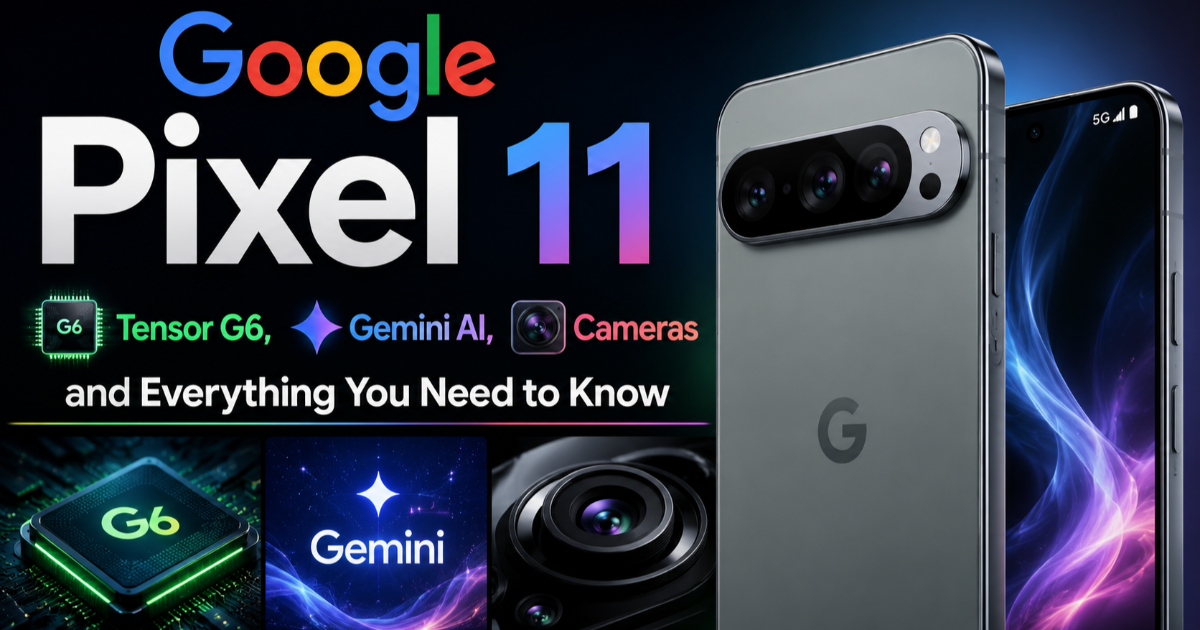
Google Pixel 11: Tensor G6, Gemini AI, Cameras and Everything You Need to Know
Google Pixel 11 brings Tensor G6, Android 17, deeper Gemini AI integration, upgraded cameras, brighter displays and new features across the Pixel 11, Pro, Pro XL and Pro Fold.
On this page
Google's Pixel 11 generation is shaping up to be one of the company's most important smartphone releases in years, not because the hardware represents a complete redesign, but because Google is using the new phones to push a much deeper change in how Android works.
The Pixel 11, Pixel 11 Pro, Pixel 11 Pro XL and Pixel 11 Pro Fold were unveiled at Google's August 12, 2026 Made by Google event. The new generation combines Google's Tensor G6 processor with Android 17, Gemini-powered features, upgraded cameras, faster local AI processing and a collection of new software features designed to make the phone more proactive rather than simply more powerful. Multiple independent hands-on reports published around the launch describe the same broader direction: Google is putting more emphasis on software and AI than on a dramatic hardware redesign.
That makes the Pixel 11 interesting beyond its specifications. The bigger question is what Google's new approach means for the future of Android phones.
The Pixel 11's Real Upgrade Is Happening Inside Android
At first glance, the Pixel 11 generation may look like a conventional annual smartphone upgrade. The exterior remains recognizably Pixel, the camera bar has been refined rather than completely redesigned, and Google has not attempted to reinvent the smartphone form factor.
But the software story is considerably more ambitious.
All four Pixel 11 models use Google's Tensor G6 platform, while the new generation is built around Android 17 and Google's Gemini Intelligence features. Independent hands-on coverage reports that the Tensor G6 includes a significantly faster neural processing component, with Google positioning the additional processing capability around local AI workloads rather than simply traditional benchmark performance.
This distinction matters. Smartphone processors have traditionally been judged by CPU speed, graphics performance, gaming benchmarks and battery efficiency. Google increasingly wants another measurement to matter: how quickly the phone can understand speech, images, video and user context without sending every operation to a remote server.
That is the foundation for many of the Pixel 11's new capabilities.
Tensor G6 Is Designed Around the AI Workload
The Tensor family has always been different from processors that compete primarily on raw benchmark numbers. Google's strategy is to build hardware around the company's computational photography, machine learning and software ecosystem.
The Tensor G6 continues that strategy. According to reporting around the launch, the new chip's TPU is substantially faster for AI processing, while the entire platform is designed to improve efficiency as well as performance. Android Central reports a 50% faster TPU for AI workloads and describes the chip as one of the central pieces of Google's local-AI strategy.
Why does local processing matter?
Imagine speaking into your phone and asking it to clean up a message, translate a conversation, identify something visible through the camera or extract useful information from a video. If every operation has to travel to a cloud server, the experience depends on network availability, server response time and the privacy policies surrounding that data.
More capable on-device processing gives Google another option: perform at least part of the workload directly on the smartphone.
That does not mean every Gemini operation is performed locally. Google's AI ecosystem still relies on cloud services for many capabilities. The important change is that the smartphone is becoming a more capable AI computing platform in its own right.
Magic Capture Changes What a Smartphone Camera Means
Camera upgrades are another major part of the Pixel 11 story, but Google is again moving beyond the traditional megapixel race.
The new Magic Capture feature is designed to combine photography and video capture in a way that allows the phone to preserve a better moment when the user is recording something that is difficult to capture perfectly with a single photograph. Multiple launch reports identify Magic Capture as one of the headline camera features of the new generation.
The idea is significant because modern smartphone cameras are increasingly becoming computational systems rather than passive sensors.
A conventional camera records what happens at the exact moment the shutter is pressed. A computational camera can capture additional information around that moment and use software to determine which frame, exposure or combination of frames produces the most useful result.
For ordinary users, that can mean fewer photographs ruined because somebody blinked, moved unexpectedly or looked away at exactly the wrong moment.
For Google, however, the larger objective is clear: camera hardware provides the raw information, while Google's software and AI determine how that information should be turned into a finished image.
Pixel 11 Pro Pushes Computational Photography Even Further
The Pro models receive the more ambitious camera upgrades.
Google's Pixel 11 Pro and Pixel 11 Pro XL introduce improved camera hardware alongside computational features such as enhanced zoom, Instant Night Sight and additional video tools. Independent reporting describes up to 120x zoom on the Pro models, with Google's processing pipeline playing a major role in producing usable results at extreme digital magnification.
This is an important distinction for buyers.
A 120x zoom number does not mean the phone suddenly has the optical reach of a professional telephoto camera. At very high magnifications, computational processing becomes increasingly important. The phone has to reconstruct detail from limited optical information, stabilize the image and suppress noise and artifacts.
That is why the quality of Google's algorithms may matter almost as much as the underlying camera sensor.
The Pixel 11 Pro models also introduce Camera Looks, which gives users more control over the visual character of photographs, while Google's Creator Suite brings additional content-creation tools into the camera experience.
HiLight Is a Small Feature With a Bigger Idea Behind It
One of the most unusual Pixel 11 features is not a processor or camera sensor at all. It is the new HiLight system on the Pro models.
HiLight uses an illuminated element around the rear camera area to provide visual notifications. Instead of requiring the user to immediately turn the screen on, the phone can communicate certain information through the rear lighting system. Reports from The Verge and Android Central identify HiLight as one of the distinctive new Pro features.
On paper, this might sound like little more than a redesigned notification LED. But there is an interesting usability idea behind it.
Smartphones constantly compete for attention. Every notification encourages the user to unlock the device, look at the screen and interact with an application. A glanceable indicator can communicate that something happened without necessarily demanding a full interaction.
That could become increasingly important as Google tries to make smartphones more proactive while simultaneously reducing unnecessary screen time.
Rambler Makes Voice Input More Practical
Another major software change is Rambler, Google's upgraded Gemini-powered speech-to-text system.
Traditional speech-to-text systems often produce a literal transcription. If someone speaks hesitantly, repeats words or uses filler expressions, the resulting text can look almost exactly like raw speech.
The new approach attempts to make the output more useful by understanding the speaker's intended wording and formatting the result more naturally. Android Central reports that Rambler can remove verbal fillers and improve formatting based on how the user speaks.
This is a subtle but important shift.
Speech recognition is moving from transcribe what I said toward understand what I meant to type.
For people who dictate long messages, emails, notes or documents on a phone, that difference can be much more valuable than simply increasing transcription accuracy by a few percentage points.
Google Is Making the Pixel More Proactive
The most important change across the Pixel 11 generation is therefore not one individual feature. It is the relationship between the phone, the user and Google's AI services.
Google is trying to make the smartphone understand more of the user's intent instead of waiting for every action to be explicitly requested.
That approach can be seen across Gemini, camera features, voice input, translation and other system functions. Google's own Pixel documentation already describes Gemini as an assistant capable of working with text, voice, images and the camera, while connecting with services such as Gmail, Maps and YouTube.
The Pixel 11 extends that philosophy into more parts of the device.
Instead of thinking of AI as an application that the user opens, Google increasingly treats AI as an operating-system capability.
Why 12GB of RAM Is Not Necessarily a Step Back
One of the more interesting discussions surrounding the Pixel 11 generation is memory.
The standard Pixel 11 starts with 12GB of RAM, while higher-end Pro models offer configurations with more memory. Some reports have characterized the standard model's memory configuration as conservative compared with certain competing flagship phones.
However, RAM capacity cannot be evaluated in isolation.
Android memory management, application behavior, processor architecture and Google's optimization strategy all influence how much RAM a device actually needs. A phone with more RAM is not automatically faster if its software does not make effective use of that additional memory.
Google's approach appears to be based partly on optimizing Android and its AI workloads around the hardware available rather than simply increasing specifications every year.
For users, the practical question will be long-term performance: how well does the Pixel 11 keep applications in memory, maintain smooth multitasking and support increasingly demanding AI features after several years of updates?
That is something launch specifications alone cannot fully answer.
The Price Increase Changes the Conversation
There is also a significant downside for buyers: Google has increased the starting price of the Pixel 11 generation.
Independent reports from AP, The Verge and Wired put the starting price of the standard Pixel 11 at $899, while the Pro, Pro XL and Pro Fold occupy progressively higher price brackets. The Pixel 11 Pro Fold starts at approximately $1,899.
The standard Pixel 11 also starts at 256GB rather than the previous 128GB baseline, which partially changes the value calculation.
Still, a $100 increase compared with the previous generation makes the Pixel 11 more difficult to evaluate simply as a hardware upgrade.
Google therefore needs buyers to believe that the new software and AI capabilities justify the additional cost.
Pixel 11 Pro Fold Shows Google's Broader Hardware Strategy
The Pixel 11 Pro Fold is particularly important because foldable phones remain one of the clearest areas where smartphone manufacturers can create a genuinely different physical experience.
Google has made the new foldable thinner while improving its display and durability. The Verge reports that the Pixel 11 Pro Fold is approximately 1mm thinner than its predecessor, while Google has also changed aspects of the external material and display design.
The significance goes beyond thickness.
Foldables create a larger canvas for AI-assisted work. A user can potentially combine a large screen with Gemini, document editing, multitasking, translation and visual analysis in ways that are less convenient on a conventional smartphone.
That makes foldable hardware particularly interesting as AI assistants become more capable.
Google Is Also Building a Pixel Ecosystem
The Pixel 11 launch was not only about smartphones.
Google also introduced the Pixel Watch 5 and Pixel Tag, expanding the Pixel family into wearables and tracking hardware. The Pixel Tag is positioned as Google's answer to products such as Apple's AirTag and uses Bluetooth and ultra-wideband technology together with Google's Find Hub ecosystem.
This matters because the future of mobile computing is unlikely to be limited to one device.
A smartphone can act as the central intelligence layer connecting a watch, earbuds, tracker, car, computer and other devices. Google's increasing investment in Gemini across these products suggests that the company wants the Pixel brand to become an ecosystem rather than simply a line of phones.
What Pixel 11 Means for Android Users
Even users who never buy a Pixel 11 should pay attention to this generation.
Google's Pixel devices often serve as a showcase for the direction the company wants Android to take. Features introduced on Pixel can influence the broader Android ecosystem as developers and manufacturers adopt similar ideas.
The Pixel 11 therefore represents a possible preview of the next phase of Android: less dependence on manually opening applications and more interaction through contextual AI capabilities.
That could eventually change how users search, communicate, edit photographs, navigate, translate languages and interact with their devices.
The Biggest Risk: AI Features Must Be Actually Useful
There is an obvious danger in Google's strategy.
Adding AI to every part of a smartphone does not automatically make the device better. If AI features are slow, inaccurate, intrusive or difficult to control, users may eventually regard them as unnecessary additions rather than genuine improvements.
Privacy is another important consideration. The more a smartphone understands about conversations, photographs, messages, location and personal activity, the more important it becomes to understand which operations happen locally and which require cloud processing.
Google's own documentation warns users not to rely on Gemini for professional medical, legal or financial advice, demonstrating that even Google's AI assistant should not be treated as an infallible decision-making system.
For the Pixel 11 strategy to succeed, convenience cannot come at the cost of reliability, transparency or user control.
Should You Buy the Pixel 11?
For someone already using a recent Pixel phone, the decision is not straightforward.
The Pixel 11 is more compelling for users who specifically want Google's latest AI capabilities, computational photography improvements, upgraded voice interaction and the newest Tensor platform. The standard model also starts with more storage than previous generations, which improves its practical value.
However, users primarily interested in raw hardware specifications may find the upgrade less dramatic. The design remains familiar, and many of the most important improvements are software-driven rather than immediately visible.
The Pro models make more sense for photographers, creators and users who want the strongest display and camera capabilities. The Pro Fold targets a different audience altogether: people willing to pay substantially more for a larger, flexible screen and foldable form factor.
The Bigger Picture
The Pixel 11 is best understood as a software platform wrapped in smartphone hardware.
Google is not simply trying to build a faster phone. It is trying to make the phone understand speech, images, video and context well enough that traditional interactions become less necessary.
That is why Tensor G6, Gemini, Android 17, Magic Capture, Rambler, HiLight and the new camera system are more interesting when viewed together than individually.
Each feature addresses a different part of the same problem: how can a smartphone become more useful without requiring the user to constantly manage the technology themselves?
The answer is still developing, and some of Google's AI promises will need real-world testing before their value can be judged. But the direction is unmistakable.
The Pixel 11 generation marks another step toward a smartphone where AI is not an optional feature sitting inside an app. It is becoming part of the operating system, camera, processor, communication tools and connected-device ecosystem itself.
That could ultimately be more important than the Pixel 11's cameras, display brightness or processor benchmark numbers. If Google's approach works, the next major smartphone upgrade may not be about what the device can do when you press a button. It may be about what the device can understand before you press one.
Written by