Motorola Signature 27 GrapheneOS Support: What It Changes for Android Users
Motorola's Signature 27 will be the first Motorola phone officially supported by GrapheneOS. Here is what is confirmed, what remains unknown, and why the hardware matters.
On this page
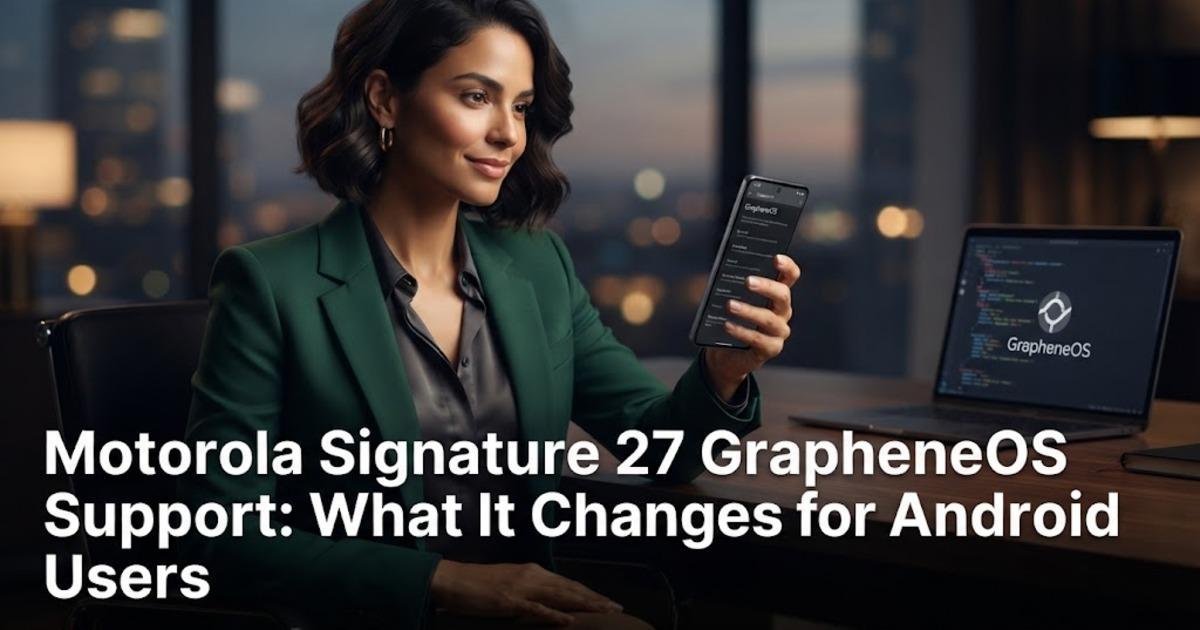
The Motorola Signature 27 is no longer just another high-end Android phone. GrapheneOS has confirmed that it will be the first Motorola smartphone officially supported by the privacy-focused Android operating system, breaking a long-standing Pixel-only pattern. The important detail is that this is a hardware-and-software compatibility announcement, not yet a complete launch plan for GrapheneOS on the phone.
The Signature 27 is the first Motorola chosen for GrapheneOS
GrapheneOS is an Android-based operating system built from the Android Open Source Project (AOSP), with a strong emphasis on reducing unnecessary data access and improving the security controls available to users. Until now, its official phone support has been closely associated with Google's Pixel hardware because those devices provide the combination of security hardware, firmware support, and long-term software updates that the project requires. The Signature 27 changes that hardware requirement equation by becoming the first Motorola model officially selected for support.
The GrapheneOS project confirmed the model directly after Motorola unveiled the phone at Qualcomm's Snapdragon Summit. In the project's own discussion forum, the Signature 27 is identified as the initial supported Motorola phone, while the project has indicated that more official information will follow. That wording matters because it confirms the device target without pretending that every installation and retail detail is already finished.
Why Motorola's hardware matters more than the software name
Installing a different Android-based operating system is not simply a matter of replacing one set of apps with another. A supported phone needs secure hardware, suitable firmware, verified boot support, and a manufacturer willing to maintain the components that keep the device secure after launch. GrapheneOS support therefore says something about the underlying platform as well as the operating system.
The Signature 27 arrives with Qualcomm's Snapdragon 8 Elite Extreme Gen 6, Qualcomm's newest premium mobile platform announced on September 22. Qualcomm says the platform combines its custom Oryon central processor, Adreno graphics processor, Hexagon neural processing unit and hardware-level security capabilities, while supporting the company's latest artificial-intelligence, gaming, imaging and connectivity features. Those capabilities are part of the reason the phone is a plausible match for GrapheneOS's hardware requirements, although independent testing of the finished device will still be needed.
Seven years of software support gives GrapheneOS more room to matter
Long-term software maintenance is another important part of the story. Motorola says the Signature 27 will receive up to seven operating-system updates and up to seven years of security updates beginning with its global launch, although the company notes that support can vary by market, carrier and model. For an alternative operating system, that commitment matters because security-focused software is much more useful when the hardware underneath it continues receiving firmware and security maintenance for years.
This does not mean seven years of GrapheneOS updates have already been guaranteed in a separate support schedule. Motorola's promise concerns the device's official software-support commitment, while GrapheneOS still has to deliver and maintain its own builds and device-specific support. The distinction is easy to miss, but it is central to understanding what has actually been announced.
The phone itself is built like a flagship, not a privacy special
The Signature 27 is significant because users are not being asked to choose a stripped-down security device. Motorola has paired the phone with a 200-megapixel periscope telephoto camera, a 50-megapixel Sony LYTIA main sensor, Qualcomm's new flagship processor and a cooling system designed to move heat away from the processor during sustained workloads. Motorola also says the phone will use Audio by Bang & Olufsen, making the device a conventional premium smartphone before its alternative operating-system support is even considered.
The camera system is particularly notable because the 200-megapixel sensor is being used for the periscope telephoto rather than simply serving as a headline number on the main camera. Motorola says its Super Zoom Pro system can reach up to 100x with generative artificial intelligence assistance. That does not mean 100x zoom will produce the same detail as native optical magnification; computational processing is doing part of the work at longer ranges.
GrapheneOS does not mean the phone becomes a Pixel replacement overnight
The new support makes the Signature 27 an alternative hardware platform for people interested in GrapheneOS, but it does not erase the practical differences between Motorola and Google's phones. Pixel devices have years of established GrapheneOS development behind them, while Motorola support is only beginning. Drivers, firmware behavior, installation procedures, update timing and device-specific quirks all have to be validated in practice.
There is also a difference between official support and shipping with GrapheneOS. Reporting based on the project's confirmation indicates that Motorola phones are planned to be sold with GrapheneOS preinstalled, but the exact availability and timing have not yet been fully detailed. The Signature 27 itself is expected to reach markets later in 2026, with Motorola's US product page pointing specifically to November for more availability information.
The bigger change is that privacy software is leaving one hardware ecosystem
For years, the practical question for someone who wanted GrapheneOS was also a hardware question: which Pixel should they buy? The Signature 27 separates those decisions for the first time at an official level. A buyer can now consider Motorola's hardware design, camera system, processor and support policy while also having the possibility of using GrapheneOS rather than the manufacturer's standard Android software.
That does not make Motorola automatically better for privacy, and it does not make GrapheneOS universally suitable. It does, however, create competition at a layer that has historically been difficult to change: the hardware underneath a privacy-focused Android installation. If the Signature 27 support works as planned and future Motorola models follow it, the more interesting story may be what happens after this first phone rather than the phone itself.
The next test is whether support arrives as a finished product
For now, the Signature 27 has cleared the most important first hurdle: GrapheneOS has named it as its initial supported Motorola phone. The remaining questions are practical ones—when supported builds become available, which markets receive preinstalled versions, how quickly updates follow Motorola's firmware releases, and how well the device behaves under real-world use.
Motorola has already confirmed that the Signature 27 is coming later in 2026, while its US product page points to November and continues to describe additional information as forthcoming. Until the software distribution details are published, the safest way to read the announcement is as the beginning of Motorola's GrapheneOS era, not the end of the Pixel era overnight.
Written by