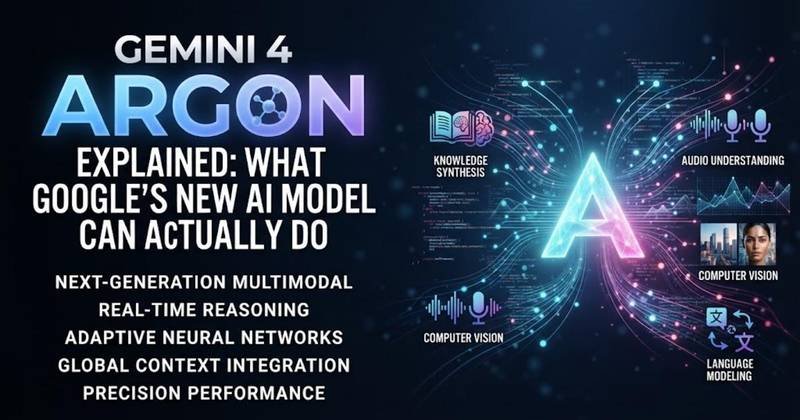
Gemini 4 Argon Explained: What Google’s New AI Model Can Actually Do
Gemini 4 Argon is Google’s new frontier AI model for long, complex workflows, coding and cybersecurity. Here are its benchmarks, pricing and limits.
On this page
Google announced Gemini 4 Argon on September 30, 2026, but it is not opening the model to everyone yet. Google is first giving access to a limited group of trusted cyber defenders through its Fairwind Program, while it tests safeguards before expanding availability to developers, businesses and consumers.
That restricted launch is part of what makes Argon different from a routine model upgrade. Google is positioning it for long, difficult workflows such as software engineering, legal and financial work, and defensive cybersecurity, where an AI system has to reason across many steps rather than simply produce a short answer. The published results are strong in several areas, but they are not a clean sweep across every benchmark, which makes the details more useful than the launch-day claims alone.
Gemini 4 Argon is designed for long, multi-step work
Argon's central design goal is sustained reasoning across complex tasks. Google says the model can work through long-horizon problems in areas including software engineering, enterprise knowledge work and cybersecurity, and the company says thousands of its employees are already using it internally for specialized coding, research and writing tasks.
Long-horizon work is different from a conventional question-and-answer exchange. A coding task might require understanding an unfamiliar codebase, tracing dependencies, changing several files and checking whether the result works. A financial or legal workflow can similarly involve reading large amounts of material before producing an answer. Argon's intended role is to maintain the reasoning chain across those stages instead of treating each step as an isolated prompt.
The one-million-token output limit changes what a model can produce
Google says Gemini 4 Argon has a maximum output limit of 1 million tokens, compared with 64,000 tokens on earlier Gemini models. A token is a small unit of text processed by a language model, so a million-token output is far beyond the size of an ordinary chatbot response. The practical value is not that users should ask Argon to write million-token documents, but that the model has room for unusually long reasoning and generated work when a task genuinely requires it.
That specification should not be confused with proof that every million-token prompt will be understood perfectly. Independent analysis of Google's launch material has pointed out that long-context benchmark results measure performance on particular evaluations rather than guaranteeing perfect recall at every possible input length. The useful takeaway is that Google is targeting workloads where keeping more information available during a single task matters, not that context length alone makes the model better at every job.
Google's benchmark results show clear strengths and clear gaps
Google published a broad set of comparisons between Argon and competing models. On DeepSWE v1.1, a benchmark for real-world software engineering tasks, Google reports 77.9% for Argon versus 74.2% for Claude Opus 5.5 and 74.1% for GPT-6 Astra. On Vibe Code Bench, Argon is reported at 91.9%, compared with 89.6% for GPT-6 Astra and 90.3% for both Claude Fable 5.1 and Claude Opus 5.5.
Those results do not mean Argon wins every coding workload. Google's own table shows 55.0% for Argon on FrontierSWE v2, compared with 65.5% for GPT-6 Astra and 62.3% for Claude Opus 5.5. Terminal-bench 4.0 is another example: Argon scores 57.4%, while Claude Opus 5.5 reaches 66.4%. The pattern suggests that Argon's advantage depends heavily on the type of work being measured, particularly when tasks move from software reasoning into terminal-heavy agent operation.
| Benchmark | Gemini 4 Argon | Reported leading rival |
|---|---|---|
| DeepSWE v1.1 | 77.9% | Claude Opus 5.5 — 74.2% |
| Vibe Code Bench | 91.9% | GPT-6 Astra — 89.6% |
| FrontierSWE v2 | 55.0% | GPT-6 Astra — 65.5% |
| Terminal-bench 4.0 | 57.4% | Claude Opus 5.5 — 66.4% |
| OSWorld-2.0 | 69.2% | GPT-6 Astra — 72.6% |
The table is based on Google's published evaluation results, not a single independent benchmark run. That distinction matters because the model's launch comparisons are vendor-reported, and independent testing is still developing. One early third-party analysis using Artificial Analysis data placed Argon below Claude Opus 5.5 on its intelligence index, while another task-specific evaluation from Vals ranked Argon highly. Different benchmarks are measuring different abilities, so a single leaderboard number would hide the actual performance profile.
Argon's cybersecurity ability explains the cautious rollout
Google is initially restricting Gemini 4 Argon to trusted cyber defenders because the model can perform sophisticated defensive security work. Google says Argon can autonomously identify, validate and patch software vulnerabilities, which means the same capabilities that can help defenders can also create additional misuse concerns if they are released without sufficient controls.
Google says Argon tied GPT-6 Astra at 68% on CWE-bench v1, a benchmark focused on identifying and addressing known software weaknesses. The company has also described a real-world test through its Scan for Good effort in which Argon helped identify a serious vulnerability in healthcare software. Those are useful demonstrations, but they remain evidence from Google's testing and deployment partners rather than an independent guarantee that the model will find every important vulnerability.
The safety controls are therefore part of the product, not an afterthought. Google says it is working through a U.S. government voluntary pre-release process and plans to strengthen safeguards against misuse, prompt injection and model misalignment before wider availability. The Verge independently reported that the initial rollout is intentionally limited while Google works on those protections.
Google is already using Argon inside its own engineering work
Google says Argon is already being used internally by thousands of employees. One example involves quantum computing: Google says Argon helped researchers optimize the resource requirements of quantum algorithms and beat a published baseline by 40% in one case. Another internal project used Argon agents to analyze data-center profiling information and identify memory optimizations that Google says freed more than 300 tebibytes of memory after deployment, with a larger potential saving estimated at 500 tebibytes to 1 pebibyte.
Those figures are company-reported results rather than independent reproductions, so they should be read as examples of where Google says the model is already useful. They are nevertheless revealing because they show the type of work Google is targeting: problems where the model has to inspect substantial technical information, reason through alternatives and produce changes that can be tested in an existing engineering environment.
The launch price is lower than the model's headline capabilities suggest
Google says Gemini 4 Argon will launch at an introductory price of $2 per million input tokens and $10 per million output tokens, with cached input tokens priced 95% below the normal input rate. Google has not yet made broad public access available, so the price matters mainly as an indication of how the company intends to position Argon when developers can actually use it.
The output price deserves particular attention because Argon's unusually large output allowance makes runaway generation more expensive than a normal short response. At the introductory rate, a theoretical 1-million-token output would cost $10 before input charges. In practice, most applications would impose a much smaller output limit, but the example shows why token limits and application-level spending controls will matter when Argon becomes available to developers.
Argon is not yet a general-purpose replacement for every AI model
The benchmark pattern makes the model's boundaries fairly clear. Argon performs strongly on several knowledge-work, long-context and coding evaluations, while competing systems score higher on some terminal, computer-use and software-engineering tests. Independent analysis has also cautioned against interpreting Google's benchmark table as a universal ranking of AI models.
That is especially relevant for developers deciding how to use a frontier model. A team building a system around long documents, complex research or enterprise workflows may care about different measurements than a team running an autonomous coding agent inside a terminal. The right comparison therefore depends on the actual workload, and Argon's launch data gives enough variation to make that distinction visible.
It also separates Argon from earlier Gemini releases without requiring a claim that every capability has improved equally. Readers already following Google's previous models, including Gemini 3.8 Flash, should think of Argon as a different class of system aimed at much heavier workloads rather than simply a faster version of an existing everyday model.
Wider access will be the real test of Gemini 4 Argon
Google has not opened Gemini 4 Argon to the general public yet. The first stage is trusted cyber defenders through the Fairwind Program, followed by broader access that Google says will eventually include developers, enterprises and consumers. That staged rollout gives Google time to collect real-world feedback and adjust its safeguards before the model reaches a much larger user base.
The more revealing test will come when people can run Argon against their own workloads rather than Google's benchmark suite. Its strongest published results suggest that long, complex work is where the model is intended to stand out, while its weaker scores show that no single model dominates every type of agentic task. For now, Gemini 4 Argon is best understood as Google's attempt to push frontier AI deeper into sustained professional work, with the restrictions around its release reflecting how much capability Google believes needs to be controlled before everyone can use it.
Written by