
Panasonic AI Smartphone Agent: How Its World Model Improves Task Success
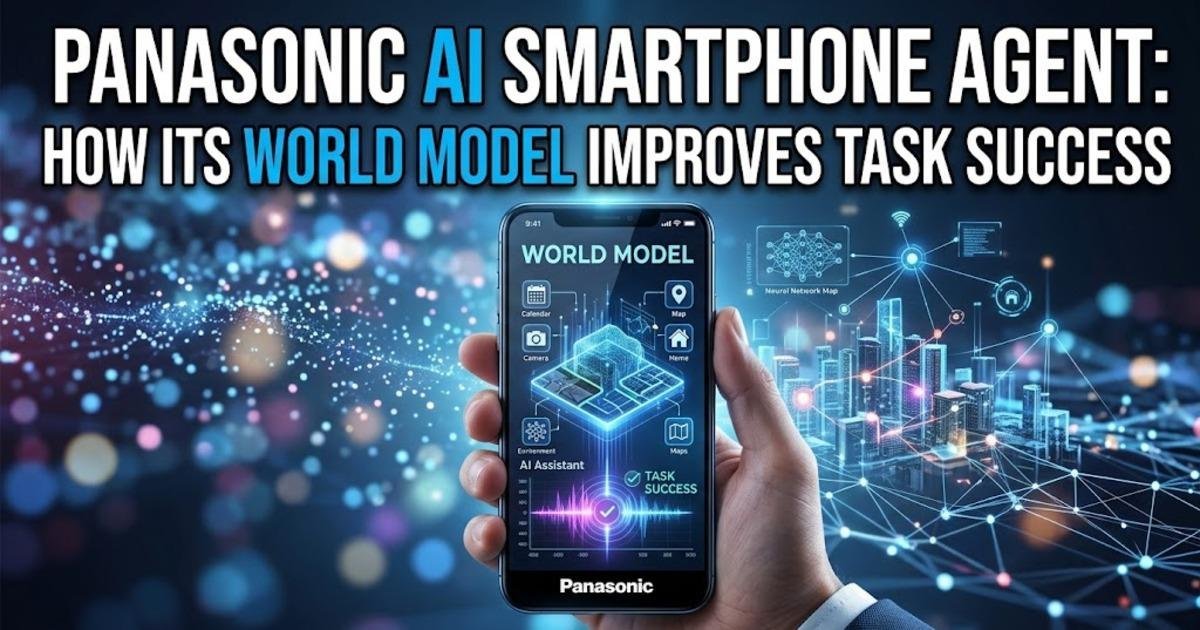
Panasonic’s AI world model predicts how smartphone screens change after an action instead of recreating every pixel. Its reported AndroidWorld task success rate rose from 46.9% to 54.3%, with real-world reliability still to be tested.
On this page
An AI assistant that taps through a smartphone can fail for a surprisingly ordinary reason: it chooses an action without reliably predicting what the screen will do next. Panasonic Holdings, Panasonic R&D Company of America and researchers at the University of California, Los Angeles, have developed a system designed to address that problem by predicting changes in plain language instead of trying to recreate every pixel on a screen. In results announced on October 21, 2026, the approach raised an AI agent’s task success rate from 46.9% to 54.3% on the AndroidWorld benchmark, a gain of 7.4 percentage points. The result offers a practical look at how AI agents might become more dependable when carrying out work across mobile apps, although it does not yet establish how well the approach performs on everyday phones.
Why smartphone agents struggle to choose the right action
Most people use a phone by looking at the screen, tapping a control and checking what happened. An AI agent has to do something similar, but it must also infer which action is likely to move it closer to a goal. A task such as opening settings, finding a particular option and changing it can require several dependent actions, and one mistaken tap can send the agent down the wrong path. The difficulty grows when the screen contains information that has little to do with the task, including notification banners, changing clocks or differences in layout.
A conventional visual world model attempts to predict what the next screen will look like. A world model is a system that learns how an environment changes in response to actions and uses those predictions to help choose what to do next. Reconstructing an entire screen, however, means accounting for many visual details that may not affect the outcome. Panasonic’s approach focuses on the meaningful change caused by an action instead: whether a settings page opens, a field appears or another relevant interface state becomes available.
How Panasonic’s AI world model predicts screen changes
Instead of generating a picture of the entire next screen, the model describes the expected result in natural language. Imagine an agent that needs to change a setting. It might consider tapping a menu, opening a search field or selecting a visible option. The world model predicts the relevant consequence of each candidate action, allowing the agent to compare those outcomes before it commits to one. This is a form of planning: the system uses an estimate of what each action will accomplish to choose the next step.
The distinction is important because the agent does not need an exact visual copy of the future screen to make a useful decision. If the task depends on whether a menu opens, the model can focus on that state change rather than predicting the status bar, notification icons and every other pixel. Natural-language predictions are not automatically correct, of course, and an inaccurate prediction can still lead to a bad action. The proposed advantage is narrower but useful: reduce the amount of irrelevant visual detail the model must predict when reasoning about mobile interfaces.
MobileWorld supplies about 1.4 million training examples
The research team built a dataset called MobileWorld from human interaction sequences on Android devices. It contains approximately 1.4 million examples in two main groups: about 942,000 descriptions of screen changes and 543,000 question-and-answer examples about subsequent states. The data records actions, screens before and after those actions, descriptions of what changed and questions that help a model reason about the resulting state. Together, these examples give a model training material for predicting what an interaction will do, rather than merely recognising the elements currently visible on a screen.
The team used a vision-language model—a system that processes images and text together—to generate and filter much of the dataset, with some examples checked manually. It then further trained Qwen3-VL-8B-Instruct, an open model with roughly eight billion parameters that can interpret images and text, using the new data. The researchers evaluated its predictions with MobileWorldBench, a benchmark designed to measure how well models describe and anticipate mobile interface changes. Panasonic reports that the model achieved the highest score among the methods compared on accuracy, completeness and relevance. That is a reported comparison within the study, not proof that the model is best across every mobile application or real-world workflow.
The benchmark result improved by 7.4 percentage points
The more practical test was whether the world model helped an AI agent finish tasks, rather than simply write better descriptions of screen changes. The team integrated the model into an agent and evaluated it on AndroidWorld, a benchmark that measures whether AI systems can complete tasks on Android devices. Without the world model, the baseline agent achieved a task success rate of 46.9%. With the model helping it predict the results of candidate actions, the reported rate rose to 54.3%.
| Evaluation setup | Reported task success | What it means |
|---|---|---|
| Baseline agent | 46.9% | Completed fewer than half of the benchmark tasks successfully. |
| Agent with world model | 54.3% | Completed more tasks successfully when action planning used predicted state changes. |
| Difference | +7.4 percentage points | About 15.8% relative improvement over the baseline rate. |
The relative improvement is calculated by dividing the 7.4-point increase by the original 46.9% success rate. In practical terms, the system moved from fewer than one successful task in two to a modest majority of tasks in this evaluation. That is a meaningful improvement for an agent that must act through a sequence of interface controls, but the remaining failure rate matters: a system that fails roughly 46 times in every 100 benchmark attempts is not ready to be trusted with every unattended workflow.
There is also a limit to what the figures establish. Panasonic’s announcement describes the benchmark results, but it does not provide an independent replication of the 54.3% result on live workplace devices. AndroidWorld is a controlled evaluation, not a guarantee of equal performance across phone brands, redesigned apps, unusual notifications or tasks involving sensitive information. The reported numbers should therefore be read as evidence that this planning technique can help under the tested conditions, not as a general reliability rating for mobile AI agents.
Where this could help people doing mobile work
Panasonic is targeting workflows in places such as manufacturing, logistics and maintenance, where employees may need to update records across several applications. A worker could, for example, need to check equipment details, confirm a spare part and update a work record. An AI agent attempting such a sequence must recognise the current interface, predict the effect of its next action and verify that it has reached the expected state. A model that helps it reason about those transitions could reduce wrong turns and repeated attempts.
The same idea could eventually apply beyond smartphones. Panasonic says the team plans to investigate websites and desktop applications as additional environments for this research. Those interfaces bring their own challenges, including dynamic pages, different permission systems and workflows that span multiple tools. The present results do not demonstrate that the method has already solved those problems; they show why predicting task-relevant state changes is a promising direction to test.
What the results do not prove yet
The model still depends on the quality of its predictions and the agent that acts on them. If the description of a screen transition is wrong, the agent may choose an action that looks sensible in its internal plan but fails on the device. Training data generated and filtered by another model can also carry errors, which is one reason manual verification and evaluation across different tasks matter. Further testing would need to establish whether the gains hold on unfamiliar apps, longer workflows and interfaces that change after an update.
Timing is another point worth separating from the announcement. Panasonic publicized the work on October 21, 2026, ahead of its presentation at the Conference on Empirical Methods in Natural Language Processing from October 24 to 29. The underlying paper, titled MobileWorldBench: Towards Semantic World Modeling For Mobile Agents, first appeared on arXiv in December 2025. The October announcement therefore highlights and presents existing research rather than marking the paper’s first publication. That distinction does not diminish the benchmark result, but it gives readers a more accurate timeline for judging the development.
The next test is whether better predictions make agents dependable
For AI agents, choosing the right action is only part of the job; they must also confirm that the action succeeded and recover when the interface behaves unexpectedly. Panasonic’s work suggests that predicting meaningful screen changes can help an agent make better choices without reconstructing the whole display. The next useful evidence will be broader evaluation, reproducible comparisons and results from real workflows where a mistaken action has a measurable cost. Until those results arrive, the 54.3% benchmark score is best treated as a research milestone—not a promise that a phone can safely run complex work on its own.
Share this post
Written by