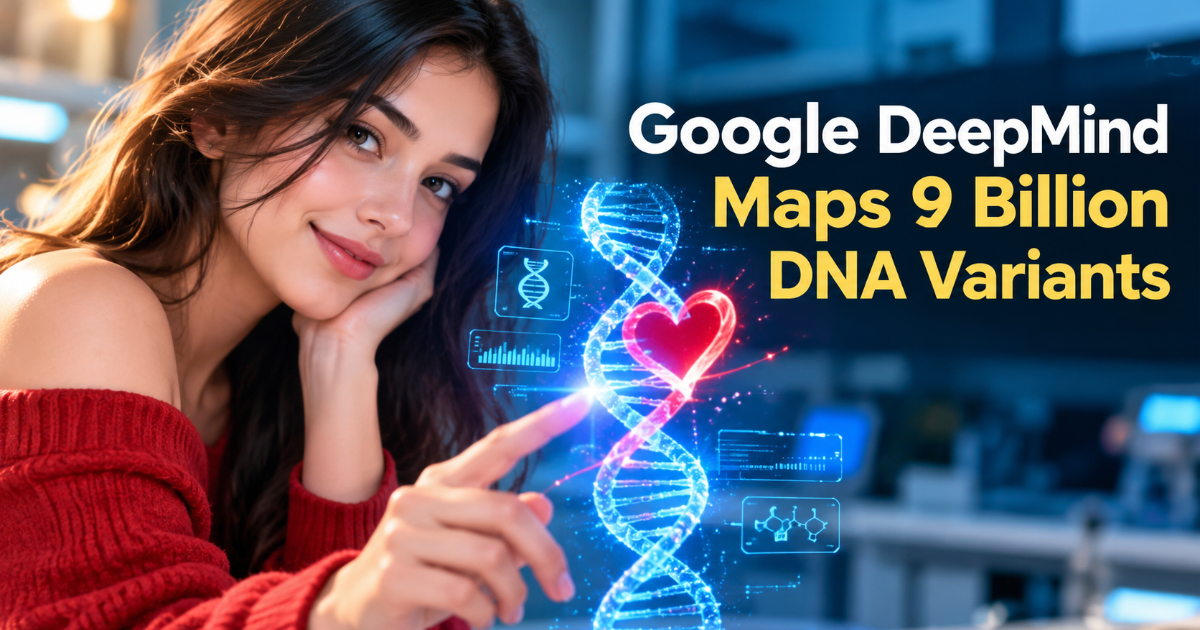
Google DeepMind Maps 9 Billion DNA Variants With AI
Google DeepMind's AlphaGenome Atlas predicts the molecular effects of roughly 9 billion possible single-letter DNA changes. Here is what the new AI dataset can do, and where researchers still need experiments.
On this page
Google DeepMind has turned one of the hardest problems in genomic research into a searchable AI dataset: AlphaGenome Atlas predicts the molecular effects of roughly 9 billion possible single-letter changes across the human genome. Released on September 8, the atlas is designed to help researchers investigate genetic variants without first running the underlying model themselves.
AlphaGenome Atlas makes billions of predictions searchable
A single-nucleotide variant is a change to one DNA letter at one position in the genome. Because the human genome contains about 3 billion DNA positions and each position can be changed to three alternative letters, there are roughly 9 billion possible single-letter substitutions to consider. DeepMind used its AlphaGenome model to calculate predictions for those variants in advance, producing a dataset of more than 1 petabyte.
That precomputation changes the practical cost of asking a question. Previously, a researcher interested in a particular variant could use AlphaGenome through an application programming interface, or API, but doing so required software and computational resources. The Atlas puts the predictions behind a searchable interface, allowing researchers to investigate variants without running the full model themselves. Nature reported that about 9,000 researchers had already accessed AlphaGenome through its API before the Atlas launch.
The important part is the 98% of DNA outside genes
The Atlas is not limited to the small portion of DNA that directly encodes proteins. About 2% of the human genome consists of protein-coding regions, while much of the remaining 98% helps regulate when and where genes are active. These non-coding regions are particularly difficult to interpret because a change can affect processes such as gene expression or RNA splicing without changing a protein's sequence directly.
AlphaGenome Atlas tries to make that regulatory information easier to investigate. DeepMind says its predictions cover effects such as gene expression, RNA splicing and chromatin accessibility, giving researchers several signals about what a DNA change might do rather than simply labeling a variant as good or bad. That makes the system more useful as a research-prioritization tool than as a simple mutation database.
AVI gives researchers a faster way to rank variants
DeepMind is also introducing the AlphaGenome Variant Impact, or AVI, score. It combines predictions from AlphaGenome with information from AlphaMissense, DeepMind's model for estimating the effects of protein-altering variants, into a single score that researchers can use to prioritize variants for further investigation.
The practical advantage is scale. A researcher studying a rare disease may have many candidate genetic changes but limited time and laboratory capacity. A ranking system can move the variants that appear most interesting toward the top of the experimental queue, reducing the amount of biological data that has to be examined manually before testing begins.
Early research shows why the atlas could matter
DeepMind says external collaborators have already used AlphaGenome Atlas to prioritize variants in unsolved rare-disease research and to identify variants associated with common traits. One example highlighted by Google involves a variant in the DNM1 gene that the system predicted could create an incorrect splice site.
Those examples are promising, but they should not be confused with clinical validation. Nature reported that researchers see the atlas as useful for scaling access to predictions while stressing that its results still need to be checked experimentally and interpreted in the context of individual cases. A prediction can help decide what to investigate; it does not by itself establish that a mutation causes a disease.
The bigger change is moving AI from a model to infrastructure
That distinction is what makes this release more interesting than another AI model announcement. DeepMind is not simply asking scientists to run a larger model. It has spent the computational effort to precompute predictions for an enormous search space and is making the resulting information easier to query. The Atlas contains more than 1 petabyte of data, which DeepMind says is over 30 times the size of its AlphaFold Database.
This resembles the broader impact of AlphaFold, where making large amounts of predicted biological structure information accessible changed how researchers could approach protein research. AlphaGenome Atlas applies a similar infrastructure idea to genetic variation: instead of repeatedly asking an AI system to calculate the likely effect of one variant, researchers can search a catalogue that has already been calculated.
Researchers still need experiments to separate prediction from biology
The atlas does not eliminate the hardest part of genetics. AI predictions are based on patterns learned from biological data, and a predicted molecular effect is not automatically an observed effect in a living organism. Tissue type, cellular context, population differences and other biological factors can influence how a variant behaves, which means researchers still need laboratory experiments and independent evidence before drawing strong conclusions.
That limitation also defines the most useful role for AlphaGenome Atlas today. It can help researchers narrow a huge search space, identify candidates and formulate hypotheses much faster, while experiments determine whether those predictions hold up in biology. If that workflow proves reliable across more diseases and populations, the value of the Atlas may come less from any single prediction and more from how quickly it lets scientists move from billions of possibilities to a manageable set of experiments.
What to watch as AlphaGenome Atlas expands
AlphaGenome Atlas is currently available for academic research through its website, with access also provided through the AlphaGenome API and Google Antigravity. DeepMind's next challenge is not simply producing more predictions but demonstrating how consistently those predictions translate into experimentally verified biological discoveries.
If researchers can repeatedly use the atlas to find important variants that conventional analysis would struggle to prioritize, it could become a practical layer of infrastructure for genomic research. The immediate breakthrough is therefore not that AI has explained every mutation. It is that scientists can now search predictions covering essentially the entire space of single-letter changes in human DNA and use those predictions to decide what deserves a closer look.
Written by