Google Antigravity AI Antibiotic Discovery: From Protein Search to Lab Testing
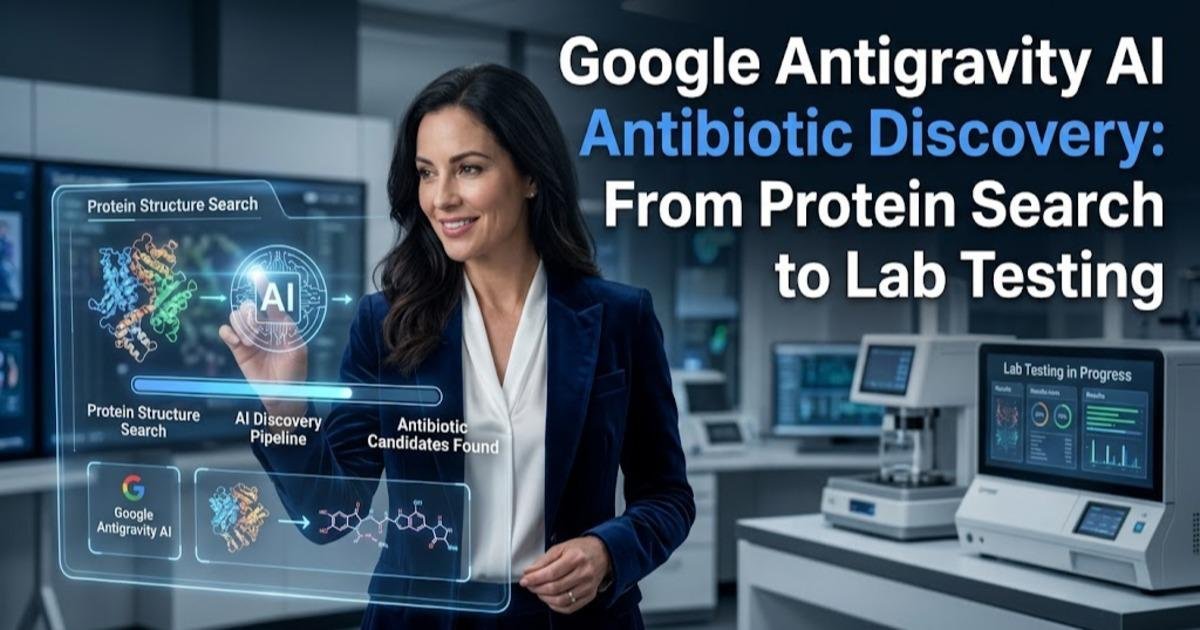
Google DeepMind used its Antigravity AI platform to identify a potential antimicrobial peptide through protein analysis, structural comparisons and genomic evidence. The candidate is now undergoing laboratory validation, where its real-world potential must be established.
On this page
Google DeepMind says researchers using its Antigravity development platform have identified a promising antimicrobial peptide hidden among previously uncharacterized bacterial proteins. The candidate, discovered through a workflow combining artificial intelligence, protein databases and structural analysis, is now undergoing laboratory validation. The result is interesting not because a computer has produced a new antibiotic ready for patients, but because it shows how AI could help scientists decide which biological discoveries deserve expensive, time-consuming experiments.
Google Antigravity brings several stages of antibiotic discovery into one workspace
In an October 15, 2026, research post, Google DeepMind described how biologists used Antigravity, an AI-assisted development environment designed to coordinate complex tasks, to investigate antimicrobial peptides. These are short chains of amino acids that can inhibit or kill microorganisms, including bacteria. Some naturally occurring antimicrobial peptides, known as bacteriocins, are produced by bacteria to compete against other microbes. Finding useful candidates is difficult because biological databases contain enormous numbers of protein sequences whose functions have not been established.
The traditional workflow can require researchers to search databases, write scripts, compare sequences, inspect three-dimensional protein structures and review scientific literature using separate tools. Antigravity brings these activities into a shared working environment where an AI agent can coordinate searches and analyses while a scientist directs the investigation. The researcher remains responsible for choosing the biological question, checking the evidence and deciding which hypotheses merit further work. This is a different use of AI from asking a chatbot to suggest possible antibiotics: the system helps carry out a chain of research tasks and connect their results.
ProtNLM helps researchers search protein sequences whose functions are unknown
The first challenge is identifying candidates worth investigating. Google DeepMind uses ProtNLM, a protein language model that predicts biological information from amino acid sequences. A protein language model works with biological sequences in a way loosely comparable to how a language model learns patterns in text, although the patterns it examines reflect protein structure, evolution and function rather than grammar alone. ProtNLM can assign functional annotations to previously uncharacterized proteins, giving researchers clues about which sequences might be biologically interesting.
The underlying resource in this workflow is UniProt, a widely used database of protein sequences and their associated biological information. A researcher cannot reasonably inspect every entry manually, particularly when many proteins lack well-established functional descriptions. AI-assisted annotation helps narrow the search by identifying sequences with characteristics consistent with a particular biological role. However, a predicted function is a research lead, not proof that a protein has the expected activity.
For the demonstration, the researchers focused on discovering antimicrobial peptides in Streptococcus pseudopneumoniae, a bacterial species associated with the human respiratory tract. The system identified a candidate belonging to the Lactococcin 972 family, with a length of 97 amino acids. That detail provides a concrete starting point for further investigation, but the sequence length and family classification alone cannot establish whether the candidate is safe, effective or useful as a medicine.
Sequence comparisons help establish whether the candidate is genuinely unusual
After identifying a promising sequence, researchers need to determine whether it resembles proteins whose functions are already understood. Google DeepMind describes using the Basic Local Alignment Search Tool (BLAST), a program that compares biological sequences to find similarities, through the European Bioinformatics Institute's search service. The team compared its candidate against Swiss-Prot, a curated collection of reviewed protein records, to investigate whether the sequence had meaningful similarities to known proteins.
The researchers reported that they found no meaningful sequence homolog among the manually reviewed proteins examined. A homolog is a protein related to another through common evolutionary ancestry, while sequence similarity is one way researchers investigate that relationship. Failure to find a close match can support the case that a candidate deserves further study, but it does not prove that the molecule has never existed or that its function is entirely new. Database coverage, the quality of existing annotations and the sensitivity of the comparison all affect what a search can establish.
This is where the AI-assisted workflow needs scientific judgment rather than simply more automation. A candidate may look unfamiliar because it belongs to an underrepresented protein family, because its sequence has changed substantially over evolutionary time, or because the database contains incomplete information. Researchers must weigh those possibilities before treating novelty as evidence of a promising discovery.
Three-dimensional structure provides a second line of evidence
Proteins do not function as flat strings of amino acids. They fold into three-dimensional shapes, and those shapes can influence how they interact with other molecules. Google DeepMind says the researchers retrieved a predicted structure for the candidate from the AlphaFold Protein Structure Database and compared it with experimentally determined structures using Foldseek, a tool for searching similarities between protein structures. This allowed the team to investigate whether the candidate's shape resembled that of a known bacteriocin, even when the sequences themselves did not provide a clear match.
The reported structural comparison supported the original functional prediction by identifying a similar fold. That matters because sequence analysis and structural analysis provide different kinds of evidence: two proteins can have substantially different sequences yet retain related shapes and biological functions. Agreement between these methods can make a hypothesis more credible than a prediction based on sequence alone. It still does not establish the candidate's antimicrobial potency, its precise mechanism of action or its effects on human cells.
Google also introduced a Biomolecular Structure Viewer within Antigravity to let researchers and the AI agent examine protein structures in the same workspace. The agent can retrieve a structure and highlight regions for investigation, while the scientist can select a residue or mark a region of interest and ask questions about its possible role. That shared visual context can reduce the friction of moving between tools, but the quality of the interpretation remains dependent on the underlying structural predictions and biological evidence.
The surrounding genes offer clues about how the peptide might work
A protein's sequence and structure do not tell the whole story. The genes around the gene that encodes a candidate can provide additional clues about its biological role, because nearby genes sometimes participate in related processes. Google DeepMind says the agent examined the candidate's genomic neighborhood and found evidence consistent with a role involving bacterial cell division. The researchers also reported a predicted activity spectrum that could include several drug-resistant pathogens.
These findings are hypotheses rather than demonstrated therapeutic effects. A predicted activity spectrum identifies organisms against which a molecule might be worth testing; it does not establish that the molecule kills those organisms in laboratory conditions. Likewise, evidence pointing towards interference with cell division does not by itself prove the precise mechanism. The next experiments must establish whether the candidate has measurable activity, which organisms respond, what concentrations are required and whether the results can be reproduced.
Genomic context can nevertheless help researchers prioritize experiments. If the candidate's predicted function, structural resemblance and neighboring genes all point towards a plausible antimicrobial role, the evidence provides a stronger reason to investigate it than an isolated computational prediction would. The same reasoning can also expose weaknesses: conflicting evidence across these sources may indicate that a candidate has been misclassified or that its biology is more complicated than the initial model suggests.
Laboratory validation is the step that determines whether the discovery holds up
Google DeepMind says the candidate, along with other peptides identified through the same workflow, is undergoing wet-lab validation. Wet-lab research involves physical experiments with biological materials rather than relying exclusively on computer simulations and predictions. The company's described follow-up work includes producing the candidate protein, measuring antimicrobial susceptibility, investigating target engagement and testing toxicity in laboratory systems. These experiments are needed to establish whether the predicted activity exists outside the computational environment.
Several questions remain open. Researchers must determine whether the candidate can inhibit or kill the intended bacteria, whether its effects extend to drug-resistant strains, and whether it harms human cells at concentrations required for activity. They also need to investigate stability, production, delivery and the possibility that bacteria could develop resistance. Even a successful initial experiment would represent an early research milestone rather than evidence that the candidate is ready for clinical trials or patient treatment.
The distinction matters because computational research and drug development have very different costs and failure points. A computer can screen many possible candidates and help eliminate weak hypotheses before researchers spend money on laboratory work. But an AI system cannot substitute for experimental evidence about toxicity, effectiveness in living organisms, appropriate dosing or clinical benefit. The value of the workflow will depend on whether its predictions consistently lead to experimentally confirmed discoveries.
AI-assisted discovery could save time without removing scientific bottlenecks
The most immediate benefit of Antigravity is the coordination of research tasks that would otherwise be spread across databases, scripts and specialist applications. Instead of manually exporting results from each tool and repeatedly reconstructing the context, researchers can direct an agent to gather evidence, compare candidates and prepare the next analysis. Google DeepMind argues that this can compress a fragmented process that might take days into a single collaborative session, allowing scientists to devote more attention to evaluating hypotheses and designing experiments.
That time-saving claim should be understood as a description of the demonstrated workflow, not as a validated measurement of overall drug-discovery speed. The company has not established in this demonstration that the approach reduces the total time required to develop a medicine, nor does the report provide a controlled comparison of discovery success rates against a conventional research team. Laboratory testing, independent replication and eventual clinical studies remain substantial sources of delay and uncertainty.
There is also a practical question about reliability. When an agent coordinates several scientific tools, an incorrect result early in the workflow can influence every subsequent decision. A mistaken annotation may lead to an unpromising sequence, a misleading structural comparison may strengthen the wrong hypothesis, and an incomplete literature search may cause researchers to overstate novelty. Scientists therefore need traceable evidence for each major conclusion, not merely a convincing final explanation generated by the system.
The next meaningful result will come from experiments, not another AI prediction
Google's demonstration shows a plausible way to combine protein-function prediction, sequence searching, structural comparison and genomic analysis into a more connected research process. The candidate is supported by several computational lines of evidence, but its biological performance remains to be established experimentally. That makes the work a promising example of AI-assisted hypothesis generation rather than a completed antibiotic discovery.
The most useful milestone to watch for is a detailed account of the laboratory results: whether the peptide demonstrates reproducible antimicrobial activity, which organisms it affects, how selective it is against bacteria rather than human cells, and whether independent researchers can confirm the findings. If those tests succeed, the workflow will have done more than make scientific software easier to use. It will have helped turn a previously obscure protein sequence into a validated starting point for further drug research.
Share this post

Written by