Google Deep Review AI Document Review: What It Can Actually Catch
Google Deep Review offers two free AI document reviews each week. Learn how its multi-stage verification pipeline works, what its research-paper trials show, and what to consider before uploading sensitive files.
On this page
Checking a long technical report for contradictions, unsupported claims, or mathematical errors can take hours, even when the person reviewing it understands the subject. Google made its Deep Review AI document review tool publicly available on October 14, 2026, offering two complimentary reviews per week and a system designed to examine complex documents in more depth than a single chatbot response. Its earlier version was tested through academic conference partnerships, but the broader release raises a practical question: how much verification can an AI reviewer provide, and where does a human still need to take over?
Google Deep Review moves beyond checking research papers
Deep Review began as the Paper Assistant Tool, an experimental system designed to help researchers find weaknesses in scientific manuscripts before submitting them to conferences. Google Research says the system was used in optional pre-submission pilots associated with STOC 2026, ICML 2026, NeurIPS 2026, and ICLR 2027, covering more than 16,000 manuscript submissions. The company has now expanded the tool's intended uses to include technical proposals, design documents, presentations, and legal or financial material. That broader scope matters because the same underlying problem appears in many kinds of work: a document can be grammatically polished while containing a faulty assumption, inconsistent figures, or a conclusion its evidence does not support.
The public launch does not mean every document type has identical support or that every claim can be independently proven. At launch, Google lists PDF files and plain text as supported input formats, with multi-file analysis planned for a later release. Its announcement describes broader use cases, but users should distinguish those intended applications from a guarantee that the system can verify every kind of document equally well. Deep Review is best understood as a structured analysis tool rather than a universal stamp of correctness.
Why a single chatbot response can miss important errors
A conventional chatbot workflow often sends a document to a model with a request such as “check this report for mistakes.” That approach can work for straightforward passages, but long documents create several problems: details may be separated by dozens of pages, a calculation may depend on an earlier assumption, and a claim in the conclusion may conflict with the methodology. A model can also accept a plausible explanation without checking whether the supporting evidence actually establishes it. Deep Review is designed around this limitation, dividing the work into smaller checks before combining their findings into a document-level assessment.
The distinction is not simply that the system uses more words or produces a longer report. Its architecture assigns different parts of the review to separate stages, allowing the system to spend more effort on dense or difficult sections. For example, a mathematical proof may need closer examination than an introductory paragraph, while a financial report may require checking whether figures and conclusions agree across sections. This process can make problems easier to locate, although additional reasoning does not guarantee that every finding is correct.
How Deep Review breaks a document into verification tasks
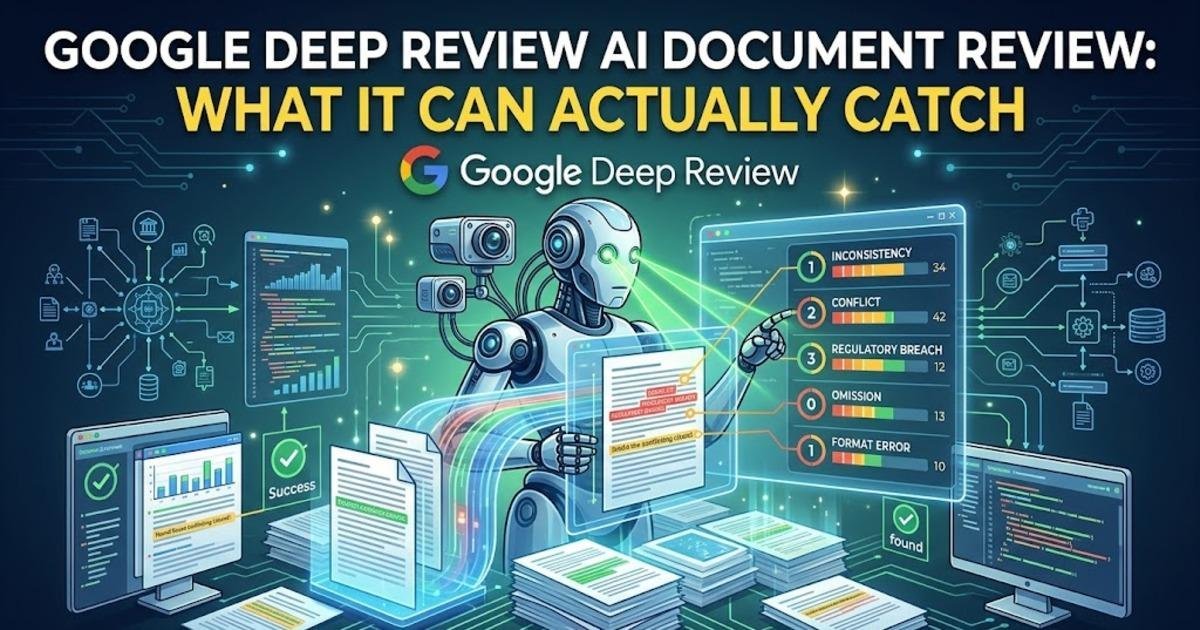
Google describes a four-stage pipeline. First, a segmentation agent divides the document into logical sections, such as the introduction, methodology, and experiments, with overlapping sections where necessary to preserve context. Next, an adaptive budgeting stage allocates computational effort according to the complexity of each section. This is intended to avoid spending the same amount of reasoning on a simple summary and a complicated proof. The approach addresses a real weakness of one-shot review: a single pass may not give every difficult part enough attention.
During the third stage, multiple specialized reasoning agents examine sections in parallel while retaining access to the wider document. That wider context matters because a statement can look reasonable in isolation but contradict a definition, result, or limitation elsewhere. Finally, a synthesis agent combines the separate findings, checks consistency between sections, and performs additional grounding checks intended to reduce unsupported conclusions. In practical terms, the output is meant to be more than a collection of proofreading comments: it should identify the reasoning behind a potential problem and help the author decide what needs closer inspection.
What the conference trials establish—and what they do not
The earlier Paper Assistant Tool pilots give Google a basis for saying the system has been used in real research workflows rather than only in demonstrations. Authors could opt in to receive feedback before their submissions, and Google says the feedback was kept separate from the conferences' official review processes. Its research paper also reports an improvement in recall for mathematical errors on the SPOT benchmark compared with a zero-shot approach, meaning a model asked to perform the task without the more elaborate review process. Recall measures how many relevant errors a system identifies; it does not, by itself, tell readers how many of the system's flagged errors are genuine.
That distinction is crucial. A tool that catches more real mistakes can still waste time by flagging correct arguments, overlooking subtle errors, or giving an explanation that sounds convincing but is wrong. The conference pilots also focused on a more specific research-paper workflow than the full range of legal, financial, and business documents described in the public launch. Google's announcement does not establish that the broader product has been independently validated to the same degree across all those fields. Readers should therefore treat the reported results as evidence of a promising review method, not proof that AI can replace an expert reviewer.
How to use Deep Review without trusting it blindly
A useful first test is a document whose claims you can independently check. A technical proposal, for example, may contain a performance estimate, an architectural assumption, and a list of edge cases. Uploading the PDF or supported text and asking for a structured review can help surface contradictions or gaps that deserve attention. Rather than accepting every criticism, compare each finding with the original passage, supporting data, and relevant technical documentation.
For a practical review, ask the system to separate factual inconsistencies, unsupported claims, mathematical or logical errors, and suggestions that are matters of style or judgement. Then work through the findings one by one, recording which issues were confirmed, which were false alarms, and which remain uncertain. If the document contains calculations, reproduce important results with a calculator or appropriate software. If it contains legal obligations or financial decisions, have a qualified professional review any consequential interpretation before acting on it.
The same discipline applies when using the tool during drafting. A review can identify a missing assumption or a weak connection between evidence and conclusion, but it cannot determine every business trade-off or decide whether an argument is strategically sound. The author remains responsible for deciding which criticism is justified, revising the document, and checking that the changes have not introduced new errors. The most useful outcome is a shorter list of specific questions for a human to resolve, not an automatic approval.
The free allowance is useful, but the data policy deserves attention
Google says each user receives two complimentary document reviews per week. People who need higher usage limits or programmatic access can connect a Gemini application programming interface (API) key for additional capacity through the Deep Review API. That makes the free tier suitable for occasional checks, such as reviewing a draft proposal or stress-testing a research paper, while heavier workflows may require a separate setup. The announcement does not provide a single universal price for every higher-volume use case, so users should check the applicable API terms before planning a recurring review process.
There is also a privacy detail that should influence which files users upload. Google says documents submitted to the public tool are not used to train, fine-tune, or improve its models, but the files are stored for one year so they can be displayed in the Deep Review interface. Not using a document for model training is not the same as deleting it immediately after analysis. Before uploading unpublished research, confidential client material, personal information, or sensitive contracts, users should check their organisation's data-handling rules and confirm that the storage arrangement is acceptable.
Deep Review is a second reviewer, not the final authority
Deep Review is most useful when the cost of missing a flaw is high enough to justify a deliberate second pass, but the document owner can still verify the findings. Researchers can use it to stress-test arguments before submission, developers can examine design assumptions, and teams can check whether a presentation's conclusions match its figures. The value will depend on the quality of the feedback in the specific field, not simply on the length of the generated report. A careful user should measure that value by confirmed errors found, false alarms, and the time saved after checking the results.
The next meaningful test is whether the public system performs consistently beyond the academic-paper setting that shaped its development. Broader document support will matter, but so will transparent evaluations showing how often it catches real problems and how often it invents them. Until that evidence is available across the advertised use cases, Deep Review is worth trying on documents that can be checked independently. For consequential decisions, the final verification still belongs to someone who understands the subject and can take responsibility for the result.
Share this post

Written by