Gemini 3.8 Flash Pushes AI Coding Into a New Tier
Gemini 3.8 Flash delivers major gains in coding and agentic tasks, with benchmark results approaching larger models while keeping Google's Flash-tier pricing.

On this page
Google released Gemini 3.8 Flash on September 2, just three weeks after Gemini 3.7 Flash, and the most revealing change is not a new chatbot feature. The model is designed to spend more effort on difficult coding and agent tasks while keeping the low-latency positioning of Google's Flash line. Early benchmark results suggest that strategy is working: Gemini 3.8 Flash reached 74% on the DeepSWE v1.1 coding evaluation, matching Claude Opus 5's score while using substantially less output and costing far less in the published test.
Gemini 3.8 Flash is built to work through longer tasks
The key change is how Gemini 3.8 Flash handles complicated jobs. Google says the model can perform more reasoning steps and call tools repeatedly, allowing it to break a difficult task into smaller actions rather than trying to produce an answer in one pass. An AI agent is a system that can use tools and take multiple actions toward a goal, so this behaviour matters more for software development and research workflows than for ordinary question-and-answer chat. Google's model card also confirms support for function calling, search and computer use, alongside a context window of up to 1 million tokens.
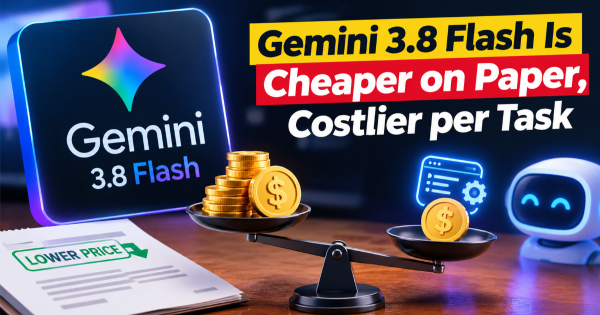
That extra work comes with a trade-off. Google has kept Gemini 3.8 Flash's introductory price at $0.75 per million input tokens and $3.75 per million output tokens, the same rates it announced for Gemini 3.7 Flash. But the company warns that higher effort settings can consume more tokens, meaning a developer paying the same rate per token can still spend more on a completed task. Independent analysis of the launch found roughly 30% more output tokens per task in its evaluations and an overall increase in task cost, showing why the price displayed on an API page does not necessarily equal the cost of getting a job finished.
The coding results are stronger than the headline price suggests
DeepSWE v1.1 is particularly useful here because it tests long-horizon software engineering rather than simple code completion. The evaluation gives an AI a substantial engineering problem and measures whether it can plan and execute the work through multiple steps. In the September 2 snapshot, Gemini 3.8 Flash scored 74% with an average measured cost of $2.36, while Claude Opus 5 also scored 74% at $11.84 and GPT-5.6 Sol scored 73% at $6.46. Those figures come from the benchmark's published runs, not Google's marketing material, although benchmark results still should not be treated as a prediction of every developer's real-world experience.
Terminal-Bench 2.1 provides another useful signal. It measures how well an AI can operate in a command-line environment, where completing a task can require running commands, inspecting files and recovering from mistakes. Gemini 3.8 Flash recorded 89.4% on the provider-run 2.1 leaderboard and ranked first in that particular snapshot. That result is impressive, but the benchmark itself has since moved to version 4.0, whose task resources and evaluation setup are different, so the older 2.1 score should not be compared directly with newer 4.0 results.
Google is targeting agents rather than just chat
The benchmark pattern explains why Google is emphasizing agentic work. Gemini 3.8 Flash is not being positioned merely as a faster model for answering prompts; Google describes it as a workhorse for software engineering, autonomous agents and multi-step reasoning. The model supports text, images, audio and video as inputs, giving an agent more ways to understand the material it needs to work with. That combination makes the model relevant to workflows where the AI has to inspect information, use a tool, evaluate the result and continue rather than stop after generating text.
There is an important distinction between being able to use tools and being reliably autonomous. A benchmark can demonstrate that a model completes a defined set of tasks, but production software has less predictable inputs, permissions, broken dependencies and expensive mistakes. Gemini 3.8 Flash's stronger benchmark scores therefore show that its capabilities have improved; they do not prove that developers can safely hand it an unrestricted software project and walk away.
The model is fast because Google is not treating reasoning as all-or-nothing
Google's Flash strategy has always been about getting a useful level of intelligence without the latency associated with its largest models. Gemini 3.8 Flash keeps that positioning while adding configurable effort levels, allowing developers to choose how much reasoning the model should apply. In practical terms, an easy request can remain relatively lightweight while a difficult coding problem can receive more computation. The model card describes this as a way to control the balance between quality, cost and latency.
That flexibility may matter more than a small improvement in a single benchmark. AI applications increasingly run thousands or millions of model calls, and not every call deserves the same amount of computation. A system that can reserve deeper reasoning for the hard cases can potentially keep routine work quick while spending more resources only when the task justifies it. The catch is that developers need good routing and effort settings; otherwise, the model's ability to think longer can quietly become a larger bill.
Gemini 3.8 Flash is not winning every test
The strongest results are concentrated in particular workloads. Independent benchmark tracking shows Gemini 3.8 Flash at 59% on OSWorld 2.0, an evaluation of an AI operating a computer through real applications, compared with a 70.6% best verified score from Claude Opus 5 in the same tracker. On Terminal-Bench 4.0, Gemini 3.8 Flash is listed at 19.1%, well below the 60.9% score recorded for Claude Mythos 5.1. These results are a useful reminder that an AI model can lead one benchmark and lag badly on another because the tasks and required capabilities differ.
That makes Google's claim that Gemini 3.8 Flash is its best Flash model easier to interpret. The evidence supports a substantial improvement for coding, agentic work and several specialized reasoning tasks, but it does not establish universal superiority. Developers choosing a model still need to test the exact workload they care about, particularly if that workload involves computer control, long-running automation or tools outside the model's strongest benchmark categories.
The rapid release schedule is part of the story
Gemini 3.8 Flash arrived only weeks after Gemini 3.7 Flash, which itself followed earlier Flash releases. Google says the new model is the third Flash release in six weeks. That pace suggests the company is treating the Flash family as a continuously improving production line rather than waiting for infrequent, major model generations. For developers, that can mean faster capability improvements, but it also creates a moving target for applications whose behaviour depends on a specific model version.
The immediate availability is broad. Google says Gemini 3.8 Flash is available through the Gemini API, Google AI Studio, Android Studio, Google Antigravity and Gemini Enterprise, while consumers with Google AI Pro or Ultra subscriptions can access it through supported Gemini products. The introductory API pricing lasts through December 31, 2026; Google says the rates will rise to $1.50 per million input tokens and $7.50 per million output tokens from January 1, 2027.
What developers should watch next
The most interesting question is no longer whether Gemini 3.8 Flash can post a high benchmark score. It is whether its ability to reason longer and use tools repeatedly translates into fewer human interventions on real projects. A model that finishes a complicated coding task with fewer retries can be more valuable than one that merely generates code faster, while a model that consumes excessive tokens or needs frequent correction can erase its apparent price advantage.
For now, the evidence points to a model that has moved the Flash class closer to the performance traditionally associated with much larger systems. Gemini 3.8 Flash is particularly compelling for developers building coding agents and other multi-step workflows, but its results are uneven across evaluations and its deeper reasoning can increase actual usage. The next meaningful test will be sustained production use: whether developers can give it harder jobs, let it run for longer, and spend less time fixing what it did afterward.
Written by