SMBC Nikko DeFi Gateway: How Uniswap v4 Hooks Could Add Compliance
SMBC Nikko and four partners are developing a Japan-focused DeFi Gateway on Uniswap v4. Here is how hooks could put compliance controls directly into liquidity pools.
On this page
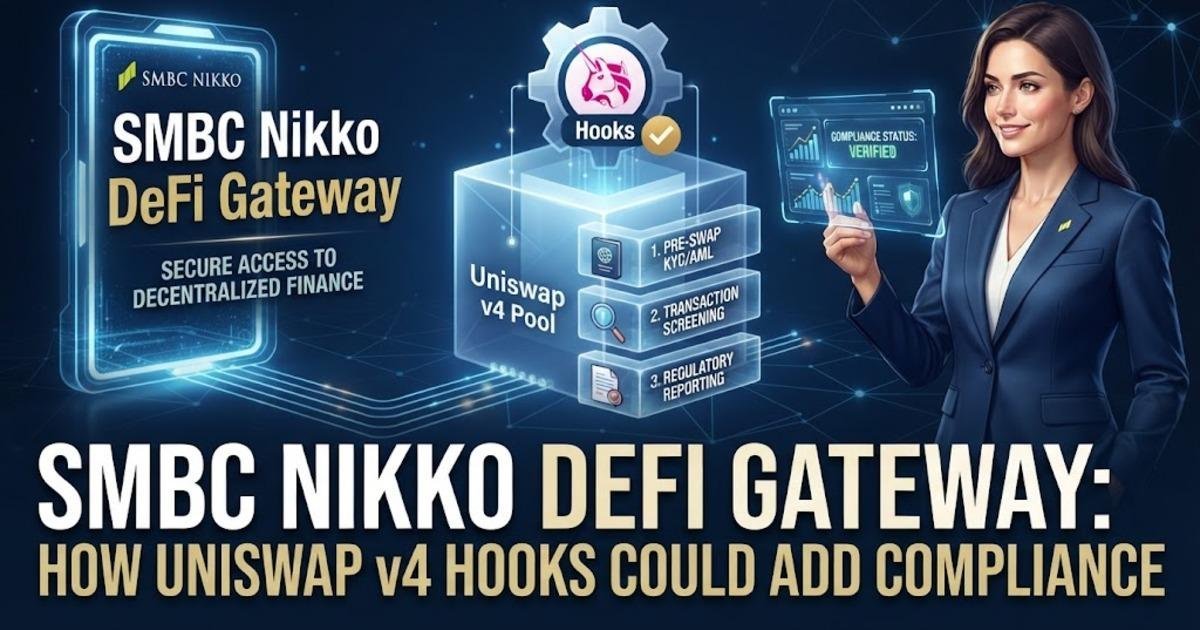
The SMBC Nikko DeFi Gateway moved from a two-company research idea to a five-party development project on October 2, with SMBC Nikko and Nethermind joining Uniswap Labs, Base and Nyx Foundation to build controlled access to decentralized finance for Japanese investors. The target is mid-2027, so there is no public product to use yet and no announced regulatory approval. The interesting part is the proposed architecture: compliance rules would sit inside Uniswap v4 liquidity pools through hooks rather than being enforced only by a website or another layer outside the pool.
The project is trying to solve a specific problem with DeFi access
Traditional financial firms can impose eligibility, risk and regulatory controls before a customer reaches a market, while open DeFi protocols are designed to let anyone interact with compatible pools and contracts. SMBC Nikko and Nethermind first announced their work in March 2026 around bringing Japanese investors into onchain finance through automated market makers, or AMMs, which are liquidity pools that let users trade without a conventional order book. The October agreement expands that research into a defined DeFi Gateway covering liquidity provision, custom pools and investor-facing interfaces. That shift matters because the project is no longer just testing whether institutional capital can interact with DeFi; it is exploring where the controls should live when that interaction happens.
Uniswap v4 hooks provide the proposed compliance layer
A Uniswap v4 hook is a smart contract attached to a pool that can run custom logic at specific points in the pool's lifecycle, such as before a swap or when liquidity is added. That makes hooks different from a normal front-end restriction: the relevant check can execute as part of the transaction itself. Uniswap's existing Permissioned Pools work this way by checking whether wallets are approved before allowing swaps or liquidity actions involving permissioned assets. The SMBC Nikko project proposes using the same underlying mechanism to build pools with anti-money laundering, counter-terrorist financing and investor-protection controls, although the final implementation has not yet been disclosed.
Why putting rules inside the pool changes the design
Consider the difference between a website that blocks an unapproved user and a pool that rejects the user's transaction. A website can refuse to display a trading interface, but another application can potentially interact with the underlying contracts directly if the contracts themselves impose no restrictions. With a hook-based design, the compliance decision becomes part of the pool's execution path, so an unauthorized swap or liquidity action can be rejected by the onchain logic. Uniswap's permissioned-pool documentation already separates permission to swap from permission to provide liquidity, showing that the architecture can apply different checks to different actions.
The first assets are planned broadly, not specifically
The October agreement does not announce a particular token that will launch through the gateway. Instead, the participants say they will develop asset-deployment strategies covering digital assets including stablecoins, which are tokens designed to maintain a relatively stable value against a reference asset, and real-world assets, or RWAs, which represent claims on assets or financial instruments outside the blockchain. That leaves considerable room for the eventual design to change as technical and regulatory work progresses. It also means readers should not interpret the announcement as confirmation that a particular Japanese security, stablecoin or investment product will become available through Uniswap.
AI is part of the gateway, but it is not replacing the controls
The proposed system also includes what the companies call agentic vaults and investor interfaces powered by verifiable and reproducible artificial intelligence. In this context, an agentic system means software that can assist with or execute predefined investment actions rather than merely displaying information. SMBC Nikko says these systems are intended to help onboard investors, while Nethermind is responsible for AI strategy and integration alongside engineering and smart-contract security. The distinction matters because the project places AI alongside the compliance architecture rather than describing AI itself as the mechanism that determines whether a transaction is permitted.
Five organizations now have different jobs to make the system work
SMBC Nikko is leading regulatory discussions and contributing expertise in compliance, risk modeling and portfolio management, while Nethermind is leading technical design and delivery. Uniswap Labs is providing protocol-integration and liquidity-deployment expertise, and Base is supporting deployment in its Ethereum Layer 2 ecosystem along with technical work around x402-related infrastructure. Nyx Foundation is advising on market-making strategies and hook structures. This division is significant because the proposed gateway combines responsibilities that normally sit in separate areas: regulation, smart-contract engineering, liquidity management and investor-facing infrastructure.
The mid-2027 date is a development target, not a launch date
SMBC Nikko's announcement says the DeFi Gateway is expected to be completed by mid-2027, with development progress shared with Japan's Financial Services Agency as discussions about the country's DeFi regulatory framework continue. The announcement does not say that the Financial Services Agency has approved the proposed product, nor does it provide a public launch date or final customer eligibility rules. That makes the current project better understood as infrastructure development than as a new Japanese DeFi service available today. The roughly nine-month-to-mid-2027 window also leaves substantial time for the technical design, compliance rules and supported assets to change before anything reaches users.
What still has to be proven before the gateway can matter
The hardest questions are now implementation questions rather than whether Uniswap v4 can technically run custom pool logic. The participants still need to demonstrate how identity checks, investor eligibility, market-making rules and investor protections interact without creating failure points that prevent legitimate trades. They also need to establish who controls the compliance rules, how those rules are updated, what happens when a regulated user's status changes, and how disputes or operational failures are handled. None of those details are settled by the memorandum announced on October 2, so the eventual design will be more informative than the partnership itself.
The next milestone is the architecture, not the announcement
For blockchain developers, the project provides a concrete example of how an established DeFi protocol can be adapted for a market where unrestricted access is not sufficient. For financial institutions, it shows a route in which compliance logic can be attached to the same liquidity infrastructure used for onchain trading rather than recreated entirely outside it. The next useful evidence will be a working pool, published hook specifications, identified assets and clearer rules for who can interact with them. Until those pieces appear, the SMBC Nikko DeFi Gateway remains a development project with a mid-2027 target, not a live Japanese investment venue.
Share this post