
JPY DeFi Tutorial: Borrow JPYdf Against USDC or wstETH
Learn how JPY DeFi lets eligible users borrow JPYdf against USDC or wstETH on Ethereum. This guide covers wallet preparation, collateral deposits, borrowing, liquidation risk, repayment, and redemption.
On this page
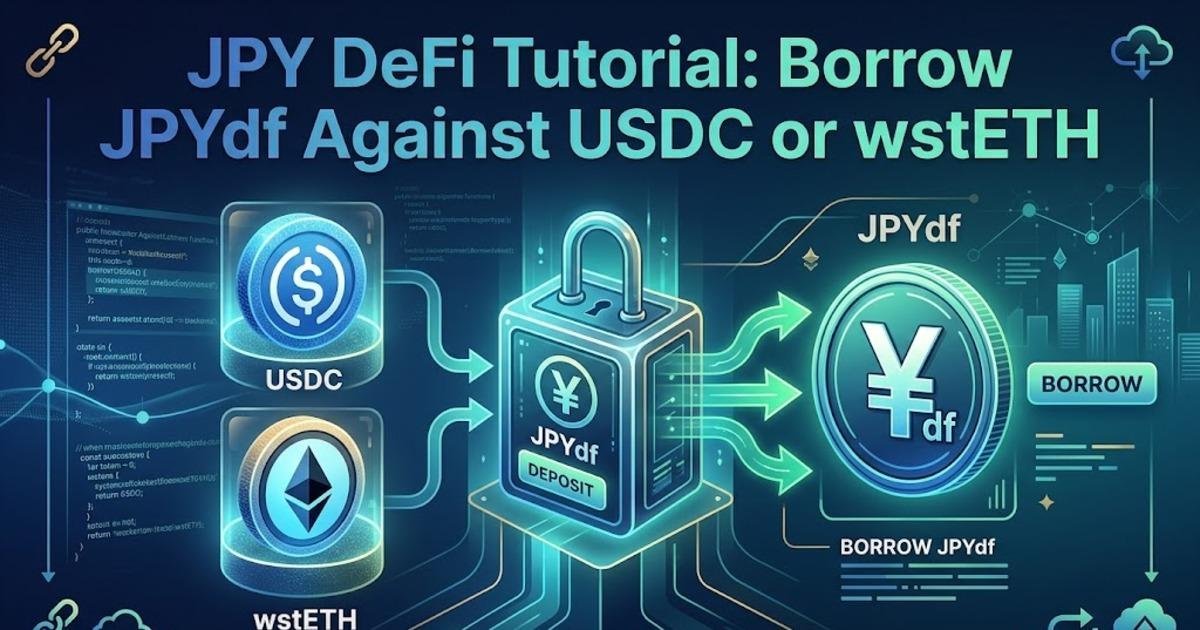
JPY DeFi went live on Ethereum mainnet on October 15, 2026, giving eligible users a new way to borrow a yen-targeted crypto asset without selling their existing holdings. The protocol accepts Wrapped Staked Ether (wstETH), a token representing staked Ether in wrapped form, or USD Coin (USDC), a dollar-linked stablecoin, as collateral for borrowing JPYdf. This JPY DeFi tutorial walks through the borrowing process, the checks to make before approving transactions, and the risks that come with a new lending protocol.
Understand what JPYdf does before borrowing it
JPYdf is designed to track the value of the Japanese yen, with a reference target of ¥1 per token. Unlike a bank balance denominated in yen, however, holding JPYdf does not give you a claim to Japanese yen or a guaranteed right to redeem each token for one yen. Its market price can move above or below the target, and neither price stability nor preservation of principal is guaranteed.
JPY DeFi is a decentralized finance (DeFi) protocol, meaning that financial operations are handled through blockchain software rather than relying solely on a conventional financial intermediary. Its borrowing system uses collateralized debt positions: a user deposits assets into a smart contract and borrows tokens against their value. The protocol is based on a modified version of Liquity v2, according to its documentation, but that relationship should not be treated as proof that the new deployment has the same risk profile as another protocol.
The launch announcement identifies two separate collateral markets: one for wstETH and another for USDC. Each market has its own rules and risk characteristics, so the asset you deposit determines which branch of the protocol you use. If the value of your collateral falls far enough relative to your debt, your position can be liquidated, meaning some or all of the collateral may be used to resolve the outstanding borrowing.
Check eligibility and prepare an Ethereum wallet
Before connecting a wallet, read the protocol's current terms and confirm that you are permitted to use its interface. The launch announcement says the frontend is unavailable to restricted persons, including people located in Japan and the United States, sanctioned persons, and people in other excluded jurisdictions. These restrictions are determined by the full terms, not just by the examples in the announcement. Do not attempt to bypass regional restrictions with a virtual private network or another location-masking method.
You will need a compatible Ethereum wallet, access to the Ethereum mainnet, and enough ETH to pay network transaction fees. You also need the collateral asset you intend to deposit: wstETH or USDC. A transaction fee, often called gas, is paid for processing a transaction on Ethereum and is separate from the collateral you supply or the JPYdf you borrow.
Use the frontend identified by the official project announcement and check that the address and branding match the project's published documentation before connecting. Never follow a sponsored search result, unsolicited direct message, or social post that asks you to connect your wallet to a similarly named site. A malicious interface can imitate a real borrowing page and request permissions that expose your assets.
Choose the correct collateral market
Once you have confirmed eligibility and opened the verified interface, select the market that matches the asset in your wallet. Choose the wstETH branch if you plan to deposit wstETH, or the USDC branch if you plan to deposit USDC. The two branches are independent, so do not assume that a displayed collateral ratio, liquidation threshold, or other parameter in one market applies to the other.
Before proceeding, review the current market parameters shown by the protocol and compare them with the official documentation. In particular, identify the minimum collateral requirement, liquidation conditions, borrowing costs, and any fees that apply to your position. Do not rely on figures from an older tutorial or a screenshot, because protocol parameters and interface details can change.
If you are new to collateralized borrowing, begin by understanding the amount you could lose if the collateral price changes. Depositing collateral does not make the loan risk-free, and the protocol's target price for JPYdf does not guarantee that you can sell the borrowed tokens at that price. A position that appears comfortably collateralized at the time of deposit can become vulnerable after a market move.
Deposit collateral and confirm the transaction
After selecting the correct branch, choose the deposit or collateral action and enter the amount you intend to supply. Review the token, amount, network, destination contract, and estimated gas fee in your wallet before approving the transaction. If the interface requests a token allowance, that permission authorizes a smart contract to transfer a specified amount of the token; approve only the permission needed for your intended action and understand whether it is limited or unlimited.
Confirm the deposit transaction and wait for it to be included on Ethereum. Check the transaction status in your wallet or a trusted blockchain explorer, then verify that the protocol interface reflects the collateral in your position. If the transaction fails or the balance does not update, investigate the transaction result before submitting it again. Repeated approvals without understanding the first transaction can create unnecessary costs or grant permissions you did not intend.
Keep enough ETH in the wallet for subsequent actions, including borrowing, repayment, or collateral management. A wallet with all of its ETH committed elsewhere may leave you unable to respond quickly if your position approaches liquidation. This matters especially when market volatility raises the urgency of a transaction and network fees increase.
Borrow JPYdf conservatively and inspect the position
With collateral deposited, use the borrowing control for the selected branch and enter an amount within the protocol's current collateral requirements. The interface should display the resulting position details before you confirm. Check the estimated debt, collateral ratio, fees, and any interest or borrowing-rate information that applies. If the interface does not clearly show the terms of the transaction, stop and consult the current documentation rather than approving it blindly.
The collateral ratio compares the value of the collateral with the debt secured by it. A higher ratio generally provides more room for a fall in collateral value before liquidation becomes possible, while borrowing close to the permitted limit leaves less room for market movement. For example, if collateral is worth less after a price decline but the amount owed has not fallen by the same amount, the position becomes less protected. This is why borrowing the maximum available amount can be much riskier than borrowing only what you can manage.
Confirm the borrowing transaction in your wallet and wait for its result. Then check that the JPYdf balance has arrived and that the protocol records the expected debt. Keep a record of the transaction hash, the collateral deposited, the amount borrowed, and the displayed position metrics so you can compare them during later reviews.
Monitor liquidation risk after the transaction
Opening a position is not the end of the process. The value of wstETH can change with the price of Ether and the market value of the wrapped staking token, while USDC can also trade away from its intended dollar value. If the collateral value declines or the debt becomes larger relative to it, the position may cross the protocol's liquidation threshold. Liquidation can result in a loss of collateral, and it is not the same as a routine repayment.
Check the position regularly and leave a buffer between its current collateral ratio and the liquidation threshold. If the margin becomes too small, possible responses may include adding eligible collateral or repaying part of the debt, provided those actions remain available and you can afford them. Do not assume that a transaction will execute instantly during market stress, and do not rely on alerts as your only means of monitoring the position.
Also consider the risks that are not visible in the collateral ratio alone. JPYdf can trade away from its yen target, smart contracts can contain vulnerabilities, price oracles can fail, and the protocol's collateral and redemption mechanisms can behave differently under stress. The project's own announcement identifies these as relevant risks; the existence of a working interface is not evidence that those risks have disappeared.
Understand how repayment and redemption differ
Repayment reduces or clears the debt associated with your borrowing position. Before submitting a repayment, confirm which token the protocol requires, how much is needed to repay the intended amount, and whether the transaction also changes your collateral balance. After the transaction is confirmed, check that the debt shown in the interface has decreased as expected. Keep some ETH available for the transaction fee even if you hold enough JPYdf to repay.
Redemption is a different mechanism. According to the JPY DeFi documentation, normal redemption exchanges JPYdf for collateral using a reference of ¥1 per JPYdf before fees and the protocol's redemption price. The actual result depends on the applicable fees and collateral exit conditions, so the reference price should not be mistaken for a guaranteed cash-out value. Redemption also does not mean that the protocol promises to send Japanese yen to a bank account.
Before relying on repayment or redemption to manage risk, read the current rules for the selected collateral branch and confirm that the operation you need is available. If you intend to exit a position, account for transaction fees, possible price movement, and the time needed for blockchain confirmation. Avoid assuming that a position can always be closed immediately at a predictable price.
Use a checklist before committing funds
Because JPY DeFi launched only recently, users should be especially careful not to confuse the existence of a live mainnet deployment with a long operating history. Before depositing meaningful value, check the current documentation, contract information, available security disclosures, and any independent assessments you can verify. An audit, if one is available, is evidence about a particular scope of reviewed code and does not guarantee that every contract, configuration, oracle, or future change is safe.
- Confirm that the official interface is available to you under its current terms.
- Verify that your wallet is connected to Ethereum mainnet and that you selected the intended collateral branch.
- Review current collateral requirements, borrowing costs, liquidation conditions, and redemption fees.
- Check each wallet approval and transaction before signing it.
- Borrow less than the maximum allowed if you cannot tolerate a sudden decline in collateral value.
- Keep ETH available for repayment, collateral adjustments, and other emergency actions.
- Record your transaction hashes and monitor the position after opening it.
Start by reading the official documentation for the exact branch you intend to use and checking the current terms before connecting your wallet. If any material parameter, contract address, fee, or permission is unclear, postpone the deposit until you can verify it. In a collateralized protocol, understanding how to exit is just as important as knowing how to borrow.
Share this post
Written by