
Googlebook Laptops Arrive October 5: What Buyers Need to Know
Googlebook laptops are reaching more markets on October 5. Here is what the five launch models cost, how Android integration works, and who should consider buying.
On this page
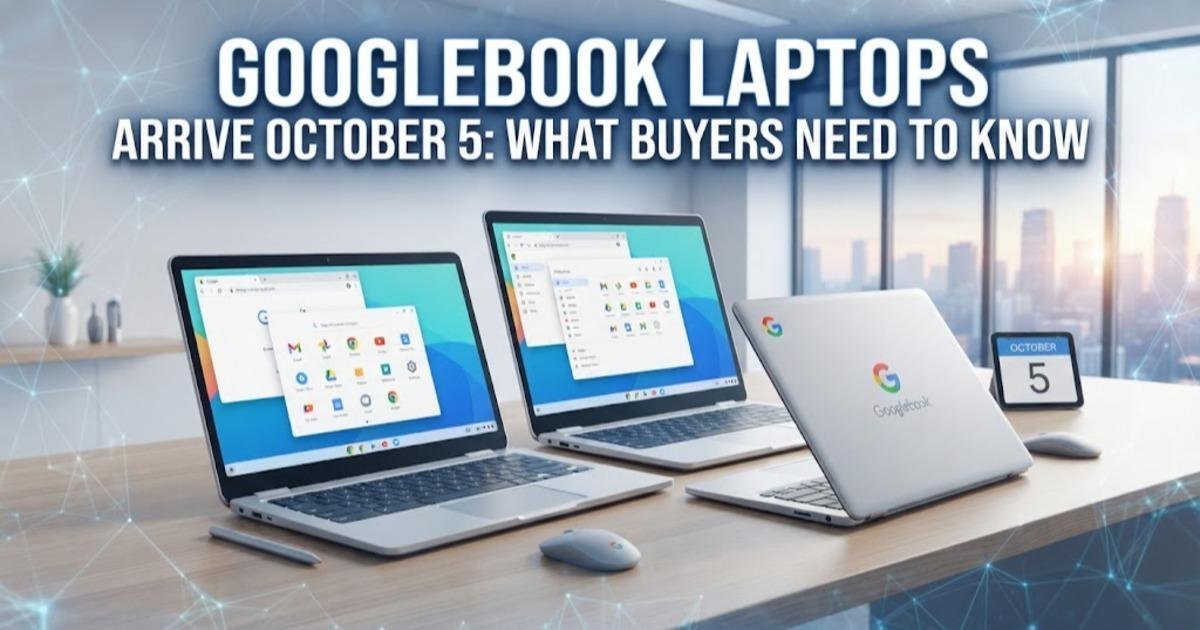
Googlebook laptops are reaching stores today, October 5, in Canada, the U.K., Ireland, France, Germany and Australia, one day after the U.S. launch. The five machines from Acer, ASUS, Dell, HP and Lenovo start at $899, but that headline price applies only to the entry-level Acer model; the other launch systems climb as high as $1,299.
That makes Googlebook more than another Chromebook refresh. Google is using a new laptop platform built on Android technology with desktop foundations from ChromeOS, then adding deeper Android-phone integration, Gemini features and premium hardware. The interesting question for buyers is not whether these machines are faster than old Chromebooks, but whether Google's new software experience is compelling enough to justify premium-laptop prices.
Googlebook starts as five different laptops, not one Google machine
Google is not selling a single first-party Googlebook. Instead, Acer, ASUS, Dell, HP and Lenovo are supplying the launch hardware while Google provides the operating-system platform and core software experience. The five launch models cover different priorities: Acer targets the lowest entry price with a convertible design, Dell focuses on a compact Snapdragon-based system, HP offers another Snapdragon option, while ASUS and Lenovo use Intel processors and emphasize premium displays and lightweight designs.
| Model | Starting price | Processor platform | Display |
|---|---|---|---|
| Acer Googlebook 14 | $899 | Intel Core Ultra Series 3 | 14-inch 2.8K OLED touchscreen |
| Dell XPS Googlebook | $1,199 | Qualcomm Snapdragon X Elite | 13.4-inch 2.5K touchscreen |
| HP Googlebook 14 | $1,299 | Qualcomm Snapdragon X Elite | 14-inch 2.8K OLED touchscreen |
| Lenovo Googlebook 15 | $1,299 | Intel Core Ultra Series 3 | 15.3-inch 2.8K OLED touchscreen |
| ASUS Googlebook 14 | $1,299 | Intel Core Ultra Series 3 | 14-inch 3K OLED touchscreen |
Every launch model starts with at least 16GB of memory, while selected configurations reach 32GB. Google also says the platform can deliver up to 14 hours of video playback or 16 hours of web browsing, although those are company figures rather than a common independent battery test across all five machines.
The real reason Googlebook exists is Android phone integration
Google is betting that an Android phone should feel like part of the laptop rather than a separate device sitting beside it. During setup, Googlebook can bring over information such as saved passwords, Wi-Fi networks, settings and messages from an Android phone. Other features are designed to let users continue tasks, access phone files and run supported phone applications from the laptop.
That approach gives Googlebook a much clearer purpose than simply offering another operating system. Apple has spent years making the iPhone and Mac feel like parts of one system, while Windows users can use Microsoft's phone integration and Android vendors provide their own cross-device tools. Google is trying to make that relationship a defining part of the laptop itself, which could be particularly useful for someone who already spends most of the day inside Google's services and Android apps.
Googlebook keeps desktop Chrome instead of turning laptops into giant phones
The software is not simply Android stretched onto a large screen. Googlebook includes a full desktop Chrome browser with extensions, access to Android applications through the Play Store and a Linux terminal for users who need development tools. Google also lists desktop applications such as Adobe Photoshop, Adobe Lightroom and CapCut among the software available on the platform.
That combination is important because the premium pricing would be difficult to justify if Googlebook were limited to mobile-style applications. Developers can also use Google's Antigravity development platform and a full terminal environment, including tools such as Claude Code and Antigravity CLI. The result is intended to cover ordinary browser work, Android applications and more traditional development workflows on one machine rather than forcing the buyer into a browser-only model.
Gemini is built into the laptop experience, but the hardware still matters
Googlebook's artificial intelligence features are tied closely to Gemini, Google's AI system. Google highlights tools such as Magic Pointer and other features intended to understand what is on screen or help users create and organize information. The launch hardware also includes neural processing units, or NPUs, dedicated to running certain AI workloads locally; Google says the launch processors provide more than 45 trillion operations per second of on-device AI performance.
The distinction between local and cloud processing matters. A local AI workload can use the laptop's own processor rather than sending every operation to a remote server, potentially reducing latency and allowing some capabilities to work without a constant server round trip. It does not mean every Gemini feature runs locally, however, and Google's headline NPU figure is a hardware capability rather than proof that every AI task will be faster in everyday use.
The $899 price hides a much bigger jump between models
The entry price looks aggressive until the lineup is viewed as a whole. Acer's $899 Googlebook 14 is $300 cheaper than Dell's $1,199 XPS Googlebook, while the HP, Lenovo and ASUS launch models begin at $1,299. That means a buyer who wants a different chassis, processor platform or display can quickly move from Chromebook territory into the same broad pricing range as premium Windows laptops and MacBooks.
Google is partly offsetting that cost with bundled services. Each Googlebook purchase includes 12 months of Google AI Pro, which includes 5TB of cloud storage and expanded Gemini access, along with additional promotional subscriptions. Google's published offer terms say the AI Pro promotion is available to eligible buyers in selected countries and that the subscription becomes chargeable after the promotional period unless it is canceled.
The $899 figure is a starting price, not the price of the Googlebook lineup. Before comparing Googlebook with another laptop, compare the exact model, processor, memory, storage and display configuration.
The long software-support promise could matter more than Gemini
Google says Googlebook OS will receive feature drops and updates for up to 10 years. That is significant for a premium laptop because software longevity changes the economics of buying an expensive machine: a device that remains supported for many years does not have to be replaced simply because its operating system reaches the end of its update cycle.
The promise also gives Googlebook a way to distinguish itself from the short replacement cycles that can make older consumer hardware feel abandoned. It is still a promise about future support, not evidence that every component will remain useful for a decade. Battery wear, application requirements and processor performance will eventually matter even if Google continues delivering operating-system updates.
Googlebook's security design is closer to ChromeOS than a typical Android device
Google has retained several security ideas associated with ChromeOS rather than treating the laptop as a large Android tablet. The company says Googlebook uses a Google Titan hardware root of trust, defense-in-depth protections and on-device malware detection. It also includes a Level 5 security-certified protected kernel-based virtual machine, or pKVM, hypervisor that isolates a Linux environment from the main operating system.
For ordinary buyers, the practical benefit is that the Linux development environment is designed to be isolated rather than simply becoming another unrestricted part of the desktop. That is particularly relevant for developers who may download code, install command-line tools or run autonomous agents. Googlebook is therefore trying to retain the security model that helped ChromeOS build its reputation while opening the platform to more demanding desktop workloads.
Who should buy a Googlebook now
The strongest case is an Android phone owner who wants a premium laptop and values having the two devices work together. Googlebook makes more sense for that buyer than for someone who only wants the cheapest laptop for web browsing, because the platform's biggest differentiator is its connection to Android rather than raw hardware alone. The $899 Acer also gives curious buyers a lower entry point, although its specifications and form factor differ substantially from the $1,199 and $1,299 alternatives.
Buyers who depend on specialized Windows or macOS software should be more cautious. Googlebook has desktop Chrome, Android applications and Linux tools, but compatibility with a specific professional application is still a separate question from whether the operating system looks capable on paper. The safest choice is to check the applications, peripherals and workflows that matter before paying premium-laptop money.
October 5 is the first real test of Google's laptop strategy
The U.S. launch has already begun, while today's wider rollout puts Googlebook in front of buyers across several additional markets. What happens next will depend less on the launch specifications than on whether people keep using the Android integration after the novelty wears off, whether Android applications behave well on larger screens and whether the premium hardware feels worth the price. Early hands-on coverage has established that the hardware is a substantial step beyond traditional budget Chromebooks, but long-term reviews will tell us more about battery life, software compatibility and day-to-day reliability.
Google has made its bet clear: the next step beyond a Chromebook is not simply a faster Chromebook, but a laptop built around Android, Gemini and premium hardware. The first five machines are now reaching customers, so the useful test begins with what happens after the unboxing—whether Google's phone-first idea actually makes everyday laptop work simpler enough to justify the price.
Written by