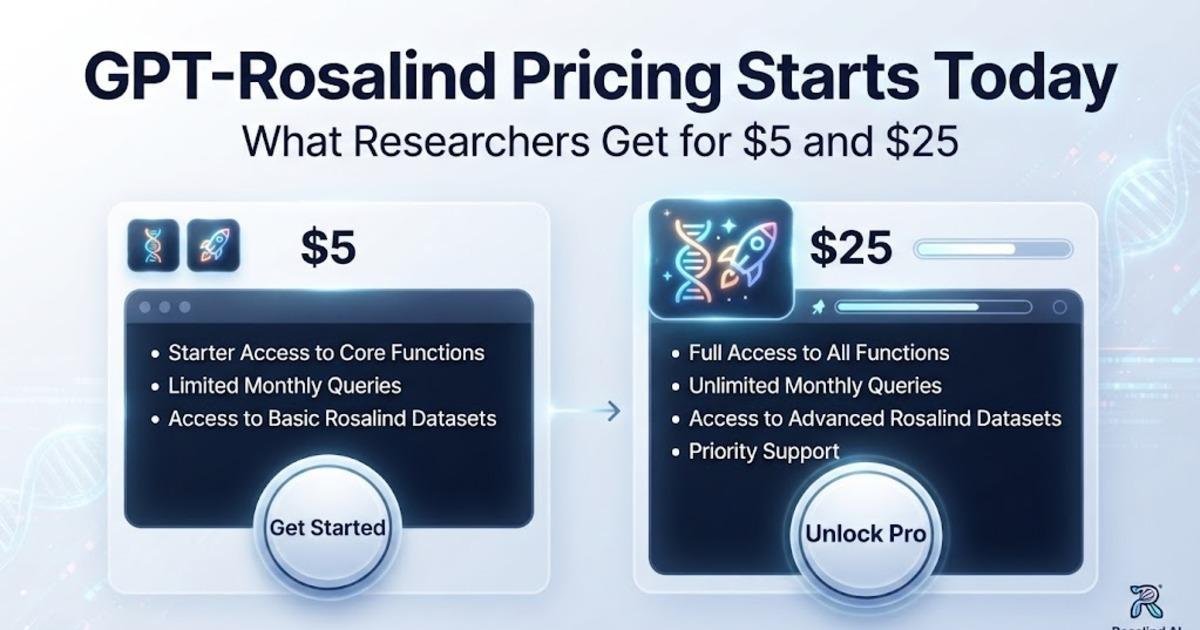
GPT-Rosalind Pricing Starts Today: What Researchers Get for $5 and $25
GPT-Rosalind begins paid billing on October 5. Here is its pricing, restricted access model, benchmark evidence and what researchers should actually measure.
On this page
OpenAI's GPT-Rosalind begins paid billing today, October 5, 2026, turning its specialized life-sciences model from a research-preview service into a priced offering for approved organizations. The API rate is $5 per million input tokens and $25 per million output tokens, but the bigger story is who can actually use it: access remains restricted to organizations approved through OpenAI's trusted-access program.
That makes GPT-Rosalind different from a normal model launch. Researchers cannot simply create an API key, select the model and start building a public application around it. OpenAI positions the system for internal life-sciences research, with access through ChatGPT Enterprise, Codex and the API, while its enterprise controls are designed to keep scientific data and model use inside governed research environments.
GPT-Rosalind is now a paid specialist model, not a general chatbot
GPT-Rosalind is designed specifically for biology, drug discovery and translational medicine, rather than being a general-purpose model with a few scientific prompts layered on top. OpenAI says the current system combines GPT-5.5's reasoning, coding and tool-use capabilities with additional training and evaluation focused on areas such as medicinal chemistry, genomics, protein engineering and experimental analysis. That specialization is intended to help with research workflows where the useful output is not simply an answer, but a chain of analysis that a scientist can inspect and continue.
The distinction matters because scientific work has a different failure mode from ordinary office automation. A fluent answer can still be scientifically wrong, and a plausible biological hypothesis is not evidence that the underlying mechanism exists. OpenAI's own system card therefore evaluates GPT-Rosalind on end-to-end research tasks, including quantitative biology and wet-lab protocol assistance, rather than relying only on generic question-answering scores.
The October 5 price is $5 in, $25 out
OpenAI's standard API pricing lists gpt-rosalind-research at $5 per million input tokens, $0.50 per million cached input tokens and $25 per million output tokens. Billing begins October 5, and OpenAI says there is no cache-write charge for this model. In simple terms, one million tokens sent into the model cost $5, while one million tokens generated by it cost five times as much.
| GPT-Rosalind usage | Published price | What it means |
|---|---|---|
| Input | $5 per 1 million tokens | Information sent to the model |
| Cached input | $0.50 per 1 million tokens | Previously cached input supplied again |
| Output | $25 per 1 million tokens | Text generated by the model |
The output rate is where research teams need to pay attention. A short question followed by a long research response can consume considerably more output than input tokens, and an agentic workflow may make multiple model calls before producing a result a scientist actually accepts. The headline $5 input price therefore should not be treated as the cost of a complete research task; the number that matters to a lab is the cost of producing a reviewed, useful result.
The model's access restrictions matter more than its API price
OpenAI's pricing page explicitly limits GPT-Rosalind access to approved internal research through its trusted-access program. Its help documentation says the model is available in ChatGPT Enterprise and Codex with enterprise-grade security and role-based access controls, while OpenAI says it does not train on enterprise customer data by default. An organization therefore has to clear the access process before the published API price becomes relevant.
This also changes how developers should think about the model. The existence of an API price does not mean GPT-Rosalind is a drop-in model for a commercial consumer application. Independent analysis of the launch has highlighted the same distinction: the price describes model usage, while OpenAI's access rules determine which research workflows are actually permitted.
OpenAI's benchmark results show a specialist advantage, with a caveat
OpenAI reports gains on several life-sciences evaluations compared with earlier general models. Its system card reports a 63.2% score for GPT-Rosalind-5.5 on Labwork Bench versus 55.8% for GPT-5.5, while using fewer tokens in that evaluation. Labwork Bench measures the model's ability to connect experimental changes with outcomes in real-world wet-lab protocols, including troubleshooting and optimization.
OpenAI also reports improvements across other research benchmarks, including genomics and medicinal chemistry. Those results are useful evidence that specialization changes performance on the tasks OpenAI selected, but they remain vendor-produced evaluations. They do not establish that GPT-Rosalind will outperform every competing model on every biological problem, nor do they replace validation against a research team's own data and workflows. That distinction becomes especially important when an incorrect answer could send an experiment in the wrong direction.
GPT-Rosalind is built around tools as much as model intelligence
The model is intended to work inside a broader research workflow rather than operate as an isolated text generator. OpenAI's Rosalind platform describes a workspace that connects scientific questions with data, evidence and tools, while Codex can be used to connect scientific tools and create research workflows that teams can review and reuse. That approach moves the model closer to a research assistant that can manipulate information and perform computational steps instead of merely explaining a paper.
For a scientist, that difference can be substantial. A useful workflow might begin with a biological question, collect relevant evidence, analyze a dataset, identify possible relationships and produce a research artifact that another scientist can inspect. The model still does not turn those outputs into experimentally confirmed findings, but connecting reasoning with tools reduces some of the manual switching between papers, databases, code and analysis environments that normally sits between a question and a testable hypothesis.
The model is not a substitute for experimental evidence
GPT-Rosalind's specialization does not change the basic scientific rule that predictions must be tested. A model can propose a promising target, identify a possible molecular relationship or suggest an experimental design, but the output remains computational reasoning until researchers validate it. OpenAI's decision to emphasize end-to-end benchmarks and wet-lab assistance is therefore more meaningful than claiming that the model can independently perform scientific discovery.
This is also where the model's strongest use case may emerge. Instead of asking whether an AI system can replace a scientist, research teams can measure whether it reduces the time spent on evidence gathering, data preparation, coding, troubleshooting and other repetitive parts of a project. The scientist remains responsible for deciding which question matters, judging whether an answer is credible and determining whether an experiment is worth running.
Who should care about GPT-Rosalind now
The immediate audience is relatively narrow: pharmaceutical companies, biotechnology companies, research institutes and other organizations that can qualify for trusted access and have a genuine life-sciences research workflow to evaluate. OpenAI says organizations including Amgen, Moderna, Thermo Fisher Scientific and Novo Nordisk used GPT-Rosalind during its research preview, giving the company experience with the kinds of workflows it wants the model to support.
For those organizations, the sensible evaluation is not simply whether the model scores higher on a benchmark. Teams should compare it against their existing process on a fixed set of research tasks, record how often its outputs require correction, measure the amount of human review required and calculate the total model and tool cost per accepted result. That would reveal whether the specialized model actually saves researchers time rather than merely producing more impressive-looking answers.
October 5 changes the question from access to value
GPT-Rosalind has already moved beyond its original research-preview stage: OpenAI made it available globally to eligible organizations through trusted access in September and announced that published pricing would begin October 5. Today's billing change therefore is less about unveiling a new model than establishing whether a specialized scientific AI system can justify a dedicated commercial price while remaining tightly controlled.
The next useful evidence will come from researchers measuring the system against real projects rather than benchmark tables alone. If GPT-Rosalind can consistently turn difficult literature, biological data and experimental questions into work that scientists can verify and use, its $25-per-million-output rate may become a relatively small part of the economics. If teams spend more time checking its reasoning than they save using it, specialization will have solved only half the problem.
Written by