
Claude Frontier Academy: How the FDE Residency Works
Anthropic's Claude Frontier Academy uses a four-day intensive and 12-week residency to train engineers for real enterprise AI deployments. Here's how the FDE program works.
On this page
Anthropic has committed $100 million to train 10,000 Frontier Deployed Engineers through Claude Frontier Academy by the end of 2027. The first program is not a video course or a conventional certification: engineers spend several days building a simulated enterprise system, then spend 12 weeks leading a real Claude deployment inside their own organization.
That structure matters because Anthropic is training for a specific job: taking an AI idea through business requirements, security review, implementation, and adoption rather than stopping at a working prototype. Here is how the residency works, who it is designed for, what the assessments measure, and what developers outside the program can learn from its approach.
The Claude Frontier Academy is built around deployment, not classroom theory
Anthropic describes the Frontier Deployed Engineer, or FDE, as an engineer who combines strong software fundamentals, experience with large language models (LLMs), knowledge of the business they work in, and the ability to turn an AI project into a production system. The company says previous experience building AI agents is not required, but candidates are expected to have hands-on engineering experience and a record of helping others adopt AI.
The distinction is useful for anyone learning AI development. A model call that produces a convincing answer is only one component of a production system. The harder work often starts afterward: deciding where the model belongs in a workflow, connecting it to company data and tools, controlling access, testing failure cases, and getting the finished system through security and operational review. That is also why the Academy's goal is explicitly tied to agentic systems that change business processes rather than isolated demonstrations.
The four-day intensive comes before the real project
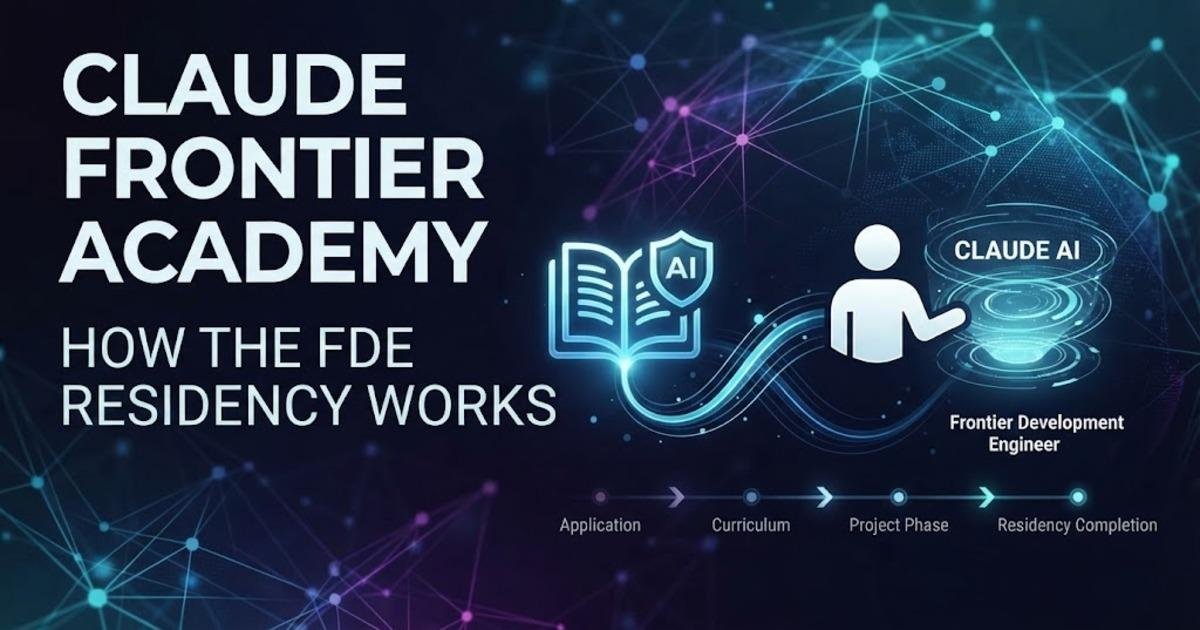
The first stage of the residency is an intensive in-person program. Anthropic's program page describes three days spent building a Claude system for a simulated enterprise, beginning with a customer request and continuing through security review and handover. On the fourth day, participants receive a new scenario and are graded on their practical response.
This sequence tests something a normal tutorial rarely can: whether an engineer can make decisions when the problem changes. Instead of memorizing a set of Claude features, participants have to identify a useful application, turn requirements into a system, account for security, and explain how the result should be handed over. Engineers who pass this stage earn the Claude Resident Engineer badge before entering the longer residency.
The 12-week residency puts the training inside a real business
After the intensive, residents return to their organizations and spend 12 weeks leading a real Claude use case. Anthropic says each nominated engineer arrives with a named Claude project to lead, while Anthropic engineers and the wider cohort provide support during the residency. A second assessment takes place at the end, and engineers who pass are expected to receive the Claude Frontier Deployed Engineer badge, with the first credentials expected in early 2027.
The important change is the environment. A simulated project can test technical judgment, but a production project introduces existing systems, internal data, security requirements, users, ownership questions, and operational constraints. Those are the conditions in which reliable agents become an engineering problem rather than simply a prompting exercise.
Anthropic is using nomination instead of an open enrollment course
The first cohorts are already running in San Francisco, New York, and London, and participation is by nomination. Anthropic says organizations can ask their Anthropic account team or Partner Account Manager whether they are eligible. The initial cohorts include engineers from Accenture, Bain, Capgemini, Commonwealth Bank of Australia, Deloitte, McKinsey, Morgan Stanley, Novo Nordisk, and other organizations.
That means the Academy should not be confused with an open beginner course. Someone who simply wants to learn Claude cannot currently sign up for the FDE Residency as an individual. Anthropic's separate Claude learning, certification, and partner programs remain the more accessible routes, while the Frontier Academy is aimed at organizations developing engineers who will lead substantial AI deployments.
The 10,000-engineer target is a program scale, not 10,000 graduates today
Anthropic says it aims to train 10,000 Frontier Deployed Engineers by the end of 2027, but the first credentials are not expected until early 2027. The company has not published the size of the first cohorts or a detailed schedule showing how the 10,000 target will be distributed across future cohorts.
That distinction matters when interpreting the headline number. The program has started, but the 10,000 figure is a forward target rather than a current count of credentialed engineers. Anthropic also says the Academy will expand with additional programs in 2027, so the initial residency is only the first part of the broader initiative.
The Academy's structure reveals what production AI skills actually require
The most interesting part of the program is not the badge. It is the sequence: learn from practitioners, solve a realistic deployment problem, work on a real project, and then prove the ability to handle another practical scenario. That is a different model from learning a model's API surface and assuming the technical work is finished once the first response arrives.
For developers building AI applications today, the same sequence can be applied without joining the Academy. Start with a real business problem, define what the model should and should not control, connect only the tools and data required for the workflow, test failure modes before release, and treat security and handover as part of development rather than paperwork at the end. Existing work on long-running agents illustrates why production AI also has to account for state, execution time, and recovery rather than only the initial model response.
What developers can learn from the FDE model now
Claude Frontier Academy is ultimately an experiment in how AI engineering expertise is developed. Anthropic is putting less emphasis on a one-time exam and more emphasis on observed performance across a simulated deployment and a real organizational project. The company says the approach is based on its experience deploying Claude inside large enterprises and professional services organizations.
For developers outside the first cohorts, the practical lesson is straightforward: an AI tutorial should not end when the model returns the expected output. A stronger learning project takes the next steps too—requirements, integration, permissions, evaluation, security review, deployment, monitoring, and a handover another engineer can actually maintain. That is much closer to the work Anthropic says its Frontier Deployed Engineers are being trained to perform.

Written by