Biwin CL100 Mini SSD Hits Retail With a Tiny Design and a Big Compatibility Catch
Biwin's CL100 Mini SSD is now appearing in European retail, offering up to 2TB and 3,700 MB/s in a tiny removable format, but compatibility remains limited.
On this page
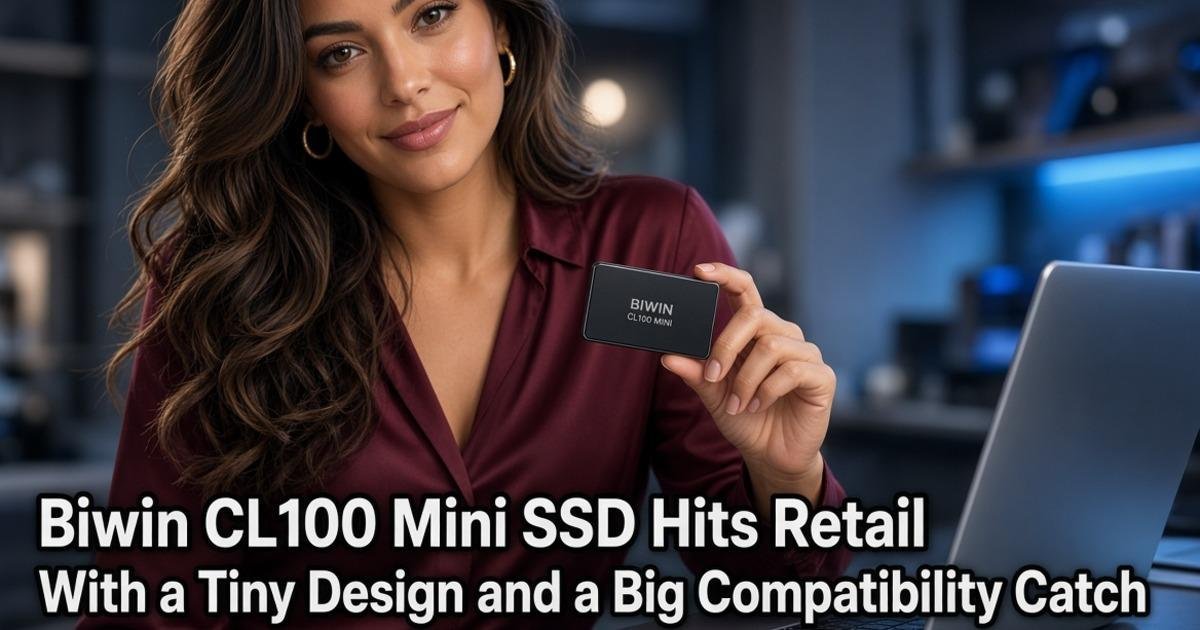
The Biwin CL100 Mini SSD has started appearing in European retail with prices that finally show what this unusual storage format costs outside its original market. Measuring just 15 × 17 × 1.4 mm, the removable PCIe 4.0 solid-state drive is smaller than a conventional M.2 2230 module and can reach 2TB, but its usefulness depends almost entirely on whether a device has Biwin's dedicated Mini SSD slot. ([computerbase.de](https://www.computerbase.de/news/storage/biwin-cl100-mini-ssd-zum-maximalen-preis-erhaeltlich.99635/))
The Biwin CL100 Mini SSD is now easier to buy, but only for specific hardware
Biwin's CL100 Mini SSD has been available in some markets for months, but recent European retail listings make the product more relevant to buyers who want a very small removable NVMe drive. The company lists 512GB, 1TB and 2TB versions, with maximum sequential read speeds of 3,700 MB/s across the range. The 1TB and 2TB models are rated for up to 3,400 MB/s sequential writes, while the 512GB version is rated lower at 2,400 MB/s. ([biwintech.com](https://www.biwintech.com/product/cl100-mini-ssd/))
That last specification is easy to miss when reading the headline numbers. The smaller model does not deliver the same maximum write performance as the larger versions, so treating every CL100 as a 3,700/3,400 MB/s drive would be inaccurate. Biwin also states that actual speeds vary with the controller, host device, file size, workload and operating conditions, meaning the published figures are maximum specifications rather than guaranteed everyday transfer rates. ([biwintech.com](https://www.biwintech.com/news/biwin-mini-ssd-cl100-user-guide/))
Its tiny size comes from packaging, not slower storage technology
The CL100 is not a memory card with an SSD label attached to it. It uses PCIe 4.0 x2 and NVMe 1.4, the same basic storage interface and protocol family used by conventional NVMe drives, but Biwin packages the controller and flash components into a much smaller card-style design. The company uses Advanced Hybrid Ball Grid Array packaging, which places the components directly into a compact package instead of spreading them across the larger circuit board used by a typical M.2 SSD. ([biwintech.com](https://www.biwintech.com/product/cl100-mini-ssd/))
At 15 × 17 mm, the drive occupies only a fraction of the footprint of an M.2 2230 SSD, which measures 22 × 30 mm. That difference matters most in handheld gaming PCs and very thin systems where every millimeter inside the chassis has to be accounted for. The CL100 can also be inserted through a card-style slot rather than requiring the case to be opened and an M.2 screw removed, although that convenience exists only on hardware designed for the Mini SSD format. ([biwintech.com](https://www.biwintech.com/news/biwin-mini-ssd-cl100-user-guide/))
The biggest limitation is the proprietary slot
The CL100's physical advantage creates its biggest weakness at the same time: it is not a drop-in replacement for an ordinary M.2 SSD. Biwin's own compatibility guide currently lists the GPD Win 5 and several OneXPlayer systems, including the X1 Air, Super X, Super V, OneXPlayer 3, OneXFly APEX, OneXFly APEX Air and X2 Mini. Buyers are explicitly told to confirm that their device supports the Mini SSD form factor and the required capacity before purchasing. ([biwintech.com](https://www.biwintech.com/news/biwin-mini-ssd-cl100-user-guide/))
This makes the CL100 very different from an M.2 2230 drive used in systems such as the Steam Deck. A standard M.2 2230 SSD can be purchased from multiple storage manufacturers and used across a broader ecosystem, while the Mini SSD currently depends on manufacturers building a dedicated slot into their products. The hardware is therefore technically impressive without automatically being a universal storage upgrade.
Recent European prices reveal the cost of going this small
European listings reported around October 1 and 2 put the 512GB CL100 at €139.99 and the 1TB model at €259.99, while a 2TB version was listed at €699.99 through third-party sellers. The 2TB figure is particularly striking because the capacity is only twice that of the 1TB model while the listed price is substantially higher. These are retail prices that can change by seller and availability, rather than fixed manufacturer pricing. ([computerbase.de](https://www.computerbase.de/news/storage/biwin-cl100-mini-ssd-zum-maximalen-preis-erhaeltlich.99635/))
The pricing makes more sense when the drive is compared with other small-form-factor storage rather than ordinary 2.5-inch or desktop NVMe products. ComputerBase reported that the smaller CL100 capacities have reached the market at prices that put them in the same broad territory as some M.2 2230 alternatives, while the 2TB listing currently carries a much larger premium. The important question is therefore not whether the CL100 has a low price per gigabyte, but whether its tiny removable format solves a physical problem that another SSD cannot. ([computerbase.de](https://www.computerbase.de/news/storage/biwin-cl100-mini-ssd-zum-maximalen-preis-erhaeltlich.99635/))
The 512GB model has a meaningful performance compromise
Biwin's specification table shows another reason to look beyond the headline 3,700 MB/s number. The 512GB version reaches the same rated sequential read speed as the larger models, but its maximum sequential write speed is 2,400 MB/s instead of 3,400 MB/s. Its random-read rating is also 450,000 input/output operations per second, or IOPS, compared with 550,000 IOPS for the 1TB and 2TB versions. ([biwintech.com](https://www.biwintech.com/product/cl100-mini-ssd/))
For a handheld used mainly to load games, the difference may not be obvious because game loading involves many operations beyond one sustained sequential write. It matters more when the drive is repeatedly used for large file transfers, video work or other workloads that can sustain heavy writes. The smaller capacity therefore saves money and space, but it is not simply the same 2TB design with fewer storage cells.
The drive is removable, but it is not upgradeable in the usual PC sense
Biwin rates the CL100 as a DRAM-less SSD, meaning it does not contain a dedicated DRAM cache chip and instead uses techniques such as Host Memory Buffer to help manage storage operations. The company also lists dynamic SLC caching, wear leveling, garbage collection, thermal throttling and other SSD management features. These are normal mechanisms for balancing performance, endurance and power use, but they do not change the fundamental compatibility requirement imposed by the Mini SSD slot. ([biwintech.com](https://www.biwintech.com/product/cl100-mini-ssd/))
Endurance also varies with capacity. Biwin rates the 512GB drive at 375 terabytes written, or TBW, the amount of cumulative data it expects the drive to handle under its warranty terms, while the 1TB and 2TB versions are rated at 750TBW and 1,500TBW respectively. Each model carries a three-year warranty or its listed TBW limit, whichever comes first. For a handheld game library, these figures are unlikely to be the first constraint most owners encounter, but they matter more for users treating the tiny drive as a frequently rewritten work disk. ([biwintech.com](https://www.biwintech.com/product/cl100-mini-ssd/))
The optional reader turns the Mini SSD into portable storage
Biwin also sells the RD510 Mini SSD Reader, which gives the removable drive a USB connection for use with computers and other compatible devices. The company positions the reader as a way to access the CL100 outside hardware with a built-in Mini SSD slot, extending the drive's usefulness beyond the handful of handhelds that currently accept it directly. ([biwintech.com](https://www.biwintech.com/news/biwin-cl100-mini-ssd-and-rd510-reader/))
There is still a performance trade-off when the drive leaves its native slot. Biwin advertises up to 3,300 MB/s access for the reader, while recent reporting has measured or estimated lower practical throughput through the external connection. That is expected: the internal PCIe 4.0 x2 link and the external USB 4 connection are different paths, and the enclosure, controller and host device all become part of the performance equation.
The Mini SSD format needs more device support to become a real standard
The CL100 shows that removable NVMe storage can be made dramatically smaller without abandoning the performance characteristics of a modern SSD. What it has not yet shown is that the format can become broadly interchangeable across PC hardware. Biwin's own documentation identifies a limited set of compatible devices, and the company has not established the Mini SSD as an industry-wide physical standard comparable to M.2. ([biwintech.com](https://www.biwintech.com/news/biwin-mini-ssd-cl100-user-guide/))
That distinction will determine what happens next. If more handheld and ultra-thin PC manufacturers adopt the same slot, the tiny drive becomes a useful removable storage category rather than a component tied to a small group of machines. If adoption remains limited, conventional M.2 2230 SSDs retain an important advantage: they are larger, but their ecosystem is already established. The CL100's retail arrival therefore matters less as a replacement for today's SSDs than as a test of whether manufacturers are willing to build hardware around a new, smaller storage format.
Share this post