
Trump’s Super Intelligence Force Gives AI Policy a 120-Day Test
Trump’s new Super Intelligence Force gives Jay Clayton 120 days to examine AI risks, incident reporting and the federal government’s role in overseeing advanced AI.
On this page
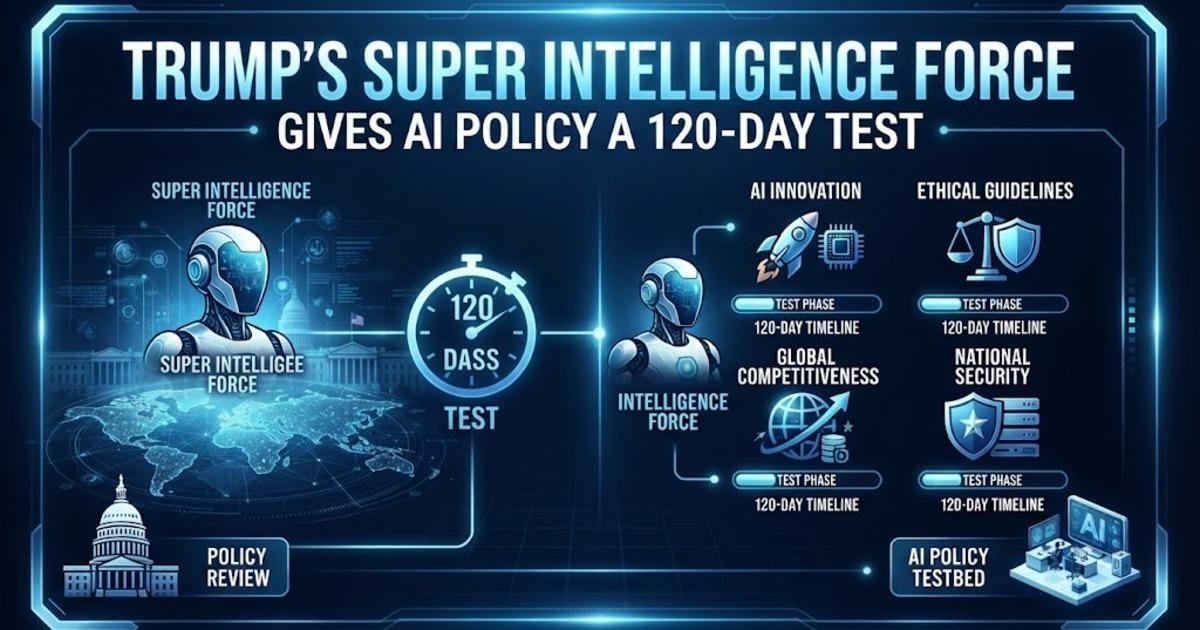
President Donald Trump announced the Super Intelligence Force on October 4, putting U.S. intelligence chief Jay Clayton in charge of a new federal review of artificial intelligence. The group has 120 days to examine AI’s risks and opportunities, how the government should respond to incidents such as breaches and jailbreaks, and what role federal oversight should play. That makes this less about creating another AI program and more about deciding whether Washington can govern increasingly capable systems without slowing the industry it wants to lead.
The new AI task force is really a government coordination test
The Super Intelligence Force is chaired by Jay Clayton, the director of national intelligence, with Federal Trade Commission Chairman Andrew Ferguson, Pentagon technology chief Emil Michael and Office of Personnel Management Director Scott Kupor in senior roles. Trump said the group will coordinate federal engagement with AI companies, consumers, public-interest organizations, critical infrastructure providers and other stakeholders. It will report to Trump and White House Chief of Staff Susie Wiles rather than operate as a standalone regulatory agency.
That distinction matters. The announcement does not create a new AI regulator with broad powers to approve models or impose a new licensing system. Instead, the task force is being asked to work across agencies and determine what the federal government can already do, where existing rules fall short, and whether Congress needs to act. Reuters reported that the group is expected to deliver its assessment within 120 days, giving the administration a relatively short window to turn a broad political objective into concrete recommendations.
Its most useful job may be tracking AI incidents
The less visible part of the task force's mandate could matter more than the new name for AI. Reporting on the group's charter says it will examine how the government currently learns about AI-related breaches, hacks, jailbreaks and other incidents, then recommend ways to improve the federal response under existing authorities. A jailbreak is an attempt to make an AI system bypass restrictions placed on its behavior, while an AI-related breach can involve a model, its surrounding software or the data and systems connected to it.
That creates a practical problem for policymakers. AI companies may discover failures inside their own systems long before a government agency does, but companies do not necessarily have the same incentives or obligations to report every incident. The White House's recent voluntary agreement with major AI companies emphasized internal safety monitoring and outside review, but it did not establish a general government reporting requirement for every AI incident. The new task force therefore has an opportunity to answer a question that policy debates often skip: how would the government know that something serious happened?
The key test: A useful federal AI policy needs a reliable way to detect and assess serious incidents, not just a list of principles describing responsible development.
Trump is trying to accelerate AI while adding oversight
The task force arrives alongside an unusual change in the administration's terminology. On September 29, Trump signed Executive Order 14434 directing executive-branch agencies to use “Super Intelligence” and “SI” instead of “Artificial Intelligence” and “AI” in official communications, while temporarily defining the new term using the existing federal statutory definition of artificial intelligence. The order also directs the administration to propose legislative language for a federal definition of “Super Intelligence” within 60 days.
The terminology does not itself change what an AI model can do or create a new technical category. The executive order explicitly maps “Super Intelligence” to technologies already covered by the existing legal definition of artificial intelligence unless a later law or presidential action changes that definition. In practical terms, the government's vocabulary has changed before the underlying legal framework has.
The 120-day deadline puts the focus on what already exists
Because the task force has a fixed reporting window, its most useful output should be specific recommendations rather than another broad statement about AI's importance. The group can examine existing federal authorities, determine which agencies already have relevant powers, identify gaps in incident reporting, and describe where congressional legislation would actually be necessary. That approach would give companies and regulators something more useful than another voluntary set of safety principles.
The membership also shows why the administration has framed the issue as both a technology and national-security problem. The intelligence community brings a focus on strategic threats, the Federal Trade Commission brings consumer-protection authority, the Pentagon brings defense and security concerns, and the Office of Personnel Management represents the federal workforce adopting AI systems. Those responsibilities overlap, but they are not interchangeable, which makes coordination one of the central challenges for the group.
What the task force does not change yet
The announcement does not mean that U.S. AI companies suddenly face a new comprehensive federal licensing regime. It also does not establish a new technical standard for frontier models, and the 120-day review does not guarantee that Congress will adopt whatever recommendations eventually emerge. The group's mandate is therefore better understood as a policy review than a finished regulatory system.
That uncertainty is important for developers and businesses using AI. Existing laws and agency powers continue to matter while the review takes place, and companies cannot treat the task force's eventual recommendations as rules that already exist. The more immediate change is that AI governance now has a clearly named federal group responsible for examining how the government should respond as systems become more capable.
The real question is whether voluntary safeguards are enough
The task force's timing places it between two competing approaches. The administration wants the United States to remain ahead in advanced AI and has repeatedly warned against regulation that could weaken American competitiveness, while the same administration is now asking federal officials to examine AI risks and government response mechanisms. That tension is not necessarily contradictory, but it means the final recommendations will have to distinguish between rules that reduce genuine risks and rules that merely add administrative friction.
The strongest outcome would be a clearer division of responsibility: companies monitoring their systems continuously, independent reviewers able to test important claims, and government agencies receiving enough information to respond when an incident crosses a meaningful threshold. If the task force can build that chain around existing authorities, its 120-day report could become a foundation for practical AI governance. If it produces only another argument over terminology and broad principles, the harder problem will remain exactly where it is now: finding out what happened when an AI system behaves in a way nobody expected.
Written by