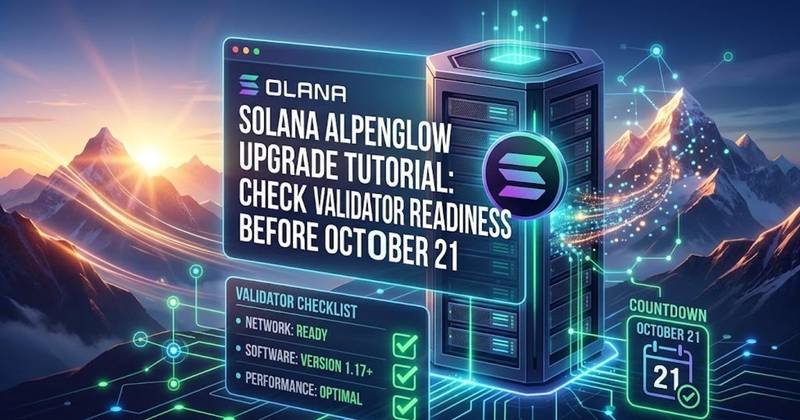
Solana Alpenglow Upgrade Tutorial: Check Validator Readiness Before October 21
Prepare for Solana's October 21, 2026, Alpenglow upgrade. Learn how to check supported validator clients, BLS registration, vote account funding, and actual cluster migration status.
On this page
Solana's Alpenglow consensus upgrade is scheduled for October 21, 2026, and validator operators have more to prepare than simply installing a newer client. The migration introduces new consensus mechanics, requires an Agave-based validator client built on version 4.3.0, and adds a recurring 0.8 SOL funding requirement for validator vote accounts. This tutorial explains how to check your validator's readiness, verify the required configuration, and confirm when a Solana cluster has actually switched to Alpenglow.
Understand what changes when Alpenglow activates
Alpenglow changes how Solana validators agree on transaction ordering and finality. The existing Tower Byzantine Fault Tolerance (TowerBFT) consensus mechanism is being replaced by a new design built around Votor, with Rotor forming part of the broader upgrade's data-distribution architecture. Finality is the point at which a transaction is considered irreversible under the network's consensus rules.
The Solana Foundation targets approximately 150 milliseconds for finality, compared with roughly 12.8 seconds under the existing system. That is a substantial reduction in the time applications may need to wait before treating a transaction as settled, but it is a protocol target rather than a guarantee that every application will display confirmation in that time. Wallet interfaces, network conditions, and application-specific confirmation policies can still affect the user experience.
The planned mainnet activation is epoch 1064, beginning on October 21 at approximately 15:00 UTC. The precise time is an estimate because epoch boundaries depend on slot timing. The change is also distinct from the earlier activation of the validator admission requirements: registering a BLS public key and enabling the Validator Admission Ticket mechanism do not, by themselves, mean that Alpenglow consensus is already running.
Check whether your validator is running a supported client
Before the activation window, determine which validator implementation and release your node is running. Agave is Solana's validator client implementation, while Jito-Solana and Harmonic Salsa are alternative clients built on the supported Agave foundation. For the migration, the official upgrade guidance calls for a release built on Agave 4.3.0. Firedancer and Frankendancer are not supported during this migration, so operators using those implementations should consult the official migration instructions rather than assume their existing setup will remain eligible.
On the validator host, inspect the installed Solana command-line tools and validator process. Start with the following command:
solana --versionThis prints the version of the installed command-line tool, which is useful for identifying the local toolchain but does not independently prove which binary the running validator process uses. Check the service definition, container image, or process arguments as appropriate for your deployment, and verify the actual client release against the official Alpenglow operator requirements. A command-line utility and the validator daemon can be installed or updated separately, so their versions should not be assumed to match.
If you operate a production validator, plan the upgrade using your normal maintenance and monitoring procedures. Confirm that the selected release is supported, that the node is synchronized, and that your operational setup can recover if the service fails to restart. Do not replace a working production binary with an unverified download or copy commands from an unofficial migration guide.
Verify the vote account's balance requirement
Alpenglow's Validator Admission Ticket (VAT) mechanism introduces a fee that participating validators must fund through their vote accounts. A vote account records a validator's voting activity and associated information on Solana. Under the published migration guidance, the account needs at least 0.8 SOL above its rent-exempt minimum to cover the VAT fee. This is separate from the validator's identity account, so checking only the identity wallet's balance is insufficient.
Use the following command, replacing the placeholder with your actual vote account address:
solana balance Compare the reported balance with the vote account's rent-exempt minimum and the required additional 0.8 SOL. The command reports the balance; it does not calculate the amount available above the rent-exempt minimum for you. Verify the account's minimum reserve and make sure the funds are available in the correct account before proceeding.
If the account needs funding, the official command-line syntax is:
solana transfer Replace the placeholders with the vote account address and the amount you intend to transfer. Review the destination carefully before signing, and confirm the resulting balance after the transaction settles. Never paste a seed phrase or private key into a website or command supplied by an unofficial migration guide.
Confirm that the validator's BLS public key is registered
Alpenglow also relies on BLS public keys, which are cryptographic public keys used by the new consensus design. A validator that has not completed the required registration cannot assume that it is eligible to participate simply because its client is updated and its account is funded. The registration and VAT prerequisites were activated on mainnet before the planned October 21 consensus migration.
Check the validator's registration status using the official operator documentation and the appropriate on-chain account information. Make sure the registered key corresponds to the validator you intend to operate, and verify any required key-management or registration steps against the current release instructions. Do not generate or replace signing keys casually on a live validator: an incorrect key configuration can interrupt participation or create a recovery problem.
The practical readiness check is therefore threefold: the running validator must use a supported Agave-based release, its required BLS public key must be registered, and its vote account must have sufficient funds above the rent-exempt minimum. Passing only one or two of these checks is not enough to establish migration readiness.
Check the cluster's actual Alpenglow status
Do not rely solely on the calendar date or a software version string to decide whether a cluster has migrated. Solana's official upgrade guidance provides a cluster-level check using the getAgGenesisCert remote procedure call (RPC), a method that requests information directly from a node. Before migration, the method returns null; after the cluster has migrated, it returns the Alpenglow genesis certificate.
The Solana command-line tools also provide a convenient status check:
solana alpenglow-genesis-infoBefore activation, the command can report that the cluster is still running TowerBFT. Once the migration has taken effect, it should report the corresponding Alpenglow genesis information. Run the check against the intended cluster and RPC endpoint; a result from devnet does not establish the status of mainnet, because each cluster has its own activation state.
There is one timing detail worth understanding when monitoring the mainnet switch. The feature gate is scheduled to activate at the beginning of epoch 1064, but TowerBFT continues to run for the first 5,000 slots of that epoch, approximately 18 minutes. The published transition point for Alpenglow consensus is slot 459,653,000. During the transition window, the status check can therefore continue to report that the cluster is running TowerBFT even though epoch 1064 has begun.
Automate monitoring without confusing readiness with activation
For production operations, record the validator client version, BLS registration status, vote account balance, cluster identity, and migration status in your operational checklist. Recheck the balance after funding and monitor validator participation through your existing infrastructure. During the migration, use the official cluster-status method rather than treating the passage of a specific number of minutes as proof that consensus has changed.
Keep readiness and activation as separate states in monitoring. A validator may be correctly configured before the network switches, while a cluster may have migrated even if an individual operator has a configuration problem. Monitoring these states separately makes it easier to distinguish a network-wide transition from a local validator failure.
What application developers should test after the upgrade
Most users sending ordinary transactions through a wallet do not need to perform a manual migration. The upgrade primarily affects consensus and validator operations, rather than requiring every wallet holder to move SOL or generate a new wallet. Developers should nevertheless review applications that depend on detailed validator or block-processing behavior, particularly systems that index transaction streams or make assumptions about timestamps and confirmation timing.
For example, an application that displays a transaction as complete only after a fixed delay should be tested against the new finality behavior instead of assuming the old confirmation interval remains necessary. An indexer that interprets block or slot metadata should also be checked against the official breaking-change documentation. Faster consensus does not automatically make a poorly designed indexer correct, nor does it remove the need to handle temporary RPC failures and incomplete data.
Operators should complete their supported-client, BLS-registration, and vote-account checks before the epoch 1064 boundary. Developers should validate their own integrations against the appropriate test environment and use the cluster's reported migration status when deciding which consensus behavior is active. That is a more reliable basis for the October 21 transition than a version number or a clock alone.
Share this post
Written by