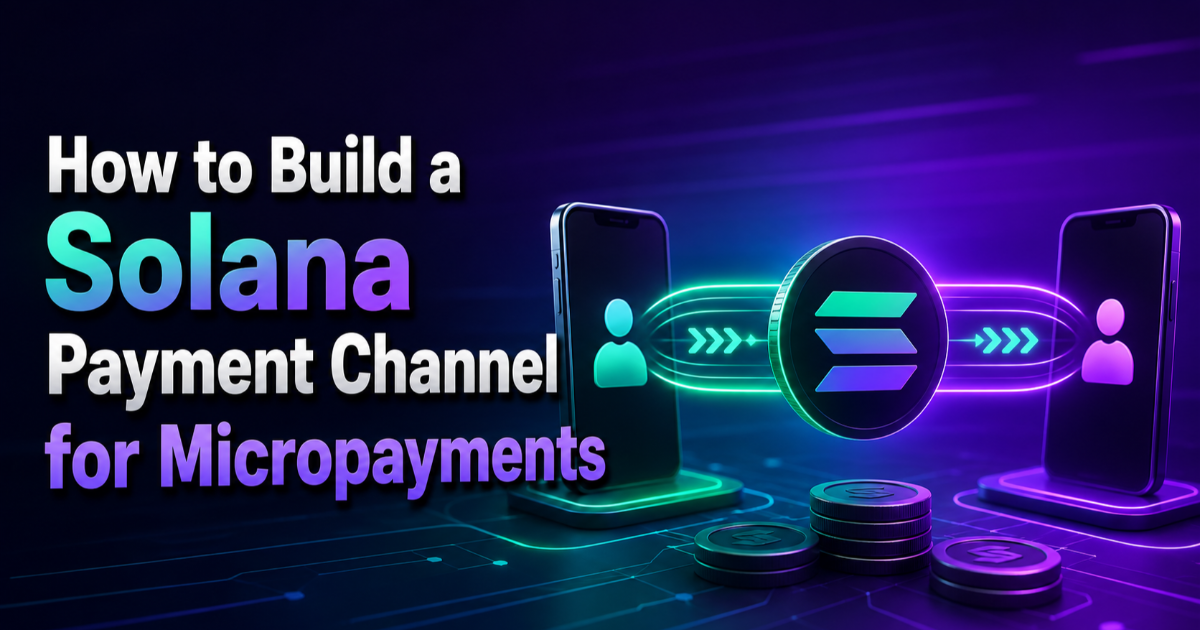
How to Build a Solana Payment Channel for Micropayments
Learn how Solana payment channels turn many small off-chain authorizations into a bounded on-chain settlement, with practical steps for building and testing metered payments.
On this page
A payment that costs a fraction of a cent is easy to imagine until an application needs to make that payment hundreds or thousands of times. Solana's new payment channels change the pattern: instead of settling every small payment on-chain, a payer deposits a spending ceiling once, authorizes usage with signed messages, and settles the amount actually consumed later. The Solana Foundation announced the system on September 3, 2026, alongside an open-source program, toolkit, documentation, and a reported test exceeding one million payments per second.
Why ordinary micropayments become expensive to manage
A normal blockchain payment couples authorization, execution, and settlement into a transaction. That is reasonable when someone buys a product once, but it becomes awkward when software is paying repeatedly for small amounts of work. An artificial intelligence agent might request many pieces of data, pay for inference based on actual usage, or consume a streamed service where the final bill is unknown when the session starts. Signing and settling every request adds both latency and operational overhead.
A payment channel separates those jobs. The payer first commits a maximum amount to an on-chain escrow controlled by the payment-channel program. During the session, individual charges are represented by signed off-chain vouchers rather than separate blockchain transactions. At the end, the operator submits the cumulative amount for settlement, and the unused part of the deposit can return to the payer. The important idea is that the ceiling is on-chain while the high-frequency metering happens off-chain.
What you need before building one
This tutorial is aimed at developers building metered services rather than ordinary wallet transfers. You need a Solana development environment, a wallet capable of signing messages and transactions, a service that can meter usage, and familiarity with Solana addresses, token accounts, and transaction signing. The open-source Solana payment-channel program is currently deployed on mainnet, while the Pay Kit repository also provides a playground that can exercise payment flows against a hosted payment sandbox without using real funds.
For production work, separate your payer, operator, and application responsibilities clearly. The payer authorizes the spending ceiling, the operator measures what the service actually consumed, and the payment program enforces the settlement rules. Do not treat the operator's server database as the source of truth for the maximum amount: the escrowed deposit is what provides the on-chain spending boundary.
Step 1: Decide what the channel is paying for
Start with a resource whose final cost can be measured after the request begins. Good candidates include streamed content, artificial intelligence inference, metered API access, or a sequence of small service calls. Define a unit of usage before writing the payment code. For example, your application might charge according to tokens processed, bytes delivered, seconds of computation, or individual API operations.
Next, determine the maximum amount a customer is willing to authorize for one channel. That number is the ceiling, not necessarily the final bill. If the service consumes only part of the authorized amount, the remaining funds are not supposed to become revenue for the operator. This distinction is central to the design because it lets the customer authorize a potentially variable service without granting unlimited spending authority.
Step 2: Open the channel with an on-chain ceiling
Opening the channel creates the on-chain state that ties the payer, recipient, token, and spending ceiling together. The payer deposits the maximum amount into escrow controlled by the payment-channel program rather than simply transferring the money to the service operator. The published implementation describes this lifecycle as opening the channel, metering usage off-chain, settling the actual amount, and distributing the funds.
Think of the deposit as a locked budget. If the customer authorizes 10 USDC, the service should never be able to settle more than that channel ceiling. The channel also binds the payment to its intended payee, which prevents a settlement from simply redirecting the escrow to an unrelated destination. The open-source specification documents these protections as part of the payment-channel profile.
Step 3: Meter usage without creating transactions
Once the channel is open, stop thinking of every unit of usage as a blockchain transaction. Instead, the agent or client signs messages representing cumulative spending. A signed voucher can say, in effect, that the payer authorizes the service to claim the current cumulative amount from the channel.
The cumulative design matters. Suppose a service consumes 2 USDC, then 3 USDC, then 5 USDC of a channel with a 10 USDC ceiling. The important settlement value is the latest cumulative amount, 5 USDC, rather than three independent blockchain transfers. The service can keep delivering work while those authorizations remain off-chain, then settle the final amount when the session ends. This is the mechanism that turns many tiny payments into one on-chain settlement.
Step 4: Make the server verify every authorization
Your service should not accept a voucher simply because it contains an amount below the advertised price. Verification needs to establish that the authorization belongs to the expected payer and channel, that the amount does not exceed the deposited ceiling, and that the destination matches the channel's configured payee. The published payment-channel specification also describes monotonic settlement state so an earlier authorization cannot simply be replayed after a later one has been processed.
This is where a common implementation mistake appears: treating the server's meter as a substitute for cryptographic authorization. Your application may calculate that a request costs 4 USDC, but the payment system still needs to prove that the payer authorized that spending and that the channel permits it. Application-level accounting determines what was consumed; the payment channel constrains what can actually be claimed.
Step 5: Settle the final amount on-chain
When the service has finished delivering work, submit the latest cumulative authorization for settlement. The program records the actual amount consumed and closes the payment lifecycle according to the channel flow. The operator receives the amount it is entitled to, while the unused portion of the escrow is returned to the payer.
That final transaction is the point where the off-chain meter becomes an on-chain financial result. If the customer authorized 10 USDC but the application consumed only 6.40 USDC, the settlement should reflect the 6.40 USDC charge rather than treating the full 10 USDC ceiling as revenue. This is one of the main differences between an escrowed payment channel and a conventional prepaid balance held in an application's database.
Step 6: Test the complete lifecycle before using real funds
Do not begin by experimenting with a production wallet. The Pay Kit repository includes a local playground designed to exercise payment flows against a payment sandbox, including metered sessions, off-chain vouchers, channel settlement, and the request-response sequence used by its payment protocols. The repository documents the basic setup as installing dependencies inside the playground and starting its development servers.
Your first test should prove the entire lifecycle rather than just opening a channel. Verify that the client can authorize the ceiling, the service can recognize valid signed usage, invalid or excessive amounts are rejected, cumulative spending behaves correctly, settlement records the actual charge, and unused funds return to the payer. Repeat the test with interrupted sessions and duplicate settlement attempts, because payment code that works only on the happy path is not ready to hold real assets.
Where payment channels fit with x402 and MPP
Payment channels are not a replacement for every Solana payment. The Solana Foundation positions them as infrastructure for payment protocols including x402 and the Machine Payments Protocol, or MPP. An x402 flow can use a ceiling for a metered request, while an MPP session can keep a channel open while many deliveries are authorized through cumulative vouchers.
That makes the choice relatively practical. For a single ordinary purchase, a normal token transfer may be simpler. For a payment whose amount is unknown until the work is completed, a bounded authorization can be useful. For repeated or streamed micro-payments, a session backed by a payment channel is more interesting because the application can avoid turning every tiny unit of usage into a separate on-chain settlement.
What the million-payments benchmark does and does not prove
The Solana Foundation reported that a test using 100,000 unique wallets and a payment-channel proxy produced more than one million payments per second, with the organization estimating a processing cost of $0.000000000776 per payment under that test setup. It also described the result as enough theoretical capacity for more than 80 billion payments in 24 hours.
Those figures should be read as a benchmark for the tested payment-channel architecture, not as a promise that an arbitrary application can independently process one million customer payments every second. The benchmark uses a proxy and measures a particular workload. Real systems still have application servers, network connections, signing operations, token liquidity, settlement timing, security controls, and service-specific bottlenecks. The useful lesson is architectural: moving high-frequency metering away from the settlement layer can dramatically change the economics of tiny payments.
The security rules worth keeping in your implementation
Never let the client authorize an unlimited amount merely because your application expects small charges. Put a meaningful ceiling on every channel and choose a lifetime appropriate to the service. The payment-channel specification also describes time limits, fixed recipients, maximum settlement amounts, and terminal channel state as important security properties.
Keep private keys away from ordinary application logs and never record recovery phrases or raw signing secrets for debugging. Treat signed vouchers as financial authorization, not as harmless API metadata. Finally, make settlement idempotent: if your server retries after a network timeout, it must not accidentally create a second claim for the same completed authorization.
When this pattern is actually worth using
Payment channels make the most sense when the application has many small payments, variable usage, or streaming delivery. They are less compelling when a user makes one large purchase and the amount is known in advance, because a straightforward Solana payment has fewer moving parts. The extra channel state, escrow management, metering logic, and settlement process are justified only when they solve a real scaling or user-experience problem.
The next useful experiment is therefore not simply sending a token through the new program. Build a tiny metered service, give it a deliberately small spending ceiling, run several off-chain usage events, and settle once. If you can inspect the resulting channel state and explain exactly why the operator received the final amount and where the unused balance went, you have understood the important part of the system. From there, the same pattern can be connected to an API, an AI agent, or a streamed service without forcing every microscopic charge onto the blockchain.
Written by