
Monero FCMP++ Stressnet v3: What the October 5 Test Actually Changes
Monero's FCMP++ and CARROT beta stressnet v3 reaches its October 5 fork. Here's what the test changes, why it matters, and why it does not affect mainnet XMR yet.
On this page
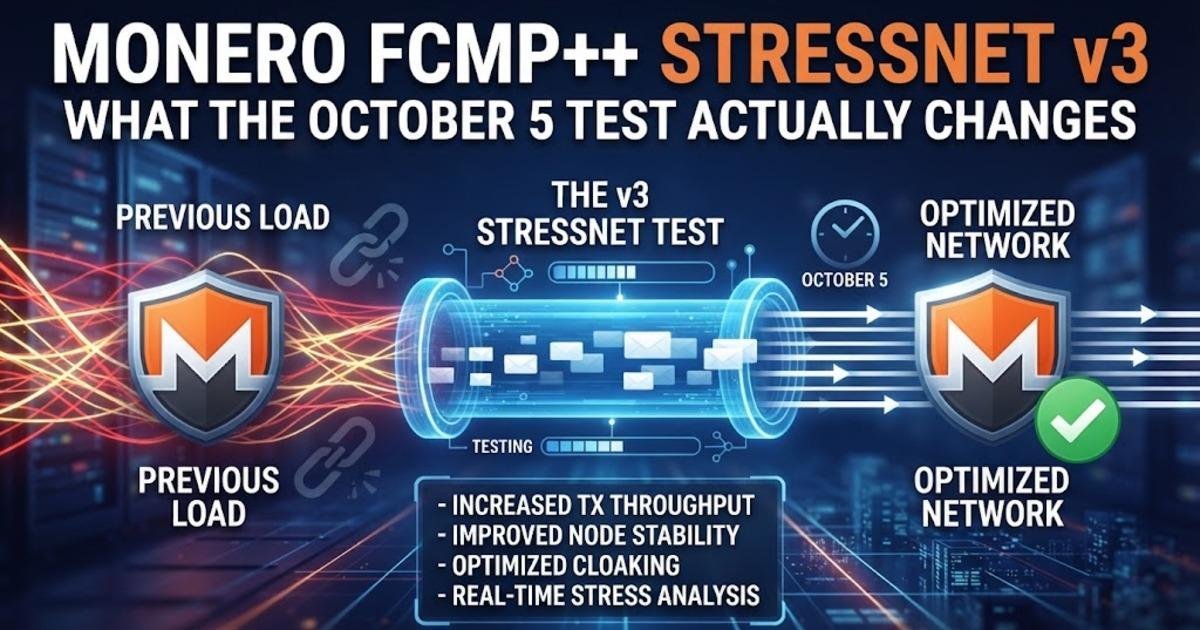
Monero's FCMP++ privacy upgrade reaches another important test on October 5, when beta stressnet v3 moves to its next hard fork at block 3,102,800. This is not a Monero mainnet upgrade and does not change anyone's real XMR, but it is a significant engineering checkpoint for a proposal that would replace Monero's 16-member ring signatures with proofs covering the full set of eligible outputs.
The October 5 fork is happening on Monero's stressnet, not mainnet
The software for FCMP++ and CARROT beta stressnet v3.0 was released on September 25, with the test network scheduled to fork at block 3,102,800 on October 5. A stressnet is a deliberately demanding test environment where developers and volunteers can generate transactions, operate nodes and expose failures before the same code is considered for real users. The distinction is critical because a stressnet fork does not require ordinary XMR holders to update wallets, move funds or take any action.
The v3 release also is not simply a cosmetic version bump. The test includes hot-cold wallet support, improvements to the transaction relay protocol, RandomX v2 support and fixes from the previous beta stressnet. Developers have asked testers to report problems because the purpose of this network is to discover issues while the software is still isolated from mainnet. The project has not announced a mainnet activation date for FCMP++.
FCMP++ changes the privacy model rather than adding more decoys
Monero currently uses CLSAG ring signatures, where a transaction input is hidden inside a ring containing the real output and 15 decoys. The network can verify that one member of the ring is authorized to spend an output without revealing which member it is. FCMP++ takes a different approach: instead of selecting a small group of decoys, it proves that the real output belongs somewhere in the entire eligible output set without identifying the output itself.
That changes the meaning of the anonymity set. Under the existing design, the ring has 16 members, so every transaction has a deliberately constructed group of possible inputs. Under FCMP++, the relevant set becomes the much larger collection of eligible outputs recorded by the chain. Monero's own documentation describes the resulting proof as establishing membership in the whole set while keeping the actual spent output hidden. The practical benefit is that developers no longer have to depend on choosing a small collection of decoys for every transaction.
The hard part is proving the whole-chain idea can run reliably
A larger anonymity set sounds straightforward until the network has to construct and verify the cryptographic proof. FCMP++ uses a structure called a Curve Tree, which organizes the eligible outputs into a commitment structure that lets a spender prove membership without exposing the particular leaf being spent. The protocol also has separate mechanisms for spend authorization and linkability, preserving the ability to prove ownership and detect double-spending.
Those operations have to work under real network conditions, not just in a mathematical specification. Nodes must build and maintain the required data, wallets must construct valid transactions, and other nodes must verify those transactions without turning normal network operation into an impractical computing or memory workload. That is why the stressnet matters more than the headline number attached to the anonymity set: a privacy improvement that cannot be operated reliably is not ready for mainnet.
Beta stressnet v3 is testing more than FCMP++ itself
The October test also includes changes around the surrounding Monero software. The v3 release includes hot-cold wallet support, which is relevant to setups where transaction signing and the machine communicating with the network are separated. It also incorporates changes to transaction relay version 2 and RandomX v2, alongside fixes discovered during the earlier stressnet iteration.
That combination gives testers a broader target than simply checking whether an FCMP++ transaction verifies. Wallet behavior, node synchronization, transaction propagation and mining-related code all have to continue working together. A failure in any of those layers can delay an eventual mainnet release even if the underlying membership-proof mathematics is sound.
The test network is intentionally too small to represent Monero's final privacy
There is an important catch for anyone interpreting stressnet results. The beta network has only a small number of participants and its anonymity set is described as being in the dozens at best. That makes it useful for finding software and protocol problems, but it does not provide the privacy properties that FCMP++ is designed to deliver on a mature Monero chain.
In other words, a transaction on the stressnet should not be treated as a demonstration of what a mainnet FCMP++ transaction will look like from an anonymity perspective. The test environment exists to break the implementation safely. Its small population is a feature of testing, not evidence that the proposed full-chain anonymity model would be limited to dozens of outputs after a mainnet deployment.
Auditing remains part of the path to a real upgrade
Monero's development process is also treating the integration as a security problem rather than assuming that successful stressnet transactions are enough. The project has a dedicated FCMP++ integration audit covering the cryptographic code, Curve Tree construction and consensus integration. Those stages are intended to subject the code that will actually run in the network to independent review before it becomes part of a mainnet consensus change.
That distinction matters because a cryptographic protocol can be mathematically interesting while its implementation contains an unrelated flaw. Consensus integration creates another class of risk: every participating node must interpret the rules consistently, because a disagreement can split the network. The October 5 stressnet therefore sits inside a larger process of implementation, testing and review rather than acting as a final launch event.
CARROT is being tested alongside the privacy proof upgrade
FCMP++ is paired in the stressnet work with CARROT, a newer addressing protocol for Monero. The two projects are related but solve different parts of the transaction system. FCMP++ changes how a spend proves membership in the set of eligible outputs, while CARROT changes parts of the way addresses and transaction destinations are represented.
This combination increases the amount of integration work that has to be tested before a mainnet fork. Wallet software must understand the new transaction and addressing behavior, while nodes need to enforce the corresponding consensus rules. The staged stressnet approach gives developers a place to find those interactions without putting real funds or the production Monero chain at risk.
What October 5 means for XMR holders
For someone simply holding or using XMR on Monero mainnet, the October 5 stressnet fork does not create an upgrade deadline. There is no announced FCMP++ mainnet activation date, and the beta stressnet is separate from the production network. Users should therefore be wary of instructions telling them that they must move funds, exchange coins or install a special wallet because of the October 5 test.
For developers and node operators, the situation is different. The stressnet provides an opportunity to test the new software, reproduce failures and report problems while the protocol is still being developed. The most useful outcome is not a particular price reaction or a larger number on a privacy comparison chart; it is evidence that the new proof system, wallets, nodes and transaction relay mechanisms continue to work when the network is deliberately pushed beyond normal conditions.
The next milestone is evidence, not a mainnet date
FCMP++ is closer to becoming production software than it was when the first stressnet experiments began, but October 5 should not be described as the day Monero gets full-chain privacy. It is another controlled test of the machinery needed to make that transition possible. The remaining question is whether the implementation can survive continued testing and independent review well enough for developers to commit to a mainnet hard fork.
That makes the reports from this stressnet more useful than a premature launch announcement. If v3 exposes problems, the test has done its job. If it runs cleanly, the result is another piece of evidence that Monero's proposed move from 16-member rings to full-chain membership proofs is becoming technically viable.
Written by