
Chip-Based Frequency Comb: A Step Toward GPS-Independent Navigation
A new chip-based optical frequency comb from NIST and collaborators performed key precision-measurement tasks comparable to a laboratory system. Learn how its two-laser design could support portable atomic clocks and navigation when GPS is unavailable.
On this page
A tiny photonic chip could help future vehicles keep track of time and position when satellite navigation becomes unreliable. Researchers working with the US National Institute of Standards and Technology (NIST) have demonstrated a new optical frequency comb that performs key measurement tasks without the bulky supporting equipment associated with earlier laboratory systems. The research paper appeared in Nature on September 30, 2026, and NIST highlighted its potential applications on October 16. The important distinction is that this is a component for more portable precision clocks, not a finished GPS replacement.
Why measuring light accurately matters for navigation
Satellite navigation systems depend on timing: a receiver estimates its distance from satellites by measuring how long their radio signals take to arrive. Tiny timing errors can translate into substantial position errors, which is why highly stable clocks are essential to navigation infrastructure. Optical atomic clocks use the extremely regular behaviour of atoms to stabilise light frequencies and can offer exceptional precision, but their supporting equipment has traditionally made them difficult to deploy in compact mobile systems. A smaller way to connect optical frequencies with electronic timing signals could help bring some of that precision into vehicles and field instruments.
This matters when satellite signals are blocked, jammed or unavailable. A vehicle equipped with suitable inertial sensors and a stable local clock can estimate its movement for a period without continuous satellite updates, although errors still accumulate over time. A more portable precision clock could reduce that drift and help navigation systems maintain useful estimates for longer. It would not independently tell a vehicle where it is, and it would not make satellite navigation unnecessary in every situation.
The chip works like a measuring ruler for light
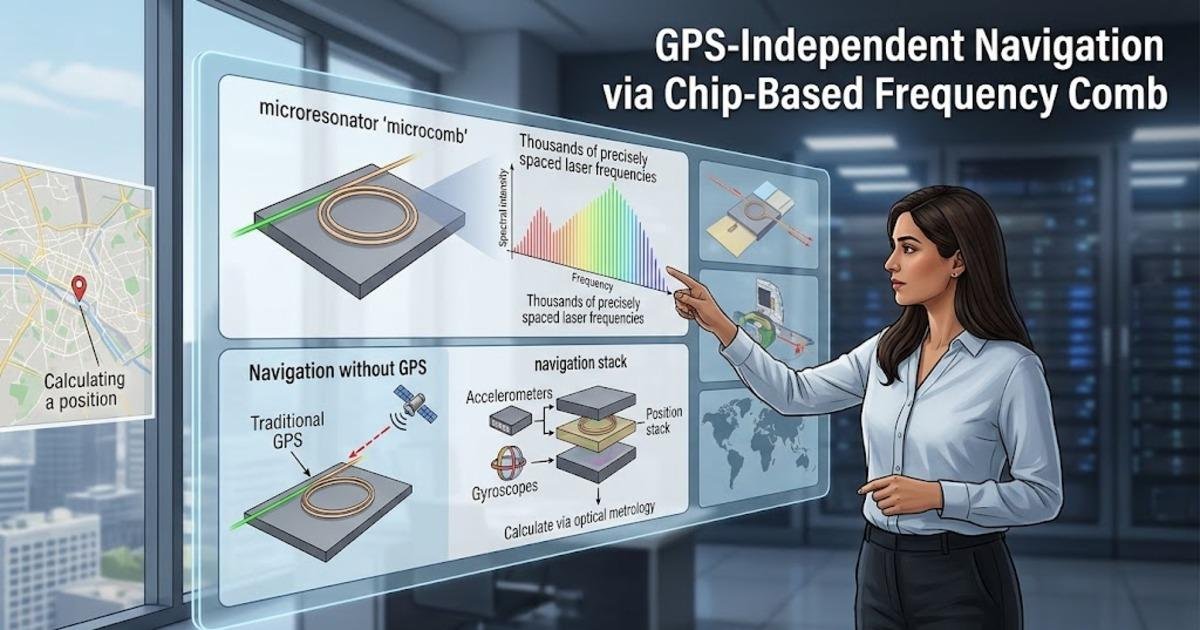
An optical frequency comb produces many sharply defined light frequencies separated by regular intervals. The pattern resembles the evenly spaced marks on a ruler, except that the marks represent frequencies rather than distances. By comparing a laser against those known intervals, researchers can measure optical frequencies or connect the stability of one frequency to another. These measurements underpin precision clocks, spectroscopy and instruments that use light to detect tiny changes in distance or motion.
The difficulty is generating a reliable comb in a package small enough for practical equipment. Earlier chip-based designs often began with one laser and generated additional frequencies outward from it. The outer frequencies could become too weak or difficult to stabilise, forcing researchers to add amplifiers, extra lasers or other laboratory equipment. That supporting hardware can undermine the size, power and complexity advantages that a chip is supposed to provide.
Two lasers help solve the weak-frequency problem
The new approach sends light from two lasers around a tiny ring-shaped resonator, a structure that makes light circulate and interact with the material inside it. Under the right conditions, those interactions generate a series of optical pulses and the evenly spaced frequencies that form the comb. Because the two input lasers sit at different frequencies, they act as endpoints for the new set of frequency lines rather than requiring the system to extend everything outward from a single central laser. This helps the researchers produce useful frequencies across the range needed for precision measurements.
The method builds on a physical process called a parametrically driven cavity soliton. In plain language, the circulating light forms a stable pulse pattern through interactions inside the resonator. The researchers combine this process with synchronisation so that the frequency lines align into a usable set, a property they call self-alignment. Without that alignment, overlapping sets of frequency lines would make the output difficult to interpret accurately. The improvement is not simply that the chip is small; it is that the generated pattern can be controlled well enough to perform useful measurements.
The researchers tested it against conventional laboratory equipment
The team evaluated the new comb on several tasks, including linking microwave signals with optical frequencies, transferring optical stability into microwave signals and producing low-noise microwave output. Those are practical functions used in precision timekeeping and measurement systems, not merely demonstrations that the chip emits a colourful spectrum. The researchers also compared its output with a conventional tabletop frequency-comb system using the same reference sources. They reported that the chip-based device matched the established system in the measurements they were able to check, including relevant frequency, stability and noise behaviour.
One clock-related test showed that the comb could help connect a stable optical reference to a microwave signal that electronic equipment can track. The team used the resulting microwave signal to measure the original optical frequency to within about 100,000 oscillations per second of the expected value, according to the research group's account. That number should be understood in context: optical frequencies oscillate hundreds of trillions of times per second, so the absolute difference is small relative to the carrier frequency. It is evidence that the frequency link works, not a claim that a finished portable clock has already demonstrated a particular navigation accuracy.
One adaptable chip could reduce setup complexity
A practical advantage is that the same comb design supported several different experiments. Previously, researchers could need specialised configurations and substantial time to prepare a miniature comb for a particular task. In the new demonstrations, changing the input light sources allowed the team to use the device for different measurement functions without rebuilding the entire system around each one. The researchers also tested devices with different layouts and found that useful results could be obtained with adjustments to the experimental setup.
That flexibility could matter for manufacturing as much as for research. If every device needs extremely precise fabrication and lengthy manual tuning, producing reliable units at scale becomes expensive and slow. A design that tolerates some manufacturing variation and can be adjusted for different applications may be easier to integrate into commercial equipment. The work does not yet establish the cost, lifetime or mass-production yield of a finished navigation product, but it addresses a real obstacle between a promising laboratory chip and a useful component.
What the result does not prove yet
The demonstration is a meaningful step in miniaturising optical measurement technology, but it is not proof that a complete optical atomic clock can now fit into a car or drone. A frequency comb is one part of a larger system that may still require lasers, control electronics, power supplies, optical connections and a suitable atomic reference. Some of these parts can also be miniaturised, but combining them while preserving stability under vibration, temperature changes and everyday operating conditions remains an engineering challenge. The researchers themselves describe the approach as a path toward deployable timekeeping rather than a finished product.
There is also a difference between a laboratory measurement and real-world navigation performance. A clock intended for a moving vehicle must keep working when its environment changes, and the complete navigation system must combine timing with motion sensors or other sources of position information. NIST's announcement identifies drones, cars, submarines and mineral exploration as possible future applications, but those are potential uses rather than deployments already demonstrated by the study. Independent field tests would be needed to show how much longer a vehicle could maintain an accurate position estimate when satellite signals disappear.
The next test is whether the full system can leave the lab
The researchers plan to refine the comb, explore broader frequency ranges and continue investigating how the technique can be integrated into practical instruments. The immediate engineering question is how much of the supporting equipment can be reduced without sacrificing the stability that makes the device useful. A successful chip must not only generate the right frequencies; it must do so repeatedly, with manageable power requirements and without constant specialist intervention. Progress on those issues will determine whether the design becomes a component that equipment manufacturers can actually use.
For navigation, the most meaningful milestone will be a complete compact clock operating outside a controlled laboratory, followed by a field test showing how its timing performance affects position estimates during satellite outages. Until then, the frequency comb is best understood as an enabling technology: a smaller and more adaptable way to measure light precisely. Its promise is not that GPS will disappear, but that future systems may have a more dependable source of timing when GPS cannot be trusted.
Share this post
Written by