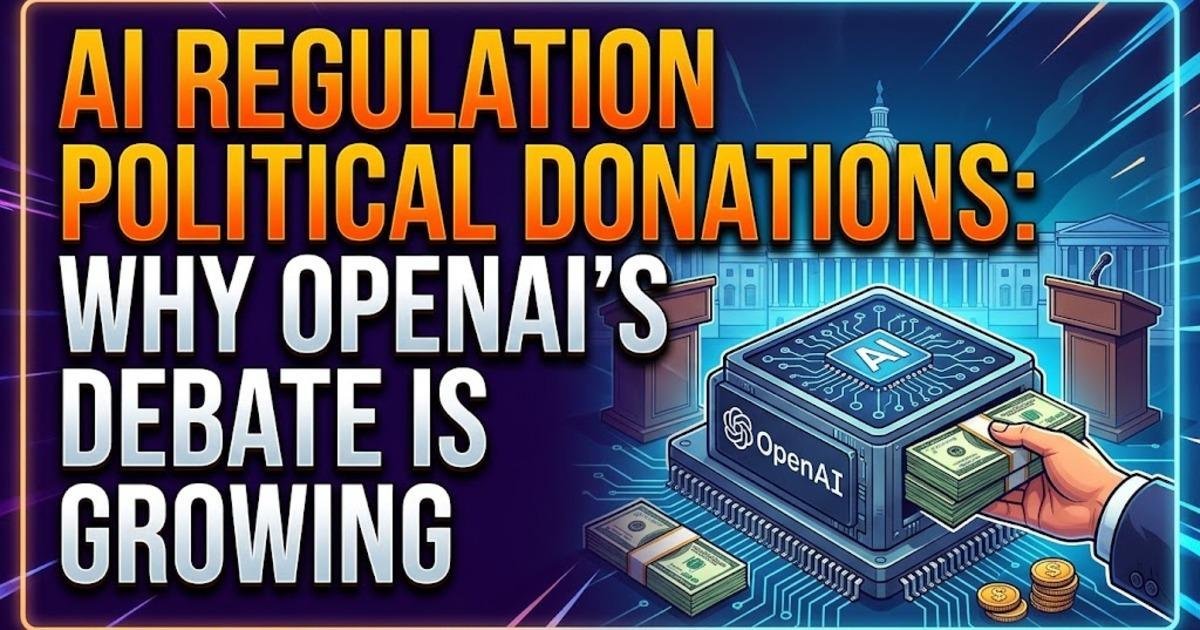
AI Regulation Political Donations: Why OpenAI’s Debate Is Growing
OpenAI President Greg Brockman’s reported $25 million political donation has renewed debate over AI regulation. Here is what the funding reveals, what OpenAI says about it, and what to watch before the 2026 midterm elections.
On this page
Artificial intelligence companies are calling for rules to manage powerful AI systems while their supporters spend millions trying to influence who writes those rules. On October 21, 2026, Reuters reported that OpenAI President Greg Brockman and his wife, Anna, had contributed $25 million to Leading the Future, a political group campaigning for candidates opposed to regulations that could unduly restrict AI development. The donations were made personally, not on behalf of OpenAI, according to the company’s public position. The distinction matters, but it also raises a difficult question: how should the public judge AI safety commitments when industry figures are simultaneously financing political campaigns that could shape the rules?
Why a $25 million donation has drawn attention
Leading the Future is a political organization supporting policies intended to keep the United States competitive in artificial intelligence. It opposes restrictions that its supporters believe could slow development, discourage investment or create disadvantages for American companies competing internationally. Brockman’s contribution places him among the prominent technology figures using political funding to influence the direction of AI policy. The donation does not, by itself, establish that he opposes every form of AI regulation, or that OpenAI controls the organization’s decisions.
The controversy comes from the difference between supporting safety rules in principle and supporting specific legislation in practice. An executive may favor independent testing, security requirements and accountability while opposing laws considered too broad or costly. Critics argue that this distinction can become a way to endorse safety publicly while weakening the measures that would make companies accountable. The central issue is therefore not simply whether an executive supports regulation, but which rules that person supports, which rules they oppose and what their political spending helps achieve.
OpenAI says its executives’ political activity is personal
OpenAI addressed the broader issue in a June 2026 policy statement, explaining that the company itself had not donated to political action committees or political campaigns. It also said employees could participate in politics in their personal capacities and that their activities should not automatically be interpreted as the company’s official position. The company argued that AI policy should be debated openly and that powerful systems should be subject to thoughtful regulation, rigorous testing, safety standards and public accountability.
That distinction is meaningful because a personal donation is not the same as a corporate decision. There is no basis for treating Brockman’s contribution alone as proof that OpenAI has secretly directed Leading the Future or abandoned its stated safety objectives. At the same time, senior executives can influence public debate through their wealth, professional standing and access to policymakers. Readers evaluating an AI company’s commitments should examine its published policies, actual practices and the legislative positions supported by its leadership rather than relying on corporate statements alone.
What Leading the Future wants from AI policy
The organization’s stated approach emphasizes a national framework that supports AI innovation and avoids a patchwork of state-level requirements. Supporters argue that different rules in different states could make compliance more expensive, especially for smaller developers operating across the country. They also contend that overly restrictive policies could slow the deployment of useful systems and weaken the United States in its competition with other AI-producing countries.
Opponents see a different risk. If federal rules replace state protections without providing equally effective safeguards, people could lose avenues for addressing harms involving privacy, discrimination, unsafe products or other consequences of automated decisions. A single national standard can simplify compliance, but that does not automatically make the standard sufficiently protective. The real test is the content of the proposed rules, the authority given to regulators and whether people can seek meaningful remedies when AI systems cause harm.
Why the AI industry is divided over regulation
Political spending around AI is not limited to one position. Technology executives and companies have supported competing groups, with some favoring fewer restrictions and others backing stronger oversight. Reuters reported on October 21 that Anthropic had contributed $40 million to a group opposing federal pre-emption, the legal principle under which federal law can override conflicting state requirements. This illustrates a broader disagreement inside the industry about whether national rules should replace state-level approaches and how much authority governments should have over advanced AI systems.
The disagreement also reflects different assessments of risk. Companies developing powerful models may worry that strict requirements will increase costs, delay releases or reveal sensitive technical information. Safety advocates may worry that voluntary commitments will not be enough when commercial pressure rewards faster deployment. Neither concern settles the policy question on its own. A workable framework needs to distinguish between low-risk applications and systems capable of causing substantial harm, while providing clear expectations that companies can follow and regulators can enforce.
What political donations can and cannot prove
Political contributions can reveal which candidates and policy agendas wealthy donors want to support. They do not automatically establish that a donor agrees with every position held by a recipient, that a donation purchased a particular decision or that a company’s technology is unsafe. Those conclusions require additional evidence. A careful assessment should separate documented contributions, public statements, proposed legislation and any demonstrated effect on government decisions.
For readers trying to understand the debate, three questions are especially useful. Does a company support independent evaluations of its systems, or only assessments it controls? Does it accept enforceable consequences when its systems fail to meet safety requirements? And do the political groups backed by its leaders support legislation that would make those commitments legally meaningful? Answers to these questions provide a more useful basis for judgment than a donor list alone.
What to watch as the 2026 elections approach
The United States’ 2026 midterm elections will help determine the political environment in which AI regulation develops. Campaign funding is one part of that process, alongside congressional proposals, state legislation, public hearings and the technical evidence regulators receive from researchers and companies. The effects of political spending will become clearer as candidates publish their positions, legislation advances and official campaign-finance records show where money is going. Until then, claims that a particular donation has already changed policy should be treated cautiously.
The practical question for businesses and everyday users is what the resulting rules will require. Strong policies should make it possible to test high-risk systems, investigate serious failures, protect sensitive data and assign responsibility when things go wrong. They should also be specific enough that compliance does not depend on guessing what regulators might demand. The next meaningful measure of the industry’s commitment to safety will be whether its political support translates into rules that can be independently checked and enforced, not simply whether its leaders say safety matters.
Share this post
Written by