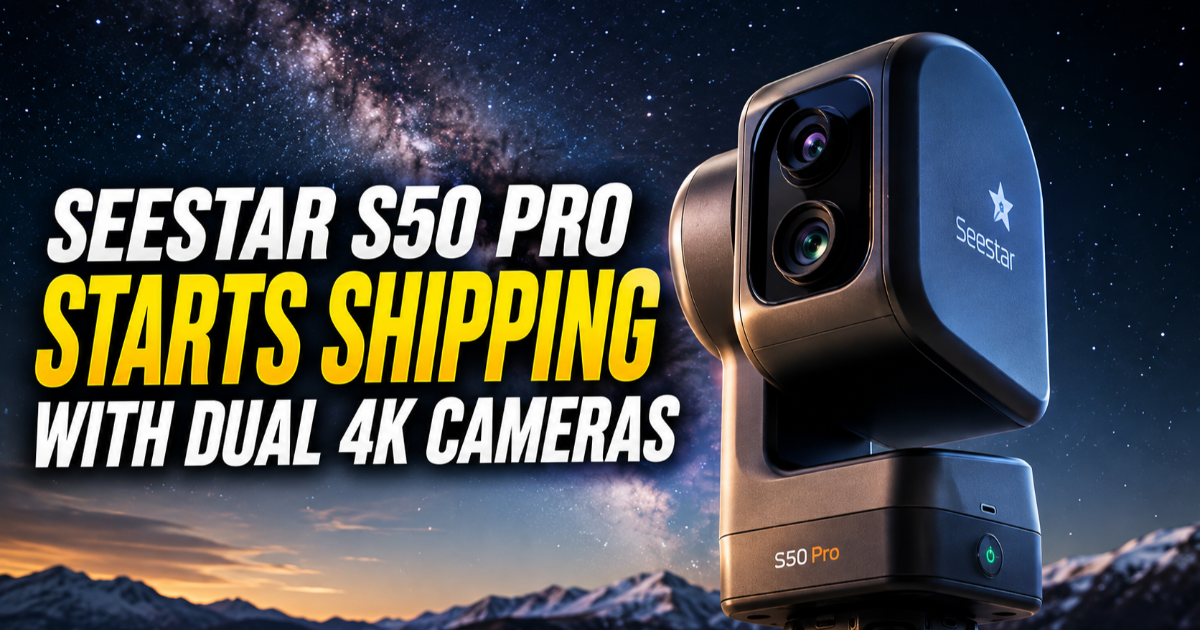
Seestar S50 Pro Starts Shipping With Dual 4K Cameras
The Seestar S50 Pro starts shipping with a 50mm optical system, dual 4K cameras, a 10,000mAh battery and upgraded tracking. Here is what the new smart telescope actually changes.
On this page
The Seestar S50 Pro begins shipping on September 1 with a $899 launch price, bringing a larger 50mm optical system, two 4K cameras and a 10,000mAh battery to a category that has usually required much more equipment. ZWO's latest smart telescope is not simply a faster version of the original S50; the hardware and software changes are aimed at making more demanding astrophotography possible from a single portable device.
The S50 Pro starts with a much larger light-gathering system
The biggest hardware change is the 50mm aperture, the opening through which the telescope gathers light. The original Seestar S50 also used a 50mm aperture, but the S50 Pro replaces its three-element optical design with a four-element apochromatic system intended to improve image quality across the frame. Its telephoto system uses a 260mm focal length and a 1/1.2-inch colour sensor, while the second camera provides a 63-degree wide-angle view. Both cameras can capture images at 3840 by 2160 resolution, giving the device a much broader range of targets than a conventional single-camera smart telescope.
That dual-camera arrangement changes how the telescope can be used. The telephoto camera is designed for smaller deep-sky targets such as nebulae and star clusters, while the wide-angle camera can frame larger scenes including the Milky Way and constellations. ZWO also says the S50 Pro can combine images into larger mosaics, allowing users to capture targets that would otherwise extend beyond the telephoto camera's field of view. The result is less about simply increasing resolution and more about giving one compact device two different photographic jobs.
Independent testing shows where the extra hardware matters
Early testing gives the S50 Pro a more useful context than its specification sheet alone. AstroBackyard found that the new model is particularly suited to smaller deep-sky objects, lunar detail and longer imaging projects, while the original S50 remains the cheaper option. Another comparison published through the Seestar ecosystem tested the S50 Pro against the older S50 under heavily light-polluted Bortle 8 skies, using deliberately short integration times. The test reported cleaner stars, better control of noise and improved detail from the newer model, although those results should be read as a direct comparison rather than proof of performance under every observing condition.
That distinction matters for buyers. Astrophotography depends heavily on sky brightness, exposure time, weather and tracking, so a better sensor does not automatically produce dramatically better pictures from every location. The S50 Pro's advantage becomes more meaningful when the user can give it enough time to collect light and when the target benefits from its larger aperture and longer focal length. For someone who mainly wants quick wide-field shots, the less expensive models can still make more sense.
The battery and tracking upgrades are designed for longer sessions
ZWO has increased the battery from 6,000mAh in the S50 to 10,000mAh in the S50 Pro. The company advertises up to nine hours of battery life, although actual runtime depends on operating conditions and how the telescope is used. A larger battery matters because astrophotography is built around repeated exposures rather than a single photograph; a longer session gives the telescope more opportunity to build a cleaner final image from many frames.
The S50 Pro also adds an equatorial, or EQ, mode for tracking the sky as Earth rotates. In ordinary alt-azimuth operation, the telescope moves horizontally and vertically, while equatorial tracking is designed to follow the apparent rotation of the stars more naturally. This can make longer imaging sessions more practical because the telescope can keep celestial objects positioned more consistently during capture. Independent testing has reported substantially improved tracking behavior, but users should still expect setup quality, alignment and local conditions to affect results.
The software is doing more of the work photographers used to do separately
The S50 Pro's most interesting change may be what happens after the shutter is pressed. ZWO has built automated target locating, tracking, capture and image processing into the Seestar workflow, while newer functions include astronomical photometry, automated imaging plans and mosaic framing. Photometry means measuring the brightness of astronomical objects from images, turning the telescope from a simple camera into a tool that can also extract quantitative information from observations.
This approach removes several pieces of equipment from the traditional astrophotography setup. A conventional beginner trying to capture deep-sky objects might need a telescope, camera, tracking mount, computer and separate processing software. The S50 Pro combines much of that workflow into one unit controlled through a smartphone. That does not make it equivalent to a high-end dedicated astrophotography rig, but it lowers the amount of equipment and technical setup required before a newcomer can start producing usable images.
The $899 price is attractive, but only for a limited window
The S50 Pro carries a regular price of $999, while ZWO's current launch offer reduces it to $899 through September 15. The company says shipping begins September 1, with orders fulfilled in the order received. That makes the launch price part of the product's current buying proposition rather than a permanent reduction.
At $899, the S50 Pro sits above the smaller Seestar S30 Pro and the original S50, so the decision is really about capability rather than simply buying the newest model. A buyer interested in portability and large nebulae may prefer a smaller telescope, while someone focused on smaller deep-sky targets has a clearer reason to pay for the S50 Pro's larger optical system and tracking improvements. The higher price is easier to justify if those features will actually be used.
It is still a smart telescope, not a replacement for every astronomy setup
The S50 Pro is best understood as an automation-heavy astrophotography gadget rather than a miniature replacement for every traditional telescope. Its strength is the combination of optics, cameras, tracking, storage and processing in one package that can be operated from a phone. That makes it unusually approachable for someone who wants to photograph the night sky without assembling a collection of specialist equipment.
Its limits are just as useful to understand. A 50mm telescope cannot gather the same amount of light or resolve the same level of detail as much larger astronomical instruments, and automated processing cannot remove poor weather or severe light pollution. The S50 Pro's real advance is therefore convenience combined with a meaningful increase in capability over the original S50, rather than an attempt to compete with professional observatory equipment.
The next test is whether owners actually use those extra capabilities
With shipping beginning today, the most revealing comparisons will come from longer real-world sessions rather than launch specifications. The important questions are how much better the S50 Pro performs on difficult targets, how useful EQ mode becomes during extended imaging and whether its automated processing produces results that beginners would otherwise struggle to achieve. Those answers will determine whether the extra $300 over the original S50's launch price represents a meaningful upgrade or simply a more sophisticated version of an already accessible telescope.
Written by